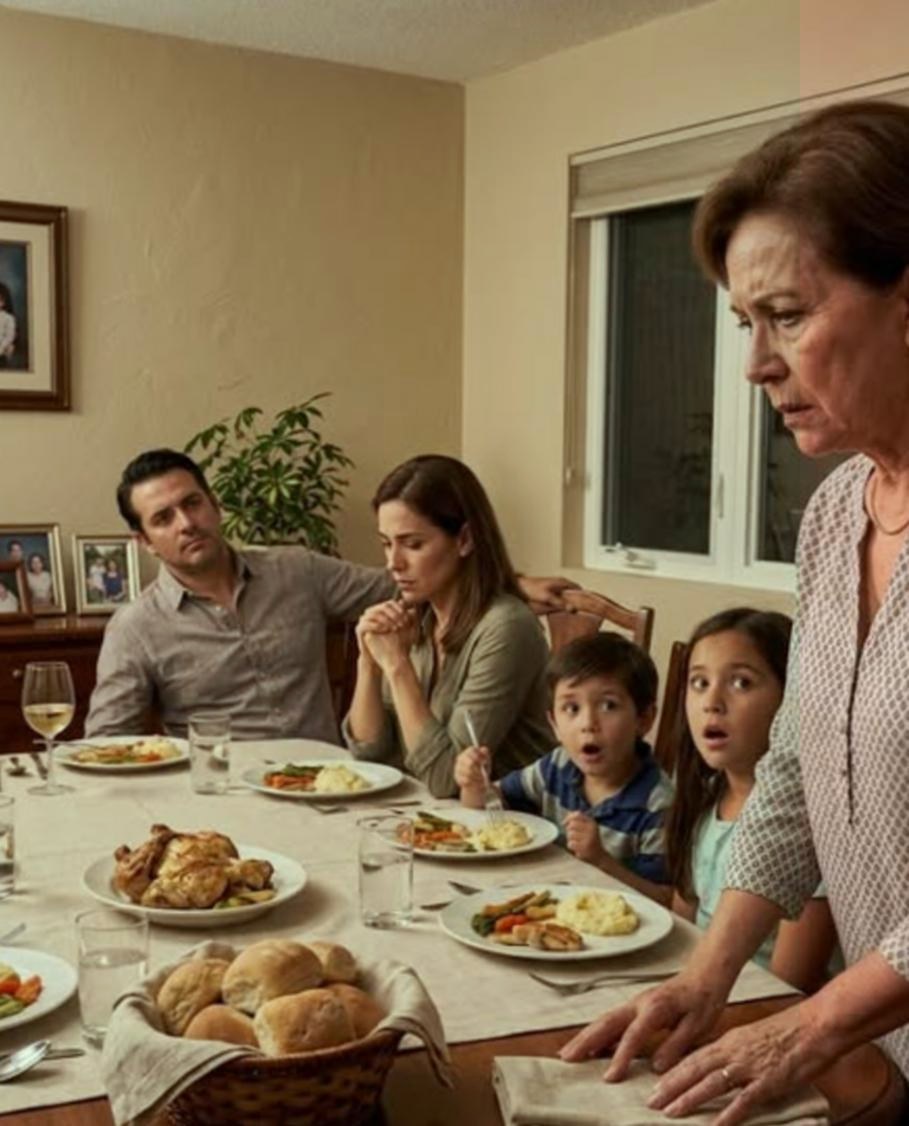


Daniel pushed his chair back and looked at me as if I were a bill that had stayed too long in his house.
It happened at six eighteen in the evening, when I was reaching for the bread basket. The chicken was already getting cold, the mashed potatoes smelled of garlic, and my two grandchildren were staring at their plates. Reni did not raise her eyes. Her lips were pressed together so tightly that I understood this question had been prepared in advance.
“Mom, when do you think you will finally leave?” Daniel asked.
I put the bread basket on the table.
No one moved.
For one moment I imagined how I would tell the truth. How his face would change when he learned that the woman they had used as a free helper for two years was no longer a helpless old woman. But I only folded the napkin. Once. Then once more.
My name is Margaret Briggs, and I had turned seventy-one.
Two years earlier, when my husband, Harold, died, Daniel convinced me that I could no longer live alone.
“Come stay with us for a little while, Mom. Until you feel better.”
I believed him.



I sold the house where Harold drank tea in the mornings, the yellow kitchen, the creaking hallway, the rose bushes, and the porch where we had learned to grow old together. Daniel’s house looked cut out of a magazine: white cabinets, black handles, an enclosed pool, and three garages. It lacked only one thing—a place where I would feel that I was mine.
Reni called my room “the guest room.”
“Do not move the chair, Margaret. The space looks better in the photographs.”
For two years I folded towels, made breakfast for the children, ironed school uniforms, and drove them to soccer and piano lessons. I knew which cup Daniel liked and which pan Reni needed for eggs.
I gave my time. My energy. The quietest part of my grief.
One Sunday, at nine in the morning, I found a small note by the coffee machine: “We are eating breakfast out today. Look after the children.”
On another day, at ten fifteen in the evening, I heard Reni’s voice beyond the bedroom door.
“She eats our food, uses our services, and what exactly does she give us?”
Daniel could have objected.
He did not.
Not once.

What they did not know was that several months earlier, leaving a doctor’s appointment, I bought a lottery ticket at a gas station. The seller smelled of cigarettes and cinnamon chewing gum. Harold used to say that sometimes luck comes in dirty shoes.
On Monday, at nine forty-two in the morning, when the house was empty and my coffee had gone cold, I checked the numbers again.
Ninety-nine million dollars.
I did not scream. I did not cry.
I folded the ticket and put it in the Bible, between the Psalms and an old church bulletin that Harold had kept.
I did not tell Daniel.
Nor Reni.
The money could not erase those two years when they had quietly turned me into a helper, but it returned what I had thought lost—the right to make decisions, without asking permission.
That was why, when Daniel asked me when I would leave, I simply answered:
“With permission.”

I went into the yard and sat on the wooden bench. The door behind me did not open. Daniel did not follow me. Reni did not apologize. My grandchildren remained at the table and watched what kind of family was being built before their eyes.
At two thirteen in the morning I opened the notebook beside my bed and wrote five lines: Silence. Lawyer. Take personally. Separate property. Find a house.
Not a room.
A house.
In the morning, when the pen touched the last word, the lock below clicked and heavy steps climbed the stairs. Daniel’s shadow stopped on the threshold, and a folder appeared in his hand. He placed his fingers on the first page and said to me:
“Mom, before you leave, there is one thing you need to sign…”
His hand moved slowly to open the folder…
His hand moved slowly to open the folder, but I already knew what had to be inside. Daniel had always thought my silence meant helplessness.
“Not now,” I said.


Cold morning light came into the room. Raindrops fell against the window glass, while a small ink stain from last night’s note still waited on my fingers.
“It is just some formalities,” he said. “Regarding the house payments and your belongings.”
“I will decide regarding my belongings.”
Daniel smiled, but the smile was tense.
“Mom, do not become emotional.”
“You asked me when I would leave. Now I am giving you the answer.”
The sound of Reni’s heels came up the stairs. She held a coffee cup with a golden rim. She stopped at the door and looked around the room.
“Are you really leaving?” she asked.
“Yes.”
“Where?”
“I do not know yet.”
It was a lie. That morning I already had three meetings scheduled.
At seven thirty in the morning, at the same table where they had demanded my departure the previous evening, I opened my laptop and used my maiden name—Harper. They had never mentioned this name. Daniel had seen it on the wedding documents, but had never asked why I kept the old seal with that name.
The first meeting was at nine. The second at ten. The third at eleven.


Patricia Holloway was the calmest of all. I arrived at her office at noon. A large clock hung on the wall, and on the desk stood a glass paperweight containing dried lavender flowers.
“Who knows about this amount?” she asked.
“No one.”
“Excellent. It must remain that way until your protection is fully activated.”
“My son thinks I depend on him.”
Patricia put down her pen.
“People most often lose precisely what they consider their property.”
Over the following days we did everything quietly and quickly. A separate legal structure was created to receive the lottery money. We divided my bank accounts. Not one old signature held by Daniel proved sufficient anymore. The rights connected with my property, taxes, and medical decisions remained only with me.
Every time I signed a new document, I held Harold’s old pen. Its wooden body was worn in one place. Years earlier he had told me that this pen brought important words out.
On the third day Patricia told me:
“Now you must choose a house.”


I already knew which house she meant.
It stood in a quiet part of the city. It had four bedrooms, a real garden, shade-giving trees, and a wide porch. It was exactly the kind of house Daniel and Reni described when they said, in the future we would move to a better neighborhood.
“We will receive guests here,” Daniel used to say.
“Here people will understand that we have achieved something,” Reni would add.
Now I began viewing the house alone. The hallway smelled of cedar and lemon oil. On the kitchen counter stood a still stone tray, and beside it was a brass key left for the viewing.
I touched it with two fingers.
At that moment I remembered the woman I had been before Harold—the woman who opened her own door herself and asked no one whether entering was permitted.
“Do you like it?” the realtor asked.
“Very much.”
“This house has many interested buyers.”
“Then make the offer today.”
The next morning, exactly at seven thirty, I offered to buy it with the full amount. Not in my son’s name. Not through Daniel’s company. Through the property structure created under my protection, and with the surname they had never needed to remember.


That same evening Daniel called me.
“Mom, I heard about that house,” he said. “It is strange. You bought exactly the house we were looking at.”
“You told me to leave.”
A long silence fell on the other side.
“That was our house,” he said at last.
“No, Daniel. That house was in your dream.”
“Who helped you?”
“A person who knows how to respect my decisions.”
Reni took the phone from his hand.
“Margaret, do not act like a child. This is all family.”
“Family does not ask you when you will leave.”
I ended the call.
However, that same night Patricia called me. For the first time I heard caution in her voice.
“Mrs. Harper, we received an additional message from the house’s seller. Daniel Briggs is trying to stop the transaction and says that you are using the money for the benefit of his family.”
“Can he prove it?”
“No. But he said something else too. He claims that he previously obtained your signature and that you do not understand what you are signing.”


I stood by the window. I still held that brass key in my hand.
“Patricia, what does this mean?”
She exhaled.
“It means you must come to me tomorrow morning. Because there is one document in the folder that you have not yet told us about…”
“Which document?” I asked.
Patricia said nothing for several seconds. In my kitchen only the quiet hum of the refrigerator could be heard. It was eleven at night, and the brass key lay on the table under a small lamp.
“I cannot explain this by phone,” she answered. “Come in the morning. Alone.”
The next morning, at eight ten, I entered her office. Daniel was already there. Reni stood beside him, her arms crossed over her chest. By the window stood a middle-aged man in a dark coat, with an expression as if every object in the room already belonged to him.
“This is Mr. Coleman,” Patricia told me. “Daniel’s lawyer.”
“You are my lawyer,” I said.
“Yes. That is why I asked you to come.”


Daniel put the folder on the table.
“Mom, we do not want a fight. We simply need to determine why you are trying to hide money intended for our family.”
“My money does not belong to your family.”
Reni snickered.
“So now you talk like this? You lived with us for two years.”
Patricia raised her hand.
“Enough. Mrs. Harper, before the property officially moved into the protected account, our investigator confirmed the history of the lottery ticket. You truly won the money.”
Daniel’s face changed.
“What ticket?” he asked.
Patricia opened the white folder and took out a sealed packet.
“This is the official copy of that ticket, whose original is in a secure vault. We also have evidence that you, Mrs. Briggs, obtained the money independently, before moving in with Daniel.”
“I did not say that!” Daniel cried out.
“You said that your mother could no longer make her own financial decisions,” Patricia replied. “But your emails prove otherwise.”
She turned on the screen.


There was a message from Daniel to Reni, sent three months earlier: “If she ever wins anything, we will protect everything. Mom will not understand what she is signing anyway.”
Reni grew pale.
“That is taken out of context.”
“Then let us hear the second message too,” Patricia said.
She played the audio recording. Daniel’s voice sounded clearly.
“When she leaves, we will use her room for the child. After all, how long are we supposed to support her?”
Silence descended in the room.
I looked at my own son and for the first time no longer searched his face for the boy who had held my hand in childhood.
Daniel struck the chair with his hand.
“That was a private conversation!”
“Yes,” I said calmly. “And now for the first time you hear how it sounds in someone else’s ears.”
Coleman looked at Daniel.
“I told you that you should not continue this case.”
“You are my lawyer!”
“I cannot defend a version contradicted by the documents and recordings.”
Reni fixed her eyes on me.
“Margaret, you can simply help us. The house was our dream.”
“I know.”
“Then why are you doing this?”
“Because for the first time I am choosing my dream.”

Patricia put the sealed packet back into the folder.
“The house purchase will be completed. Daniel will have neither rights nor access to it.”
Daniel stood up.
“I will not allow this.”
At that very moment a call came to my phone. The number was unknown. I answered.
“Am I speaking with Mrs. Briggs?” a man’s voice asked. “We found an old power of attorney signed by your son. If it is genuine, your entire property may become disputed.”
Daniel slowly raised his head.
There was no fear in his eyes anymore. Something more dangerous was visible there—hope.
And I realized that winning the lottery had only been the beginning…
დანიელმა საკუთარი ხმის მოსმენისას პირველად ვერაფერი თქვა…
ფინალმა ყველაფერი სხვა კუთხით დამანახა. ის, რაც დასასრულად მეგონა, ყველაზე მძიმე სიმართლის დასაწყისი აღმოჩნდა.
„ეს მხოლოდ საუბარია. მაგრამ ეს საუბარი შენი იყო.“
დანიელმა თვალები დახარა.
👇 ისტორიის ფინალი უკვე გახსნილია
Related posts:
 A Flat Tire Stopped Me at a Desert Diner, but When the Waitress Heard My Name, the Color Drained from Her Face
 Part 4 — A Flat Tire Stopped Me at a Desert Diner, but When the Waitress Heard My Name, the Color Drained from Her Face
 The Woman I Met One Night Came to My Interview, but After My Answer the Smile Disappeared from Her Face
 My husband gave me a choice in front of the family, but one message suddenly erased his smile
 On the Third Day After the Wedding, I Refused to Serve at the Table, but When My Husband Brought Unexpected News to His Mother’s House, My Mother Turned Pale
 The Mafia Boss Paralyzed Me Hired Me, but When a Strange Box Was Found in His House, the Lawyer Stopped Smiling