
For several seconds after the lawyer’s last words, I could not say anything.
I was standing in the clinic hallway. In my hand I held Valeria’s water bottle, whose plastic cap I was twisting nervously.
“Who knows?” I asked.
“Your mother’s message says that your cousin Hector is helping her. He found out the clinic’s address.”
“Are they coming here?”
“The patrol has already been warned. But before they arrive, notify security.”
I rushed into Valeria’s room.
“Hector knows we are here.”
She opened her eyes.
“Did he come because of the baby?”
“I don’t know. But this time I will not leave you alone.”
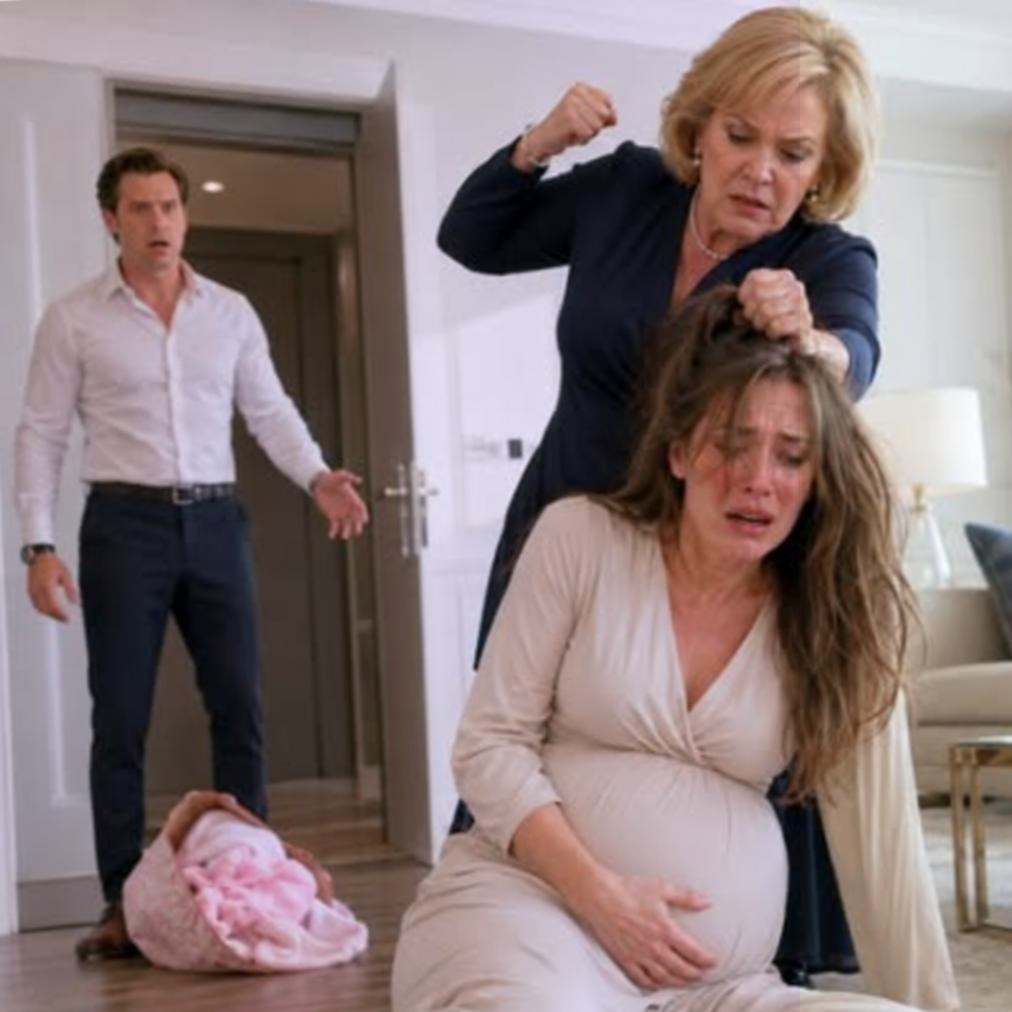
Five minutes later the clinic security called us. Two people downstairs were asking to meet us. One was Hector, and the other was Aunt Patricia.
“Don’t meet them,” Valeria told me.
“I will not meet them alone.”
We waited in the hallway for security and the police. Hector’s voice could be heard beyond the door.
“Diego, come outside! We just want to talk!”
“You have nothing to say here,” I answered.
“Your mother has been taken to the police station and you are standing there calmly?”
“You hit Valeria, threatened her, and sent false letters to my workplace. Now speak to the police.”
The patrol took them away from the hallway. Until the last moment Hector repeated that nobody could interfere in a family matter.


A family matter.
Those words had hidden the violence for three years.
That same night my mother and Hector were taken to the station for questioning. My mother demanded a lawyer. Hector denied everything at first.
The next morning my lawyer called me.
“Your mother wants to speak with you. She says she is asking for only five minutes.”
“I don’t want to.”
“You can refuse.”
Valeria heard my voice.
“Meet her,” she told me.
“Why?”
“So that at least once you hear what she will say when she no longer has a way to escape.”
In the station’s small room, a camera hung on the wall. Two plastic cups stood on the table. My mother sat on the other side. Her face was tired, but the same old certainty was still visible in her eyes.
“You humiliated me,” she said.
“You beat Valeria.”
“I was teaching her how to behave in this family.”
“My wife is not your student.”
“You became a stranger to me.”
“No, Mother. I am simply listening to you for the first time.”
She tried to laugh.
“What are you planning to listen to?”

The lawyer placed the phone on the table and turned on the recording.
The room filled with my mother’s own voice.
“If you give birth to this child, I will tell them that you are unfit for motherhood.”
My mother immediately lowered her eyes.
My voice sounded in the recording:
“Vale, don’t make this more difficult now. Mother is angry. Just apologize.”
My mother looked toward me.
“You yourself were blaming her too.”
“I know.”
“Then why are you punishing only me?”
That question entered me like a knife.
“Because you hit her. And I protected you. My guilt is that I believed you and did not believe Valeria. But now I will no longer use my responsibility as a shield for your crime.”
For the first time, my mother could not answer me.
Only the hiss of the recording’s final seconds could be heard in the room.
The evidence presented against her consisted of photographs, four hundred twelve entries, medical conclusions, and messages from my family members. The court issued a temporary protective order. My mother was forbidden to approach us or contact Valeria.
Hector received the same restriction. A separate investigation began against him because cameras recorded his breaking into the clinic and threatening us.
My mother tried calling me several times.
On the first day there were twenty-one calls.
On the second day, only one message: “You are still my son.”
I held the phone in my hand for a long time.

Earlier, at that sentence, I would have immediately run to help her. But now I was sitting beside Valeria’s bed and hearing her calm breathing.
I did not answer.
Two weeks later we returned home. My mother’s room was empty. In the wardrobe there remained only one small piece of paper on which was written: “At least here I had a place.”
I did not keep the paper.
But I found the red suitcase under the wardrobe. Its zipper was broken, and the wooden fish was no longer hanging from the handle. I found it near the kitchen floor and closed it in my palm.
Valeria stood in the doorway.
“Do you want us to throw it away?” I asked.
“No. Keep it.”
“Why?”
“So that you remember how easily a home can resemble a prison.”
The child was born six weeks later.
It was three o’clock at night. White lights were on in the maternity room, while Valeria squeezed my hand with such strength that my fingers went numb.
“Don’t let me go,” she told me.
“I won’t let you go.”
“This time, really?”
I looked into her eyes.
“This time not with words, but with actions.”
We named our daughter Elena.
When I picked her up for the first time, her fist closed around my finger. She was so small that I was even afraid to hear her breathing.
And for the first time I understood what a home should be: a place where nobody repeats an apology for being in pain.

Three months later, the trial in my mother’s case took place. We went there. Valeria gave her testimony calmly. Her voice did not tremble.
“Three years of silence was not my choice,” she said. “It was a way of survival.”
My mother avoided her gaze.
The judge heard the evidence, left the protective order permanently in force, and sentenced my mother for violence and threats. The final decision did not resemble a victory seen in films. Nobody applauded. My mother was not taken away against a background of sinister music.
Simply, for the first time she lost the right to control another person’s life according to her wishes.
And for the first time I was no longer trying to survive her.
Months passed.
We moved to another neighborhood, into a small apartment from whose window a row of elms could be seen in the morning. I continued going to work, but after six in the evening I turned off my phone. Valeria went to a psychologist twice a week. Together with Elena, we entered a small café where colorful birds were painted on the wall.
One morning, during the first snow, Elena drew a house on the floor with a pencil. The house had a large door and four yellow circles near the windows.
“What is this?” I asked.
“Light,” Valeria answered me.
“Why four?”
Elena counted on her fingers.
“Me, Mommy, you, and what protects us.”
Valeria lowered her head so that we would not see her tears.
I went into the kitchen and put water on for tea.
For the first time, silence was pleasant.

Then the phone rang.
It was an unknown number, but I recognized the voice immediately.
“Diego,” my mother said. “I only want to see Elena once. I won’t do anything. I swear.”
I was standing by the window. Outside, snow was falling silently.
“We cannot meet,” I told her.
“I am your child,” she told me.
“I am your child. But Elena is not your property.”
“You made mistakes too, Diego. Why don’t you give me a chance to make things right?”
“A mistake happens once. Violence four hundred twelve times is not a mistake.”
Silence fell on the other side of the line.
“Then will you leave me like this forever?”
“I did not abandon you. I simply will no longer protect you from your consequences.”
I ended the call.
Valeria stood in the kitchen doorway. In her hand she held Elena’s drawing.
“Are you all right?” she asked.
“Yes.”
That short word was true now.
I placed the wooden fish on the top shelf of the wardrobe. The little object removed from the red suitcase’s handle was no longer the sound of a threat. It had become only a memory.
That evening Elena sat on my lap and drew lines with her finger across its scales.
“Dad, why doesn’t this fish swim?”
I looked at the snow through the window.
“Because it is home now.”
And for the first time in a long while, I locked our door from the inside peacefully.
Missed the beginning?
Related posts:
 I Found My Pregnant Wife on the Floor, While My Mother Declared Herself Innocent — But the Smile on Her Face Suddenly Disappeared
 Powerful Men Threatened My Family, But an Old Man Stood Up to Them and Hector Stopped Smiling for the First Time
 Three Weeks Before the Wedding, My Fiancée Poured Wine on the Maid, and After My Silence Her Smile Suddenly Disappeared
 They Broke Both of My Wife’s Legs and Everyone Called It an Accident, but My Question Made Her Relative’s Smile Disappear
 I took my mother from the house, but when my brother opened her room with a duplicate key, the color drained from his face
 Two days before my brother’s wedding, my mother forbade me from coming, and when she read my reply, April’s smile disappeared