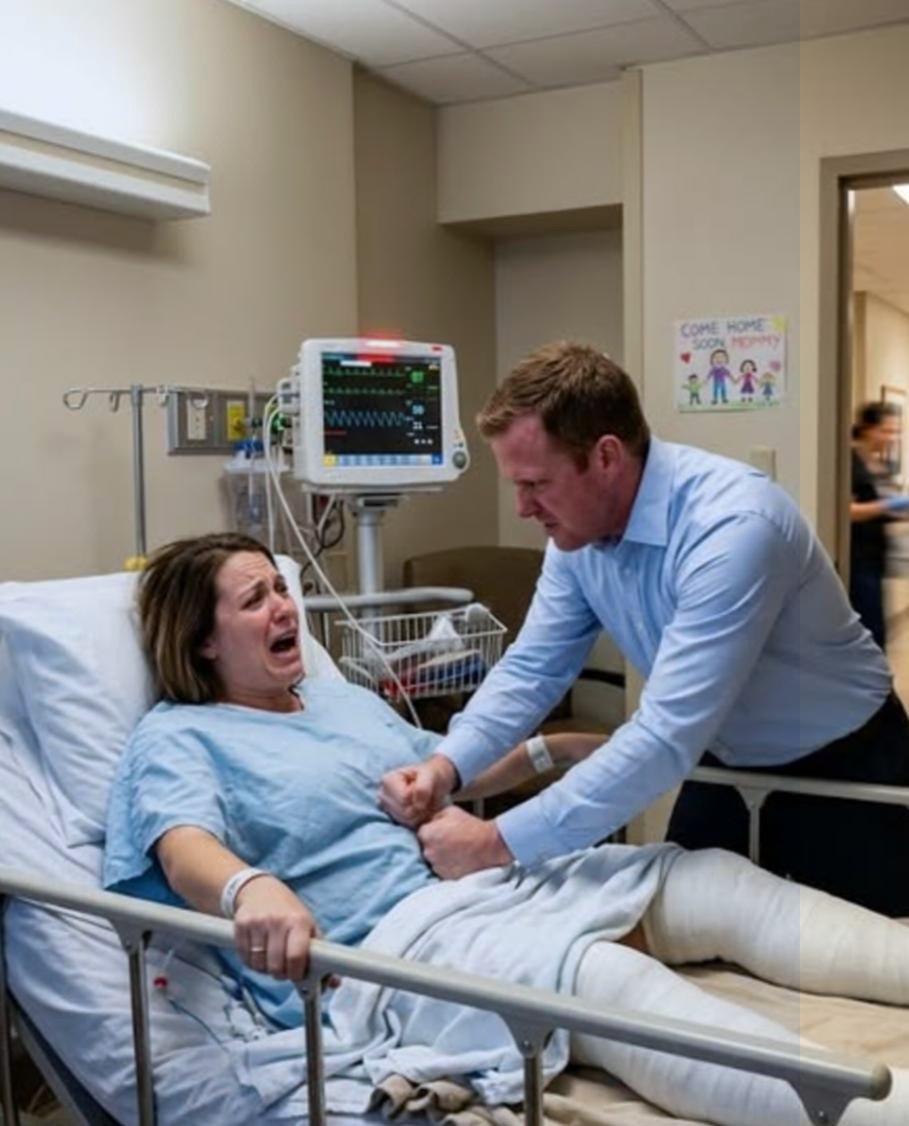

The sentence written below the photograph was not from Caleb.
“If you want to see your daughter, do not trust the police anymore.”
I stared at the screen for several seconds.
Then I tried to stand up, but the weight of the plaster immediately brought me back onto the bed.
“Caleb did not write this,” I said.
The investigator took the phone from me.
“The number is hidden. The message was sent just now.”
The social worker called the school. The nurse ran into the corridor to request the security cameras. In the hospital room, I continued listening to the monitor clicking.
Click.
Inhale.
Click.
“Caleb could not have done it alone,” I said.
The investigator nodded.
“There are two voices in the car recording. The second person’s face is not visible.”
“Who is it?”
“We do not know yet.”
The phone rang again.
This time the investigator answered.
“Yes?”
His face slowly hardened.
“The school’s rear camera recorded the car. The license plate is registered in Caleb’s brother David’s name.”
David.
Caleb’s older brother, who had sat silently at every family gathering for years and looked into my eyes as if I were a temporary guest in their family.
“Is Emma in the car?” I asked.
“The camera shows only the car leaving,” the investigator said. “But we have the direction.”
His phone rang again.
“They found her,” he said.
The social worker froze in place.
“Where is she?”
“At the old summer house, by the lake.”
I had been there. Caleb’s family used that house every summer. A small red boat stood there, on the side of which Emma usually drew a yellow sun.
“I’m coming with you,” I said.
“You cannot move.”
“My daughter is there.”
“You will stay in the hospital. We will go.”
“If Caleb knows that we have the recording, he may use Emma to influence her.”
The investigator looked at me for several seconds.
“Then we will need you to speak to her by phone when we approach.”
Thirty minutes later my room resembled a small command post. The investigator had a communication device in his ear. The social worker stood beside my bed. On the screen was a map of the house by the lake.

Caleb called me.
“Mom?” Emma’s voice sounded.
My heart contracted.
“Emma, I’m here.”
“Dad says that you will send him to prison.”
“You are not guilty of anything, my darling.”
“David is here too.”
Then Caleb intervened.
“Do you understand now, Rebecca? You can lose everything if you do not act wisely.”
“I have already lost eleven years,” I answered. “You cannot add anything to your threats anymore.”
“The recording means nothing if they think it was not me.”
I closed my eyes.
“You yourself told me that you cut the brake.”
“I also told you at your bed that you were a burden. Should you record that too?”
Everyone in the room looked at one another.
The investigator raised a finger.
Caleb continued.
“You always thought that no one could protect a woman who stayed at home. That is why you did not notice when I took money from your accounts. I still remember your old accounting code.”
My breath caught.
“What do you mean?”
“The money that I transferred into your name. The amount you had been saving for Emma for years.”
This was the final piece.
I remembered the small notebook hidden under the bed, where I wrote down every transfer. Caleb thought my career had ended, but I could still remember numbers. In that notebook I had recorded each of his transfers, the date, and the recipient.
“You proved it yourself,” I told him.
The investigator ended the call.
“Enough. Now we have a confession, a recording, and financial evidence.”
A few minutes later the police voice sounded over the radio.
“The child has been found. David is under arrest. Caleb is running out the back door.”
I stared at the screen.
Then the investigator said:
“Caleb reached the car, but our people were already waiting there.”
He was arrested that same night.
Caleb was handcuffed. David tried to cooperate and blamed everything on him. But in the end Caleb repeated the same words he had used for so long.
“I only wanted to maintain control.”
The police officer turned on the phone, and Caleb’s own voice sounded in the room: “If you do not survive, the money will come to me.”
Caleb listened to the recording.
For the first time he saw his own face through someone else’s eyes.
His voice continued circling in the room. The brake line. The money. Taking Emma away. My death.
Caleb lowered his head.
“Did I say this?” he asked.
“Yes,” the investigator replied. “You.”

I was not required to attend the trial. My written testimony was sufficient. The hospital records documented Caleb’s attack, the security cameras showed his entry and exit, and my financial notebook showed the theft accumulated over the years.
His lawyer called me once.
“If you change your testimony, the sentence may be reduced.”
“I will not change anything.”
“This will have serious consequences against your husband.”
“I am not causing the consequences. I am simply no longer hiding them.”
The lawyer exhaled quietly.
“Mrs. Walker, you have changed very much.”
“No. I am simply standing on my own side now.”
Two days after Caleb’s arrest, I went to his house accompanied by the police. Only to take my things.
Our bedroom was almost empty. My clothes were no longer in the closet, because Caleb had thrown some of my things into the trash after the accident. On the kitchen table only one thing remained—my old wooden calculator, on the back of which Emma had drawn a small yellow sun.
I picked it up.
The lines of Emma’s fingers were still visible on it.
Her drawing no longer hung on the wall in the children’s room. Caleb had torn it down, but the four small corners of the paper had remained by the nails.
I carefully removed it from the wall.
The house was so quiet that the sound of the refrigerator motor echoed through the large room.
Six weeks later I managed for the first time to take several steps without a wheelchair. First in the hospital corridor, then in the small kitchen of our new apartment.
Emma and I moved to the other side of the city. The apartment was not large, but sunlight entered through the window in the morning. I continued keeping accounts at the kitchen table, only now it was my job. The old accounting company gave me my job back, and I worked from home three days a week.
Emma changed schools.
During the first weeks she woke at night and asked me whether someone was opening the door. Each time I answered that now only someone whom we invited would enter our home.

One morning, when the first snow began falling outside the window, Emma sat beside me.
“Mom, is Dad still in prison?”
“Yes.”
“Do you hate him?”
I looked at her little hands for a long time.
“No. I simply no longer try to save him from the consequences he created himself.”
Emma thought.
“Then we are free?”
I smiled at her.
“We are for the first time.”
That same evening I received a letter from Caleb. It was two pages. He apologized, said that he was a changed person, and asked me to agree to a meeting.
I put the letter on the kitchen table.
Emma was drawing on the floor. On the paper she was again making a yellow sun, but this time she also drew a small house beneath it, with its door wide open.
I wrote to Caleb’s lawyer.
“There will be no meeting. All matters concerning Emma will be decided only through the court and social services.”
I wrote nothing more.
I received no further answer.
Several months later I was able to walk alone in the city park again. A thin layer of snow lay on the trees. Emma ran ahead, holding the old wooden calculator, which was painted with her yellow sun.
“Mom, look!” she called to me. “The sun has come out too!”
I walked toward her. My steps still hurt, but I was no longer afraid of pain.
The calculator in my hand was a symbol of eleven years of silence. Now Emma used it as a toy and, pressing each button, laughingly pretended that our life was being counted from the beginning.
When we returned home, I put it on the table. The yellow sun was still visible on its back.
This time I drew a small red door beside it.
And for the first time, when I heard a clicking like a monitor coming from the phone, I was not afraid.
It was only a message.
I was no longer living to the rhythm of someone else’s threat.
Missed the beginning?
Related posts:
 He was trying to force me out of bed when I refused—and suddenly his hand stopped moving on the door handle
 On the twelfth night after giving birth, my mother-in-law threw us out of the house, but after one answer from my husband his father froze on the spot
 Three Weeks Before the Wedding, I Canceled Our House, but When I Asked Lukas One Question, His Smile Disappeared
 A woman who came to a blind date was slapped by her ex-husband in front of everyone, but one question from me immediately erased her smile
 My son’s wheelchair space was taken away, but the man’s face changed when the old woman opened the little box
 An Unknown Man Humiliated Me in Front of Everyone, but the Restaurant Owner Looked at Me Only Once — and His Smile Immediately Disappeared