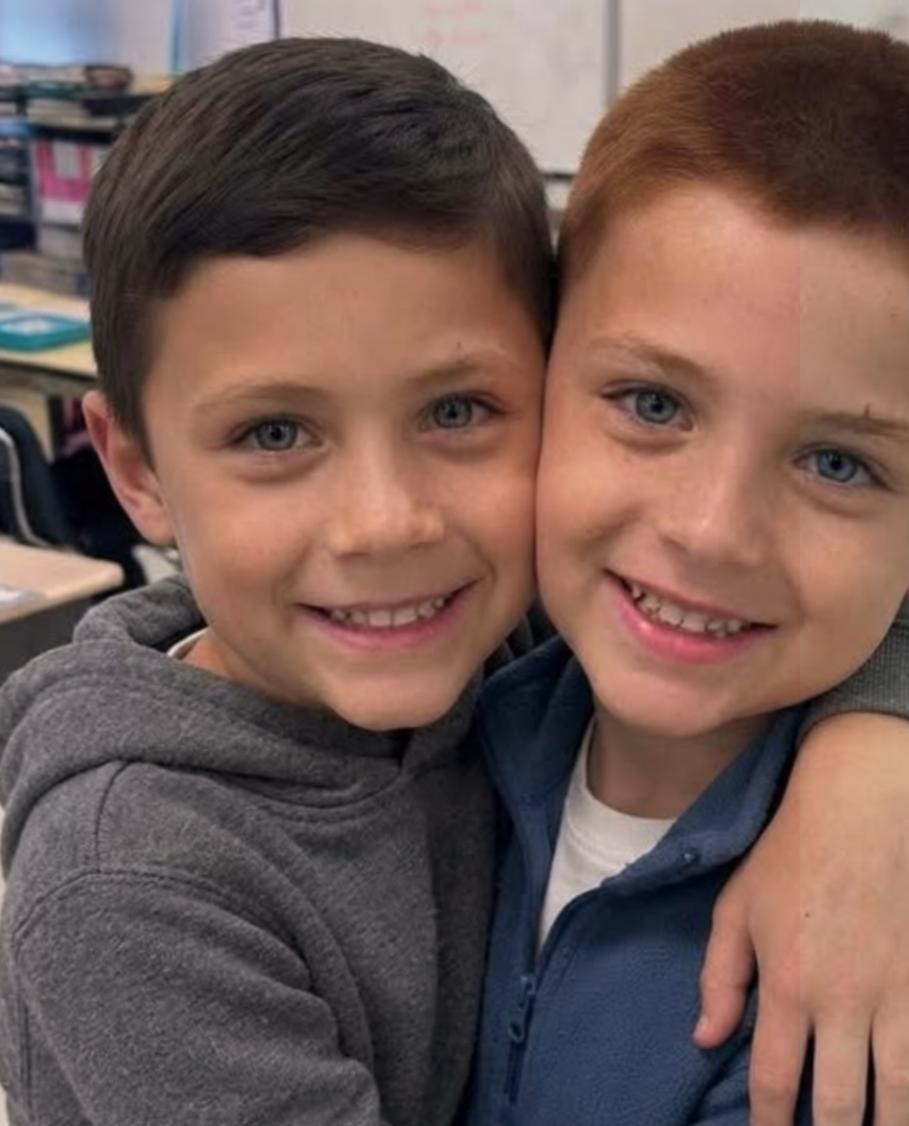
In the school principal’s office, a boy sat beside my son who had exactly the face of my lost child, and at that moment I stopped breathing.
It was Thursday, eleven in the morning. Fine drops of rain crawled down the windows, while the wall clock ticked so loudly, as if it were counting everyone’s nerves. My son, Koli, stood by the principal’s desk, his right lip split and a white bandage from the school nurse wrapped around his hand.
“Darling, are you all right?” I ran toward him.
Koli did not answer me. He only slowly raised his hand and pointed behind me.
A second boy was sitting by the wall.
When I turned my head, my knees gave way.
Gray eyes. An elongated face. A small dark mark near the left eyebrow, exactly where Koli had one. At first glance, it was as if my son had decided to look into a mirror, except the mirror had remained eight years behind.
Only their hair was different. Koli had light, honey-colored hair, while that boy’s was almost black.
My fingers began trembling so much that the keys fell from my bag onto the floor.
“Who is he?” I whispered.
The principal, Mrs. Darejan, looked at both children and then at me.
“This is Stepan. They have been fighting with each other for the last two weeks. But today things went seriously too far.”
“Why?” I asked, although I was afraid of the answer.
Koli looked up at me for the first time.
“He kept telling me that he is my brother.”
Stepan lowered his head. Wet earth clung to his shoes.
“I wasn’t saying that I’m simply your brother,” he said calmly. “I told him that we have the same father and different mothers.”
Four days earlier, Koli had told me this phrase at home with a laugh. At the time I had only smiled, as if it were childish nonsense.
“He probably just wants to annoy you,” I had said.
“He says his father is Mark,” Koli added.
At that moment, the air in the room changed.
Mark had been my husband. The father of my children. The center of my only family.
Eight years ago, I had been pregnant with twins. Labor began much too early. I remember everything in fragments: the sharp hospital lights, the beeping of the blood-pressure machine, Mark’s cold hand on my forehead, and my voice constantly asking the doctors whether the babies would survive.
Two days later I woke up.
Only one crib stood beside me.
One baby.
“Where is the other one?” I asked Mark.
He looked away.
“He didn’t survive.”
I did not go to the funeral. I did not see the body either. Mark told me I was so weak that I would not endure it, and that he had arranged everything himself.
I believed him.
And now the boy sitting by the wall looked so much like my lost child, like a living answer to a question asked eight years ago.
The principal placed her fingers on the desk.
“We are waiting for Stepan’s guardian. When she comes, many things will probably become clear.”
“Who is his guardian?” I asked.
Darejan did not have time to answer.
The sound of quick footsteps came from the corridor. Then the door handle was sharply pushed down.
The door opened.
A woman stood on the threshold, holding a black umbrella; water dripped from her cuff onto the floor. I recognized her face immediately, although I could not understand from where.
The woman looked at Stepan, then at Koli, and finally at me.
Her lips froze.
“Nino?” she said.
I took a step backward.
“Who are you?”
The woman put the umbrella on the floor and took a folded folder from her bag. On her finger was a silver ring, with a small bird engraved on its surface.
“I am the person to whom Mark said that you would never find out about this story.”
She put the folder on the desk.
Darejan reached toward it, but the woman was already opening the first page. And I could see only how her finger moved toward the yellowed paper placed inside the folder…
The woman’s finger lifted the corner of the yellowed paper, but before that Stepan jumped up and stood in front of her.
“Mother, tell her that I am not lying.”
The word fell into the room like a heavy object.
Mother.
The blood in my ears quickened. Koli looked toward me, as if waiting for an answer from me, while I could no longer tell where the sound of the rain ended and the beating of my own heart began.
“What is your name?” I asked the woman.
“Miriani.”
“Miriani who?”
She lowered her eyes.
“Miriani Abashidze. Stepan’s guardian.”
“I asked about his mother.”
Miriani pressed her lips tightly together. She placed a hand on Stepan’s shoulder. The boy did not raise his head.
“Not his biological mother,” she said. “But I have been raising him for eight years.”
Koli grabbed the chair.
“Mom, what does this mean?”
I wanted to tell him that it was nothing, that the children were inventing something, that we would go home and everything would become normal. But my own child’s eyes looked at me from Stepan’s face, and the lie stuck in my throat.
“Do you know Mark?” I asked.
Miriani smiled bitterly.
“Very well.”
That same evening, at four forty, I returned home. Mark’s work bag stood in the living room, and beside it was his favorite coffee cup, with a faded moon painted on it. These ordinary objects turned out to be more frightening than any threat.
Mark stood in the kitchen washing his hands under the faucet.
“The school called me,” he said, as if he were speaking only about Koli’s fight.
“Who is Miriani Abashidze?”
The water was still running. Mark did not turn off the faucet.
“I don’t know.”
“Stepan’s guardian.”
His hands stopped.
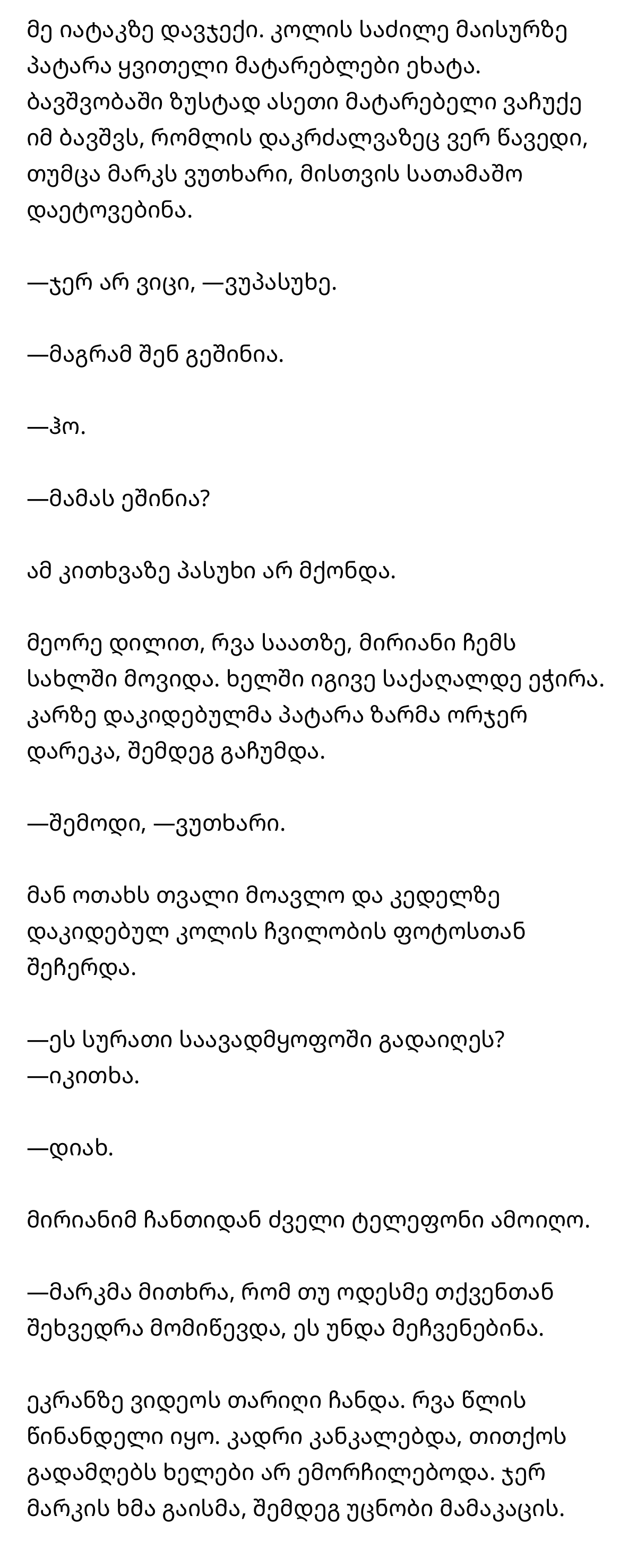
“Children hear things and then repeat them.”
“Stepan has your eyes.”
“Many people have gray eyes.”
“The same mark by the eyebrow.”
Mark turned off the faucet. The sound of drops remained in the kitchen.
“Nino, don’t start.”
“Don’t start what? Eight years ago you convinced me that my second child had died. Today at school his twin told me that you have the same father.”
Mark’s face tightened.
“You were ill. Your mind was confused.”
“You told me the child did not survive.”
“And what do you want, for us to go back to the hospital now?”
“I want to know where you buried my child.”
His gaze fell to the floor for a moment. Only for a moment, but it was enough.
“You will not endure this story,” he said quietly.
“I have already endured it. Every morning, for eight years.”
That night Mark went to a hotel. When he closed the door, Koli asked me from the corridor:
“Mom, is Stepan my brother?”
I sat down on the floor. Small yellow trains were drawn on Koli’s sleep shirt. In childhood I had given exactly such a train to the child whose funeral I had not attended, although I had told Mark to leave a toy for him.
“I don’t know yet,” I answered.
“But you are afraid.”
“Yes.”
“Is Dad afraid?”
I had no answer to that question.
The next morning, at eight o’clock, Miriani came to my house. She held the same folder in her hands. The small bell hanging on the door rang twice, then fell silent.
“Come in,” I said.
She looked around the room and stopped by Koli’s baby photograph hanging on the wall.
“Was this picture taken at the hospital?” she asked.
“Yes.”
Miriani took an old phone from her bag.
“Mark told me that if I ever had to meet you, I had to show you this.”
The date of the video was visible on the screen. It was from eight years earlier. The frame shook, as if the person filming could not control his hands. First Mark’s voice was heard, then an unknown man’s.
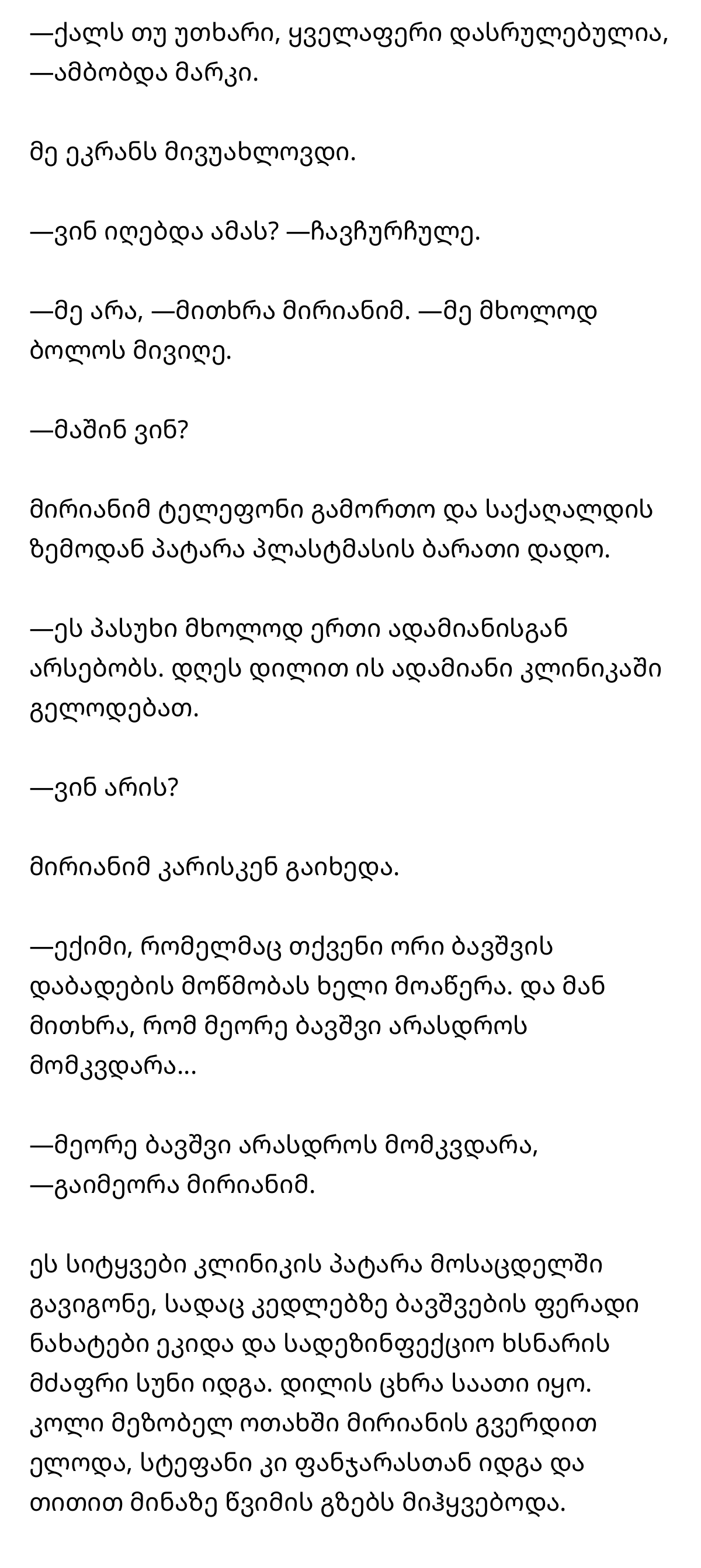
“If you tell the woman, everything is over,” Mark was saying.
I moved closer to the screen.
“Who was filming this?” I whispered.
“Not me,” Miriani told me. “I only received it at the end.”
“Then who?”
Miriani turned off the phone and placed a small plastic card on top of the folder.
“The answer exists only with one person. That person is waiting for you at the clinic this morning.”
“Who is it?”
Miriani looked toward the door.
“The doctor who signed the birth certificates of your two children. And he told me that the second child never died…”
“The second child never died,” Miriani repeated.
I heard these words in the clinic’s small waiting room, where colorful children’s drawings hung on the walls and there was a strong smell of disinfectant. It was nine in the morning. Koli waited in the neighboring room beside Miriani, while Stepan stood by the window and followed the paths of rain on the glass with his finger.
Doctor Irakli Vosiani sat down in front of us. An old black pen showed from the pocket of his white coat.
“Eight years ago, during your delivery, both children were born alive,” he said.
I gripped the arm of the chair.
“Mark told me that one of them did not survive.”
“Mark signed a document according to which the child was transferred to another institution for medical reasons. It was a lie.”
“Why did you sign it?”
The doctor lowered his head.
“I did not sign permission to transfer the child. My signature was forged. That night the nurse on duty was Mark’s relative. She took the child out of the ward.”
Miriani placed the phone on the table and turned on the recording.
Mark’s voice was heard again.
“Nino will not find out. One child will stay with her, and the other will grow up in Miriani’s family. It will be better for everyone.”
The unknown man asked:
“What if the woman asks about him later?”
“I will tell her he is dead. She depends on me.”
The recording ended.
Silence fell over the waiting room. My body seemed emptied from within. For eight years, on every birthday, I had lit two candles: one for Koli, and the other for the child whose name I did not even know. Meanwhile, Mark had been raising a living child somewhere else.
“Is Stepan my son?” I asked.
The doctor carefully took out a sealed laboratory result.
“The genetic analysis confirms that you and Stepan are biological mother and son. Koli and Stepan are identical twins.”
Miriani lowered her eyes.
“I knew they were brothers, but I thought Mark had settled everything with you. He told me that you had given up the child yourself.”
“I never gave him up,” I said.
“Now I know.”
Stepan entered the room. He held a folded paper in his hand.
“Mother, if you are my mother, why didn’t you come to me?”
This question destroyed me more than the recording.
I knelt in front of him.
“I thought you had died.”
“Dad told me that you had abandoned us.”
Koli crouched at the doorway.
“So he lied to both of us?”
I could say nothing. I only hugged both boys. Their shoulders moved in the same way.
That same evening Mark came to the clinic. His face was gray, and in his hand he held the coffee cup he always left at home.
“Nino, listen to me,” he said.
“No. Now you listen to me.”
“I did not want to do this.”
“But you did.”
“Miriani’s family had no child. They would pay for the adoption. I had to cover our debts. Then I was afraid the truth would destroy the family.”
“You destroyed the family when you took my child.”
Mark held out his hand.
“Forgive me.”
I stepped back.
“You did not want forgiveness. You wanted me to remain silent again.”
Police officers appeared in the corridor, but did not enter. Behind them stood a lawyer holding a new folder.
“Mrs. Nino,” he said to me, “this is only the first recording. This morning we received the complete statement of Mark’s transfers from the bank. However, there is one more thing you must know first.”
He opened the folder, and the phone rang.
An unknown number appeared on the screen.
Miriani looked at the call and suddenly turned pale.
“That is the person to whom Mark handed the child,” she said. “And if she is calling now, it means that she is no longer asking for Stepan to be returned…”
მარკმა პირველად მოისმინა საკუთარი ხმა და გაფითრდა…
ფინალში ყველაფერი იმაზე მეტად შეიცვალა, ვიდრე მეგონა. ყველაზე მძიმე პასუხი იქ დამელოდა, სადაც სიმართლის მოსმენას აღარ ველოდი.
„ვიცრუე.“
და მიხვდა, რომ სხვის დანაშაულს კი არა, საკუთარ თავს უსმენდა.
😱 გაიგე, რას მალავდნენ ისინი →
👇 ისტორიის ფინალი უკვე გახსნილია
Related posts:
 Part 4 — After My Son’s Fight at School, I Saw the Other Boy, and His Guardian Looked at Me, Stopped at the Door
 When My Husband’s Family Broke My Leg and My Husband Mocked Me, Derek’s Smile Vanished at the Sight of the Lawyer
 An Unknown Man Humiliated Me in Front of Everyone, but the Restaurant Owner Looked at Me Only Once — and His Smile Immediately Disappeared
 Before her husband died, he gave something to the doctor, but when I needed to open it, the doctor’s face suddenly turned pale
 My husband left me for another woman before childbirth, but my sister’s call suddenly erased his smile
 A Flat Tire Stopped Me at a Desert Diner, but When the Waitress Heard My Name, the Color Drained from Her Face