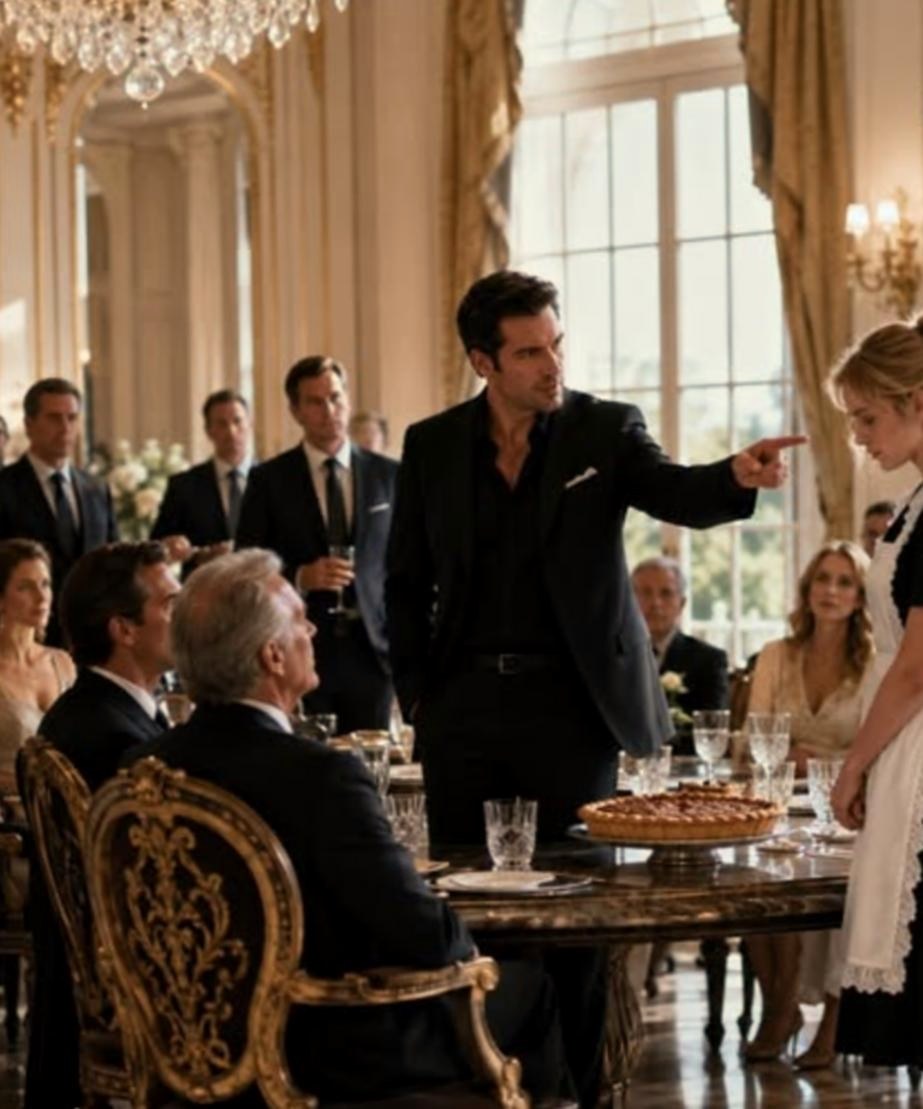



That evening, when more than two dozen armed men guarded the Orsini house, I was made to stand at the table like a criminal because no one had touched the mafia boss’s favorite pie.
The winter of New Orleans was cold. December dampness gathered along the edges of the windows, while in the Garden District the old oaks looked like black skeletons against the yellow lanterns. But in the Orsini mansion crystal chandeliers shone, wine glittered on the white tablecloth, and the rich guests spoke as if we, the servants, were part of the furniture.
Three years had passed since I began working in this house. For three years I cleaned the stairs, washed the silver dishes, and silently carried trays. During all that time, not once had anyone asked my name.
That evening Chef Reynolds cut his hand and could not prepare dessert. At four o’clock I saw nuts left in the pantry, remembered my mother’s old recipe, and baked a pie. My small copper timer lay beside the oven, with a little star engraved on it. Mother had always used it.
Seven minutes.
Not a second more.
When Carmine Orsini swallowed the first bite, his fork stopped in the air. He was thirty-three years old, but he looked like the most dangerous man in the room. They said his business stretched from the port to restaurants and construction companies. His father had died four years earlier, and since then Carmine had listened to people instead of shouting and waited until they gave themselves away.
He looked at the plate.
“Who made this pie?”
The conversation in the room stopped immediately. I stood by the wall, my gloved fingers gripping the silver tray tightly.
No one answered.
Carmine raised his head.
“I asked who made it.”
“I did, sir,” I said.



The housekeeper, Odette Pruitt, stepped forward. The old keys hanging from her neck struck one another quietly.
“Mr. Orsini, if there is a problem with the dessert, I will bring Chef Reynolds.”
“I am speaking to Miss Nellie.”
Odette stopped immediately.
Carmine pointed to the chair beside him.
“Sit down.”
I sat on the chair as if I were being interrogated. Carmine pushed the pie toward me.
“Taste it.”
“I already know what it tastes like.”
“Nevertheless.”
I took a small piece and tasted it.
“It is too sweet.”
One of the guests chuckled quietly. Carmine looked at him, and the laughter immediately caught in his throat.
“Everyone else likes it.”
“They drank bourbon and red wine. At such a time the taste of sugar changes.”
For the first time I saw interest in his eyes.
“What would you change?”
“I would use less dark syrup, roast the sugar longer, and roast the nuts in the oven, not in a pan.”
“Why seven minutes?”
My fingers involuntarily searched for the chain of the copper timer, which was in my apron pocket.
“If the mixture is too hot, the egg sets. If it is too cold, the sugar no longer distributes evenly through the cream.”
“Did your mother teach you this?”
At that question, an old pain opened in my heart.
“Yes.”
Odette called sharply to me:
“Nellie, the third floor needs finishing.”
I stood up and took the tray.
“There is another pie downstairs,” I said and headed toward the exit.
Before the door closed, I heard Carmine’s voice.
“Beno, bring her personal file to my office tomorrow morning.”



The next morning, Saturday, at ten past nine, the hallway carpet was still damp when Beno Romano brought a thick file into Carmine’s office. I was carrying a tea tray to the door and accidentally heard Carmine’s calm voice.
“Why does the surname change here?”
My step stopped.
Inside, sheets of paper rustled.
“Beno, find the investigator who signed my father’s bakery fire report three years ago. And find out why it said only one sentence about the back exit…”
The door handle went down. Beno’s hand reached toward the last page of the file…
Beno’s fingers touched the page, but the door of Carmine’s office opened all the way and I found myself in front of him with the tray in my hands. The teacup shook slightly. The spoon fell onto the porcelain with a clink.
Carmine looked first at the tray, then at me.
“How much did you hear?”
“Enough to know that you are looking into my past.”
Beno looked toward the door. A small communication device gleamed in his ear.
“I will wait outside,” he said.
“No,” I stopped him. “If this concerns my father, I am staying here.”
Carmine pulled out a chair for me.
“Sit down, Nellie.”
This time I was not afraid. For three years I had been invisible in this house, but now for the first time I felt that my silence occupied no less space than the room.
Beno opened the file. My old surname was written on it—Fontaine. Below it was my father’s name, Emmet Fontaine, and the bakery’s address on Journal de Buis Street.
“You already know all this,” I said.
“I know that the bakery was destroyed by fire. I know that your father suffered severe brain damage from the smoke. I know that the insurance company did not pay and made you responsible for the damages.”
“The court made me responsible. Because the investigator said I had left the oven on.”
Carmine looked away.
“But the report does not say why the back door could not open.”
“The lock had burned from the inside.”
“Then why did they not investigate it?”
A bitter smile escaped me.
“Because we were poor and the opposing side had money.”

That same evening, at six o’clock, Beno took me to a small café. The café stood by the riverbank, steam ran down the windows, and the coffee machine breathed heavily every few minutes. Carmine sat opposite me, and the investigator’s old address lay on the table.
“His name is Jules Vautrin,” Beno said. “He left the police six months after signing the report.”
“Where is he now?”
“He lives in a small apartment near the hospital.”
Carmine turned the coffee cup in his hand.
“Did Odette know about your family?”
The question cut through me so sharply that I could not speak for several seconds.
“She hired me three months after the fire. She told me that they always needed a quiet person in Carmine’s house. Not once did she ask why I had hidden my surname.”
“Who asked you to change your surname?”
“No one. I changed it myself. I could no longer find work under the name Fontaine. Everywhere they reminded me of the fire.”
Carmine tapped his finger on the table.
“If you think Odette had something to hide, why did you not tell me?”
“Speaking with you was possible only when someone else needed to be served. And I did not want your pity.”
Something changed on his face. For the first time he no longer looked like the mafia boss. He was simply a man to whom the walls of his own house had become unfamiliar.

On Monday, at eleven in the morning, Jules Vautrin met us at the old bakery. The building was half-collapsed. The smell of dampness stood in the brick walls, while pieces of burned glass still glittered on the ground.
“I wrote the report,” he said and crumpled his hat in his hands.
Carmine stopped in front of him.
“Then tell me why you lied.”
Jules looked at me first.
“Because they offered me money.”
My knees became heavy.
“Who?”
He did not answer. He only took a small key from his pocket.
“The back-door camera was not working that night. But there was another device in the old bakery basement. Your father hid it when someone demanded that he sell the business.”
Carmine’s voice lowered.
“Do you have the recording?”
“Not a recording. I have a memory card. I kept it for three years because I knew opening it would bring my death.”
Just then Jules’s phone rang. He looked at the screen and lost the color from his face.
“Who is it?” I asked.
Jules ended the call.
“The person who paid me then. He knows that I am with you.”
Carmine signaled to Beno to take the phone. But before he could, a black car appeared at the end of the street. The man sitting in the car lowered the window and aimed directly at Jules.
There was no gunshot.
Only one brief flash.
Jules fell to the ground, while Beno pressed me against the wall.
“To the basement,” Carmine shouted. “Now!”
We ran toward the burned door. Carmine thrust Jules’s key into the lock, but from the other side the iron was blocked by something.
Then for the first time I understood that all these years the truth had not been hiding alone. Someone was still protecting it.
Carmine looked at Beno.
“Break the door.”
Beno drew his gun, aimed at the iron lock, and before the sound of the shot split the old street, Carmine bent toward me.
“Whatever is there, this time you will not face it alone…”

The shot opened the basement door and a cloud of dust struck us directly in the face. The smell of burned wood rose from the walls. Inside there were only old shelves, a broken mixer, and a small iron box.
Jules had been taken outside to the doctors. The bullet had struck his shoulder, but he was alive. I was looking at that box as if my entire life were supposed to come out of it.
Carmine put on a glove.
“Is this your father’s handwriting?” he asked.
On the lid of the box, one letter was written in chalk—E.
“Yes.”
Beno broke the lock. Inside lay a memory card, bank receipts, and a small audio recorder. The papers still smelled of burned cinnamon and oil.
Carmine turned on the recorder.
At first only static could be heard. Then I recognized my father’s voice. Tired, but clear.
“If anyone finds this, know that I am not going to sell the bakery. This place was built by my wife and belongs to Nellie.”
My breath caught.
Then another voice sounded.
Odette’s.
“Emmet, you are in debt. If you do not give up the land, the fire will take it from you anyway.”
Father answered:
“Carmine does not know that you work for his uncle. When he finds out, he will destroy us both.”
Odette chuckled.
“Carmine will not find out everything. We will tell him that the girl left the oven on. And the girl will be so frightened that she will hide even her own name.”




My hands froze.
“No…” I barely said.
The voices in the recorder continued.
Odette and Salvatore Orsini were talking about the bakery land. They wanted to build a warehouse there for the port. Salvatore was Carmine’s father’s brother and helped manage the business in those years. He threatened my father, while Odette was certain that after the fire I would choose to hide in the Orsini house.
Carmine stood motionless. His face had become pale.
“My uncle,” he said.
Beno spread out the receipts.
“There are transfers to Odette’s account. Then the same amounts went to Jules Vautrin.”
“And my signature?” I asked.
Carmine picked up the last sheet.
“The sale agreement. It is made out in your name, but the signature is forged.”
A sob caught in my throat.
“Father kept everything.”
“Because he knew that in the end he would not be able to bring the truth to you,” Carmine told me.
The sound of footsteps came from above. Odette stood at the basement entrance. She held the house keys in her hand and had such calm on her face as if she had come to inspect the kitchen.
“This box is the property of my house,” she said.
Carmine raised the audio recorder in his hand.
“You are not my house servant, Odette. You are a traitor to my family.”
Odette looked at me.
“Your father would have died anyway. And I helped you.”
“You hid me in your house for three years,” I said. “Because you knew that if I reached Carmine, everything would end.”
“You chose silence yourself.”
“No. You chose fear.”
Beno called the police. Carmine contacted his uncle. Salvatore answered the call immediately.
“Carmine, come back home. This girl is manipulating you against me.”
Carmine put the phone on speaker.
“Why did you transfer money to Odette on the night of the fire?”
A long silence fell.
Then Salvatore said:
“If you believe her, there is still a lot more that will collapse for you.”
At that exact moment Beno’s second phone rang. He moved away, but his face immediately changed.
“What happened?” I asked.
Beno looked at Carmine.
“Your father was taken from the hospital. The doctor said two men entered his room and drove away with him.”
The recorder of my father trembled in my hand.
Odette lost her calm for the first time.
Carmine slowly lowered the phone.
“Salvatore knows where he is,” he said.
And then I understood that the truth about the fire was only the beginning. My father was still alive, but now someone needed to kill him along with the truth…
სასამართლოში პირველად მოისმინა საკუთარი ხმა…
სიმართლე მხოლოდ ხანძარს არ ეხებოდა. ფინალში გავიგე, ვის ეკუთვნოდა ჩემი შიში და რატომ დამალეს იგი ამდენი ხნით.
„რაც შენ გეკუთვნის, აღარ მინდა ჩემთან დარჩეს.“
და პირველად მშვიდად გავუღიმე.
😱 გაიგე, რას მალავდნენ ისინი →
👇 ისტორიის ფინალი უკვე გახსნილია
Related posts:
 Part 4 — When My Pie Silenced the Whole Table, the Mafia Boss Looked at Me for the First Time and the Housekeeper’s Smile Suddenly Disappeared
 My Father Was Fed by a Poor Woman at Night, but When I Followed Her Trail, a Stranger’s Face Suddenly Turned Pale
 I helped an injured man in an abandoned building, but after my six words, the smile disappeared from his face
 The Husband Married Another Woman in Front of Three Hundred Guests, but After My Calm Response, the Lawyer Put His Phone on the Table and Turned Pale
 A Flat Tire Stopped Me at a Desert Diner, but When the Waitress Heard My Name, the Color Drained from Her Face
 An Unknown Man Humiliated Me in Front of Everyone, but the Restaurant Owner Looked at Me Only Once — and His Smile Immediately Disappeared