
I looked at that message once more. The letters flickered on the screen, as if Raul was sure that I would still play by his rules.
But that night, for the first time, I did not obey him.
Daniel took the phone from me.
“Do not answer.”
“He is threatening me with Camila.”
“That is exactly why you must not go alone. The police already know everything.”
The siren stopped at the kiosk. Two police officers got out in the rain, while a third remained by the car. Marta stood beside the door, her hands tucked into her apron. A few minutes earlier she had been shouting. Now she looked as if she had heard her own voice for the first time.
“This is a family matter,” she said.
“Threats, forged documents, and fraud are no longer a family matter,” the police officer replied.
Raul was no longer there.
His car was found on the other side of the market, with the door open and his phone lying on the driver’s seat. He had tried to escape, but the bank transfer and the message had already blocked his path.
At eleven o’clock at night my lawyer, Elena, called me.
“I received the documents,” she told me. “Your mother’s will, the recording, the photographs, and the bank data are enough for us to request a temporary protection order.”
“What is Raul doing?”
“He says that you gave him access to the account.”
“That is a lie.”
“I know. The bank cameras show that he entered in the morning and used a copy of the documents. But there is one thing you should know.”
“What?”
“Raul is already trying to place the responsibility on Marta. He says he has no connection with your mother’s death and that his mother-in-law made everything up.”
I closed my eyes. At that moment, what I heard most was Mother’s voice: “Be careful with Marta’s calls.”

“Be careful with Marta’s calls.”
The next day both of them were waiting for me at the police station. Raul sat on an iron chair, his hands clasped together. Marta was crying beside him, but no tears came from her eyes.
Elena placed the recorder on the table.
“Now we will listen to the recording.”
Raul shook his head.
“It is edited.”
Daniel answered him:
“It was recorded with the same device whose serial number the examination confirmed.”
The recorder was switched on.
“We will take Camila away from you if you do not sign.”
Marta’s own voice sounded in the room.
“Go out for those candies tomorrow morning. It will rain, but people will blame your death on an accident.”
Marta covered her face with her hands.
Raul suddenly stood up.
“It was not like that!”
But the words were already standing before everyone. Alive, clear, merciless.
I looked at him.
“That is your voice, Raul.”
“I was only frightening Mother. Nothing was supposed to happen.”
“Did you hear what you yourself said?”
He could not answer.
It was the first time he had heard his own words from the outside. His face fell. In his eyes I saw not power for the first time, but a man to whom his own words had returned.

Elena placed a second paper on the table.
“It says here that the money was transferred illegally. The bank stopped the transfer and froze the account. And the kiosk belongs to Valeria.”
Raul seemed not to understand.
“This is my house.”
“No,” I told him calmly. “That house was bought with my mother’s money. You simply lived there.”
That day a temporary order was issued. Marta was forbidden to approach me and Camila. Raul was arrested for financial fraud and threats. Marta later continued trying to prove that my mother’s death had been an accident, but the neighbor’s photographs and the call recordings showed something else.
I felt no revenge.
Only exhaustion.
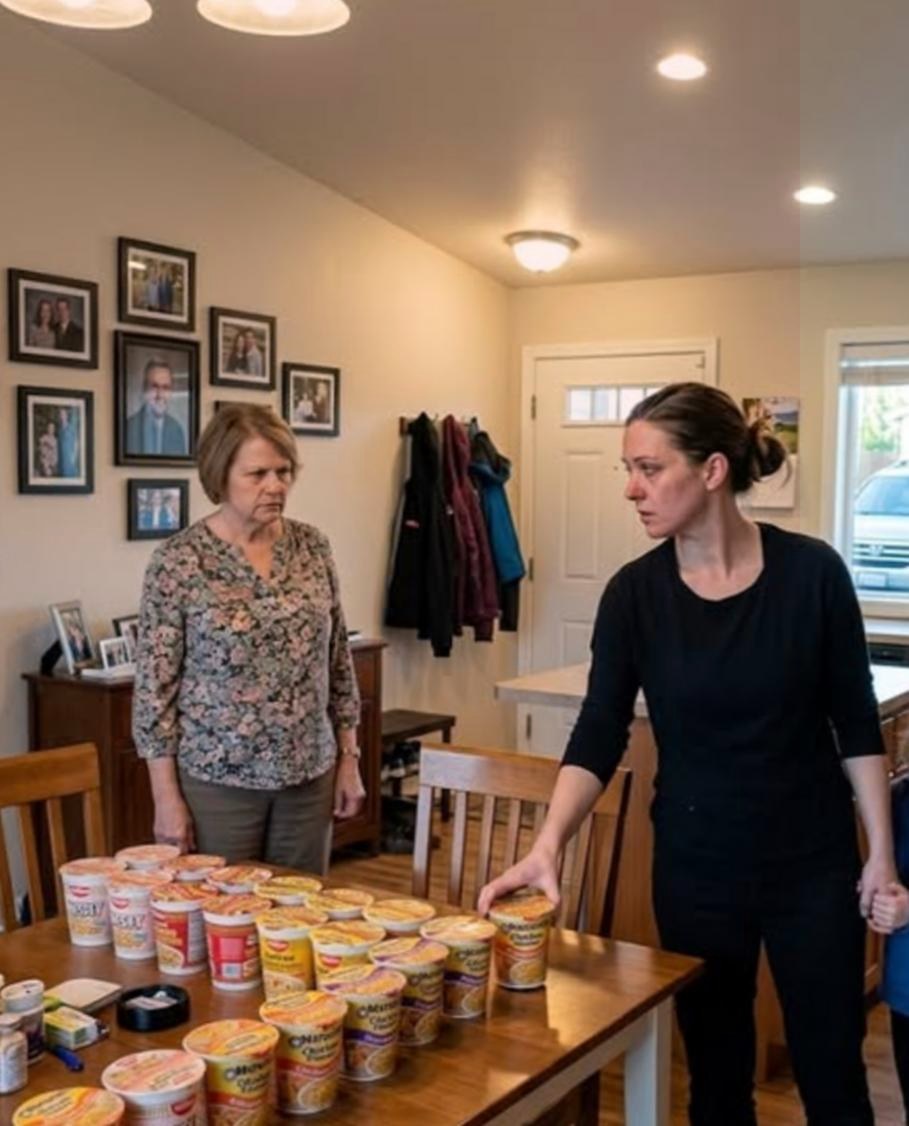
When I returned home in the evening, the living room was empty. Paola’s birthday balloons had drooped from the ceiling. On the table there remained one plastic spoon from the twenty-four that I had arranged beside the noodle cups that day.
Camila looked at me.
“We will not live here anymore?”
“No, darling.”
“Where will we go?”
“To Mother’s kiosk. That is where our home is.”
The little girl nodded. Then she picked up from the floor the crushed noodle cup that Marta had thrown on the day of the party.
“Shall we take this?”
“No, let it stay here.”
“Why?”
“So that we will always remember when we began to leave.”

Three weeks later I opened the kiosk. The first morning was awkward. My hands trembled as I stirred tomatoes in the pot. The old seller from the market opened the door and came in.
“Do you still have your mother’s soup?”
“I made it according to her recipe.”
“Then give me two bowls.”
That day two bowls became ten. Ten became twenty. People came, remembered Mother, and said that the place lacked her warmth.
Camila sat on a small wooden stool and drew on a sheet of paper. She drew a house, three people, and a large sun. In one corner she drew a little key, colored it gold, and told me:
“This is the key to our door.”
“Mother gave it to me.”
“Now it gives you the house.”
Her words struck me more strongly than any court hearing.
Four months later the court sentenced Raul. Marta admitted that she had made the calls to Mother, though she said she had not intended the death. The court also held her responsible. The kiosk remained with me. The bank returned part of the money; the rest was to be recovered over the years.
I no longer expected anyone to suddenly set my life right.
Every morning I opened the lock myself.
Every evening I locked the door myself.
In November the first snow came. The market was almost empty. Camila drew a little heart on the window with her finger, and I let steam rise from the pot so that another heart would appear on the glass.

That evening Raul’s lawyer called me.
“He wants you to meet him.”
“Why?”
“He says he has changed. He wants to see Camila and your help.”
I was silent for several seconds.
Earlier I would have run immediately after such a request. I would have turned his problems into my problems. I would have forgiven his threats in the name of love.
But now I looked at the snow through the window.
“Only the court will decide about Camila’s safety,” I told him. “I will not come to meet him.”
“Valeria, he says that he regrets it.”
“Regret is a word. I need action.”
“Do you want me to pass anything on?”
“Yes. Tell him that I will not return to the life he lost.”
I ended the call.
That same night I found a letter at the door. I did not open it. I knew who it was from. I put the envelope into the kiosk’s stove and waited until the paper turned to ash.
Then I entered Camila’s room. She was sleeping. Beside the bed lay a sheet on which she had drawn our house. A small rusty key hung on the door.
My mother’s key.
It was still heavy, but it no longer hurt me.
In the morning, before I opened the kiosk, I closed the key in my hand and felt for the first time that I was no longer carrying the past.
I was holding the door.
And it was already mine.
Missed the beginning?
Related posts:
 Returning from her mother’s funeral, they asked her to prepare food for twenty-four guests, but the first glass placed on the table took away everyone’s smile
 The Meat My Mother Sent Was Being Saved by My Husband for His Mother-in-Law, but When He Opened the Refrigerator, His Face Suddenly Turned Pale
 Part 4 — The Meat My Mother Sent Was Being Saved by My Husband for His Mother-in-Law, but When He Opened the Refrigerator, His Face Suddenly Turned Pale
 My mother-in-law took my car and left me on the road with the baby, but one call from my father erased her smile
 An Unknown Man Humiliated Me in Front of Everyone, but the Restaurant Owner Looked at Me Only Once — and His Smile Immediately Disappeared
 The night before the wedding, the groom announced that he would stay at a hotel with another woman, but when he knocked on my door, his mother turned pale