
That evening, when in my father’s kitchen my mother told me that I had to give up my eight-year-old child, the glass door of the cupboard slowly rattled, and I realized that this conversation had been prepared for a long time without me.
Brian had called me an hour earlier. His voice was calm, too calm for a man who had destroyed his family by betraying it with another woman.
“I’ll take Kara out of the state,” he told me. “Laura will be better for her.”
“You will not take my daughter anywhere while I am alive.”
“The court will decide, Elena.”
When I hung up the phone, my hands were trembling. Brian had not gone to Kara’s therapy for months, did not know which sounds frightened her, how to hide a bright light, or why she ate only three specific foods when she was overtired. But now he had suddenly remembered fatherhood.
I went to my parents because I thought I would at least have an answer with them. Mother always said that family protects you in difficult times. I had grown up in that house. I thought the door would open for me again.
Kara sat in the next room, her headphones hanging around her neck, drawing little square-handed robots in a notebook. The sound of her pencil point blended with the clock standing on the floor.

I sat down at the table. Father sat in his usual place, by the window. Erica was leaning against the kitchen counter with her arms crossed over her chest.
“Brian is going to take Kara,” I said. “He says he will move to a new state with Laura.”
Mother dried the plate twice, as if she were already looking for an answer on dry porcelain.
“Calm down, Elena.”
“Calm down? He told me he was taking my child.”
“If the father wants her,” Mother put the towel on the table, “give her to him.”
For several seconds I could not understand what I had heard.
“What did you say?”
Erica exhaled quietly.
“Kara takes everything from you, Elena. Time, money, energy. There is no other place left in your life.”

“She is eight years old.”
“And she has autism,” Mother added as if the diagnosis were an accusation. “Constant supervision, therapy, noisy scenes. We get tired too.”
“You are talking about her as if she were an object.”
Mother looked toward the door. The door beyond which my child was drawing robots.
“She is a burden, Elena.”
That word remained in the room.
Father did not raise his head. The presenter’s voice could be heard from the television, but even it seemed to have gone far away.
“Say something, Dad,” I begged.
He wrapped his fingers around the edge of the table.
“Your mother is simply thinking practically.”
Then I realized that this conversation was not happening for the first time. They had simply been discussing it without me until now.

I pulled the chair back so quickly that its leg made a scratching sound on the floor.
“You will not speak about my child like that anymore.”
Mother stood up too. Her silver bracelet struck the edge of the table.
“Then listen to me carefully, Elena. If you are not going to abandon her, don’t call me Mother anymore.”
A pencil rolled in the hallway.
I turned around.
Kara was standing there. Her headphones hung around her neck, and she had crumpled the notebook in both hands. Her eyes first turned to Mother, then to me.
“Grandma doesn’t want me to be here anymore?” she asked in a whisper.
Mother covered her mouth with her hand, but not for an apology. It was as if only now she remembered that a person was standing in the room.
Kara ran into the guest room and hid between the bed and the wall.
“Do I ruin everything?” she asked me when I knelt beside her.
Her hands were cold.
“No, my little one. You are not the problem.”

At that moment Mother said from the threshold of the door:
“Stop dramatizing. If you want to leave, go.”
I took Kara’s gray blanket, her fox-shaped toy, her headphones, the charger, and the plastic box where her calming things were arranged. When I grasped the door handle, Father looked at me for the first time.
“Elena, where will you go?”
“Where my child will not be considered a burden.”
Erica chuckled.
“You’ll come back in two weeks.”
The wall clock in the hallway struck nine. I opened the door, but Mother called to me from the threshold:
“If you go out now, don’t come back.”
I squeezed Kara’s hand more tightly. Just then Father took something from the table and moved toward me…

My father’s fingers were still in the air when Kara clutched my hand so tightly that her nails dug into my skin.
“Mom, let’s go,” she said.
I looked at Father. He was holding a small folded piece of paper, but I did not ask anymore what he intended to do. Staying in that house for another minute already felt like betrayal.
“Elena, wait,” he said.
“You were silent for years. Now one minute of silence will not be enough for you.”
Mother stepped back.
“You are choosing this life yourself.”
“No, Mother. I am choosing my child.”
Kara lowered her head, but she did not let go of my hand. Her fox-shaped toy fell to the floor, and its eyes shone in the plastic light. I picked it up, put it in the bag, and closed the door.

That night we stayed in a small hotel room. The air conditioner hummed harshly, hallway light came in from under the door, and the bedspread smelled of unfamiliar detergent. Kara covered her ears with her hands.
“The sound won’t stop,” she told me.
“I know.”
“Will Grandma really not be my grandma anymore?”
The answer caught in my throat.
“You have not lost a grandmother. She has lost the right to be close to you.”
In the morning I called a lawyer. By noon I was at the police station, and in the evening Brian’s messages were coming.
“I need a stable home for Kara.”
“You are emotionally unstable.”
“Laura has more resources.”
I read every message and remembered how afraid Brian was of Kara’s meltdowns. But now, for court, he kept repeating the word “stability.”

In three days I found a small apartment on the third floor of an old brick building. A fire escape was visible from the window, and only two chairs fit in the kitchen. But when the door closed, the silence was ours.
I installed soft lights in Kara’s room. I arranged her things in transparent boxes and attached a picture to each one. I hung her drawing beside the bed: a robot with a large heart on its chest.
“Everything is in its place here,” she said.
“You are too.”
“Me too?”
“Especially you.”
The first months were difficult. During the day I worked in a bakery, and at night I filled out Kara’s therapy records. Sometimes I fell asleep sitting beside the washing machine. But when Kara came out of her room in the morning and checked the little lamps arranged by the window, I knew that going back was no longer possible.
My parents told relatives that I had supposedly abandoned the family. Erica wrote on social media that “some people get used to the role of the victim.” I did not answer any of them.

Years passed.
First Kara dismantled toy robots, then an old radio, and finally repaired an engineering model in the school laboratory that older students had been unable to repair.
She was fourteen when the teacher told me:
“Your daughter understands space differently.”
“She simply listens carefully to what others do not notice.”
At eighteen she was given a full scholarship. At university Kara created a device that helped neurodivergent children tolerate noise and light. The device included a soft pulse light, a noise-filtering system, and a small screen that warned the child about a change in advance.
“I do this,” she told me one evening when only the two of us were in the laboratory, “so that another child will not think that they themselves are the problem.”
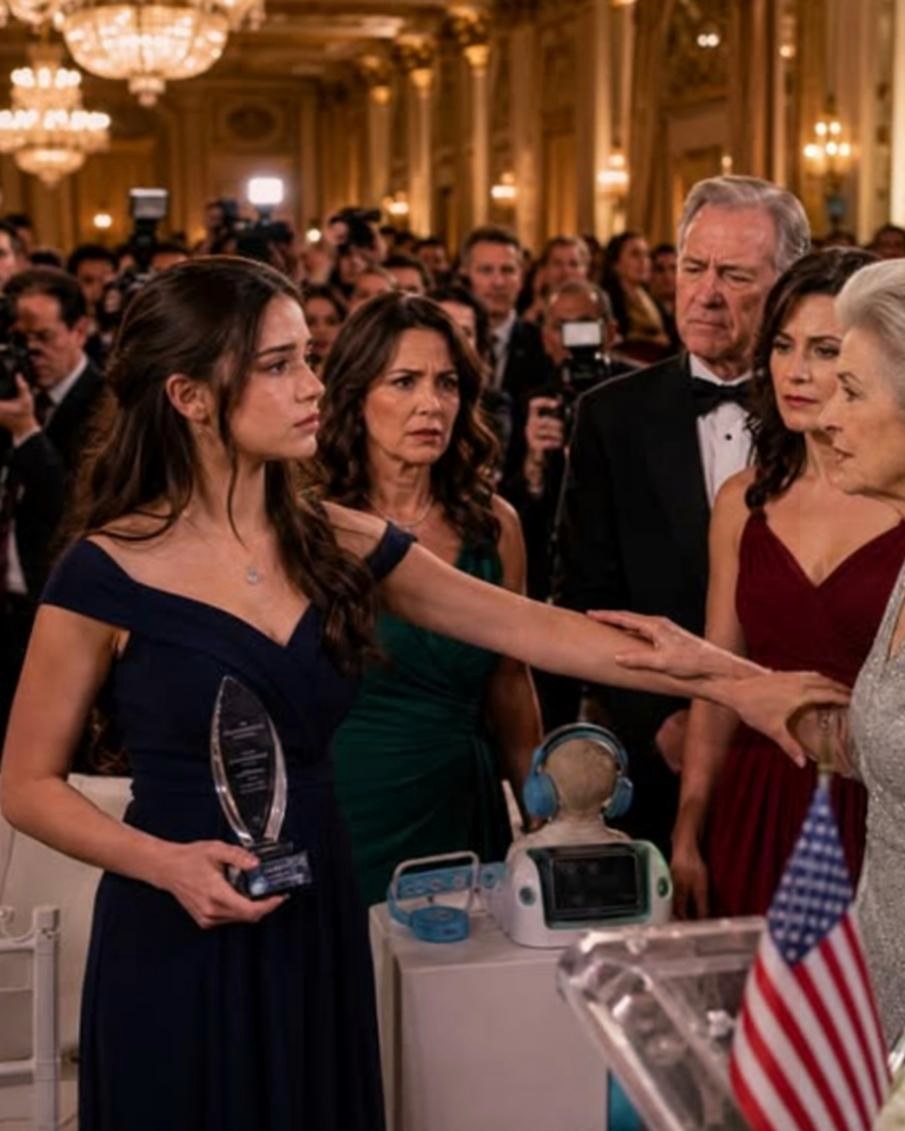
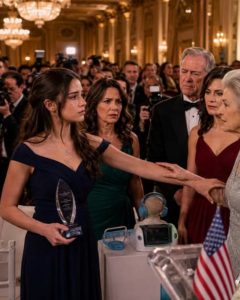
After her first major contract, we received an invitation from the company. The gala was being held in the hotel’s golden hall. Kara’s name was displayed on the screens, journalists were preparing their cameras, and investors were talking about her device.
I pinned a small copper star to my black dress. Kara had forged it for me from old wire when she was sixteen and told me that a star meant finding the way.


A few minutes before the speech, a hand touched Kara’s shoulder.
It was Mother.
“Look how much you have grown,” she said loudly.
Erica stood beside her, while Father smiled a few steps behind them for unfamiliar guests.
“We always knew you had a great future,” Erica added.
“Family should be together at moments like this,” Mother said, looking toward the journalists.
I stepped between them.
“You should not have been here.”
Mother’s smile hardened.
“We are family, whether you like it or not.”
Kara moved behind my back. Conversations in the hall gradually quieted. One journalist raised a pen.
Mother reached her hand toward Kara again.
“Child, we always believed in you.”
Kara stopped her hand in the air. Her eyes were calm, but something heavy was hidden beneath that calm.
“No,” she said.
Mother’s face changed.
Kara looked around the hall, then looked directly at them.
“I remember every word from that night. And now you will have to listen to them too…”

Kara took a small black device from her bag. It looked like an ordinary voice recorder from the outside, but it had an old scratch on it—the one she had found on the floor of our first apartment and kept as a toy.
“What is that?” Mother asked.
“Memory,” Kara answered.
Someone in the hall quietly exhaled. Kara signaled to the technician. On the large screen, first the date appeared, then the file name: “Guest Room, nine hours and four minutes.”
My stomach tightened.
“Kara, it isn’t necessary,” I whispered.
She turned toward me.
“Mom, for years you protected my peace. Now I will protect your truth.”
The recording began.
At first the sound of the rolling pencil could be heard. Then my mother’s voice, clear and cold:
“If you are not going to abandon her, don’t call me Mother anymore.”

Every sound in the hall disappeared.
Then my voice was heard:
“Say something, Dad.”
My father’s old, tired voice answered:
“Your mother is simply thinking practically.”
Erica’s laughter was so clear that it seemed as though she were still standing in that kitchen.
“Everything would be better without her.”
Mother lowered her eyes.
“Turn it off,” she said.
Kara did not look at the technician.
“You said that you always believed in me. This recording was made when I was eight years old. I could not explain the words, but I remembered the voices. Years later I found this file in an old tablet. Mother turned on the recorder then because she wanted to talk about Brian’s call. You forgot that you had left it on.”
My eyes burned. I did not know that Kara had found the recording. I did not know how long she had been carrying this weight alone.

“Kara, we were angry then,” Father said.
“You were not angry; you were honest.”
Erica stepped forward.
“This is a family conversation. You cannot use this publicly.”
Kara looked at her.
“You told me publicly that you were part of my family. I will also answer you publicly that this is not true.”
One of the journalists asked:
“Is this device your invention?”
“Yes. And all the company rights are registered in my name. They never helped me. Neither in creating it nor in financing it.”
Mother turned pale.
“We are your grandparents.”
“That is kinship, not merit.”
At these words Father grabbed the chair. Erica took out her phone and quickly dialed a number.
I looked at Kara. Her shoulders were no longer trembling. She was no longer the child who hid between the bed and the wall. But in her eyes I still saw the little girl who had asked me whether she ruined everything.
“You ruin nothing,” I whispered.
“I know, Mom.”


Just then my phone rang. The lawyer’s number appeared on the screen.
“Elena,” he said as soon as I answered, “leave the gala immediately. Brian and Erica have filed a lawsuit against the company. They claim that Kara’s idea was a common family project.”
My mother was still smiling in the hall, but now the smile was tense and dangerous.
“What does a lawsuit mean?” I asked.
The lawyer lowered his voice.
“This is not only the beginning. They submitted a document according to which Kara supposedly signed over the rights when she was eighteen. And, Elena, your signature is also on the document.”
My fingers froze.
Kara saw my face.
“Mom, what happened?”
Brian appeared at the entrance to the hall. He held a folder in his hand and had the expression of someone who had finally returned victorious.
“It is time for everyone to learn who owns all this,” he said.
But he had not yet seen the paper that I had hidden in my bag, beneath the copper star…
მისი ძველი ჩანაწერი დარბაზში ჩაირთო…
მეგონა, ყველაზე მძიმე უკვე უკან მოვიტოვეთ. მაგრამ იმ საღამოს დამალულმა სიმართლემ ყველაფერი თავიდან შემოატრიალა.
„დიახ, ეს ჩემი ნათქვამია.“
ბრაიანმა თვალები ვეღარავის გაუსწორა.
😱 გაიგე, რას მალავდნენ ისინი →
👇 ისტორიის ფინალი უკვე გახსნილია
Related posts:
 Part 4 — I Refused to Abandon My Child and My Mother Told Me, “Don’t Call Me Mother Anymore” — Years Later, Her Smile Began to Disappear
 I Refused to Give Up My Eight-Year-Old Daughter, and Years Later My Mother’s Smile Suddenly Disappeared at the Gala
 After My Husband’s and Daughter’s Funeral, My Mother Asked Me for the Insurance Money, but the Bag on My Table Suddenly Erased Her Smile
 A Flat Tire Stopped Me at a Desert Diner, but When the Waitress Heard My Name, the Color Drained from Her Face
 Mother Left Me Alone for a Month, and I Left Something Waiting for Her in the Kitchen — Her Smile Disappeared Immediately
 On Thanksgiving Day, My Brother’s Girlfriend Slapped My Child, and by Christmas Her Smile Suddenly Began to Disappear