
When I read the sentence written by Irina Alferova’s mother in her own hand, my hands trembled so much that the newspaper page fell from the table.
“I must refuse to have the child before it is too late.”
These words were written on a small, yellowed card. In its corner lay a strange object — a copper spindle, on whose surface a star shape had been scratched. The spindle was so worn, as if someone had carried it in the palm of their hand all their life.
It was six in the evening when I was left alone in the basement of Moscow’s old archive. Rain struck the windows, the lamp’s light trembled on the papers, and I was trying to understand why I could not tear myself away from one simple sentence.
The matter concerned Irina Alferova’s mother, Ksenia Arkhipovna — a woman who endured the war years, lived to be one hundred and four, and, as the records showed, faced such a choice at a young age that even imagining it was difficult.
The archivist Elena locked the doors and returned to me.
“Are you still here?” she asked me.
“Where did you find this card?”
“Not me. You found it. There should be others in the folder.”
She did not touch the spindle. She only looked at it from a distance.

“This object appears every time something is written about Ksenia Arkhipovna’s life,” she told me. “Strange, isn’t it?”
It truly was strange. But stranger still was that the child’s name had not yet been written on the other side of the card. Only one word was visible: “Girl.”
That same night I went home, though I could not sleep. Copies of the old records lay open on the table. In one photograph Ksenia was young — a thin face, tired eyes, and that little copper spindle tucked into the pocket of her apron. Beside her stood a man whose face had almost been erased in the newspaper clipping.
The next day Elena brought me a new folder.
“This is personal correspondence,” she told me. “It should not have been in the official collection, but the family submitted it years ago.”
“Why has no one published it until now?”
Elena shrugged.
“People protect some family stories even after death.”
There were several letters in the folder. In one of them Ksenia wrote that, because of hunger, fear, and loneliness, having a child seemed to her not joy but punishment.
“If a girl is born, perhaps I should give her to someone else. With me, only hardship awaits her,” the letter said.

The words blurred before my eyes. I knew that history consisted not only of beautiful photographs, but it was still painful to read such a confession.
That same evening I met an old guard, Nikolai, in the archive corridor. He held a bunch of old keys in his hand.
“Are you collecting materials about that woman?” he asked me.
“About Ksenia Arkhipovna?”
“Yes. Her daughter came here once. She did not say much. She asked me only one question.”
“What question?”
Before answering, Nikolai put the keys into his pocket.
“She asked whether her mother’s object remained — the one she always turned in her hand as a child.”
“The spindle?”
The old man slowly nodded.
“Did you immediately understand which object it was?”
“Everyone knew. The woman never let it leave her hand.”

On the third day I found the last sheet in the folder. It was folded and sealed with a small, broken piece of wax. On the outside there was only one date — the day when Irina was supposed to be born.
Elena told me:
“If you open it, you will not be able to put it back.”
“And if I do not open it?”
“Then you will never know why everything changed.”
My fingers stopped at the seal. Only the ticking of the clock could be heard in the room. At last I put the sheet on the table and placed the copper spindle beside it.
At that moment footsteps sounded from the corridor. The door slowly opened. Someone entered and reached a hand toward the folder…
Someone’s hand reached toward the folder, but Elena seized the person by the wrist.

“Who are you?” she asked sternly.
A middle-aged woman stood in the doorway. She wore a dark blue coat, raindrops glittered in her hair, and she held a small leather bag in her hand.
“I am from the family,” she answered. “This material should not have been opened.”
I stood up.
“You knew this sheet was here?”
The woman looked at me and narrowed her eyes.
“You do not know what you are looking for.”
“Perhaps. But do you know what you are hiding?”
A heavy silence descended in the room. Elena’s fingers gripped the edge of the folder. I continued looking at the copper spindle. Its scratched star glittered in the lamplight.
The woman opened her bag and took out an old photograph.
“Look at this before you decide anything.”

In the photograph Ksenia sat beside a small window. She held a newborn in her arms. Her face bore such exhaustion, as if she had not slept for several nights, but she looked at the child as if no one else existed in the world besides it.
“When was this photograph taken?” I asked.
“On the third day after the birth.”
“Then why does the letter say she intended to give the child to someone else?”
The woman lowered her head.
“Because a decision does not change in one day. Sometimes a person loves and is still afraid.”
Her answer sounded strange to me. I had always thought that love made a choice easier. That night I understood for the first time that sometimes love makes choosing more painful for a person.
Elena locked the door.
“If you are from the family, tell us your name.”
The woman stood silently for several seconds.
“I am Marina. Irina Alferova’s relative.”

“And why do you want to stop this sheet?” I asked.
Marina put the photograph back into her bag.
“Because Ksenia was not merely one frightened woman. She built a life. If you take out this one sentence, people will see her as a cruel mother.”
“Then you must tell us the rest of the story.”
“The rest of the story does not belong to every family.”
Outside, thunder rumbled. Wind blew through the pipes of the old building, as if someone were breathing quietly behind the walls.
Marina left, but as she went she told me only one thing:
“Before you open the sheet, see what is written beneath the spindle.”
As soon as the door closed, I picked up the object. Until then I had not examined its underside. I removed the darkened dirt with my fingernail and saw tiny letters.
“Do not surrender to fear what love has given you.”
Elena held her breath.
“Are these Ksenia’s words?”
“I do not know.”

“Then whose are they?”
Initials were written below the phrase. One letter matched Ksenia’s name, and the other belonged to the man whose face had been erased in the photograph.
After returning home that evening, I looked through the old newspapers again. One small notice said that after the war Ksenia Arkhipovna had refused to leave the city and had stayed with her child. Another article mentioned an unknown man who had helped the family for several years.
His name was nowhere written in full.
The next day Elena called me.
“That woman has come again,” she told me. “This time she is not alone.”
When I arrived at the archive, Marina was standing in the corridor with two lawyers. One of them held a paper certified with a court seal.
“You must hand over the materials,” she said. “The family does not agree to publication.”
“I have not published anything yet.”
“But you intend to.”

“I am looking for the truth.”
Marina’s voice became tense.
“Sometimes the truth destroys a family.”
Elena took her place beside me.
“And what does hiding do?”
Marina could not answer. The lawyer unfolded the paper.
“If you do not hand over the folder now, we will be forced to use an official demand.”
I looked at the paper, where the seal was faintly visible. Then I looked at the folded letter. Something told me that its contents concerned not only Ksenia’s past.
I went to the window and carefully lifted the edge of the seal. The wax cracked. Marina said quietly:
“Do not open it.”
I continued anyway. The sheet slowly unfolded, the first line appeared, and Elena raised her voice…

Elena raised her voice because the very first line contained only one sentence:
“I will give the child to no one — no matter what happens.”
Marina froze in place. The lawyer reached for the paper, but I stepped in front of him.
“You have already read it,” I told him. “Now everyone must hear it.”
“This document is private,” the lawyer said.
“Then why did you bring a court demand? You wanted to see it too.”
Elena took the sheet and continued reading aloud.
“Today the doctor told me that the child’s chance of survival is small. Yet I still feel its movement. If it is born, my fear must not pass to its name. I may be poor, I may remain alone, but I will no longer take away from myself the right to be a mother.”
Marina’s eyes lit up.
“This is not the last record,” she said.
“What else is there?” I asked.
She took a small audio recorder from her bag. It was an old object, scratched on the side, with its sound button fixed with transparent tape.

“Irina gave this to me,” Marina said. “She told me that if this story ever fell into the hands of a stranger, the truth should be heard to the end.”
At first a hiss came from the recorder. Then a tired woman’s voice.
“I thought giving up the child meant saving it. Then I touched her cheek for the first time and understood that I was giving up my own life. From that day I was no longer afraid of poverty. I was afraid only that someday someone would tell my child that I had not wanted her.”
It was Ksenia’s voice.
No one moved in the room. The lawyer shifted his gaze to the floor. Elena’s eyes filled with tears, while Marina covered her face with her hands.
The recording continued.
“Irina, if you ever hear this, know this: I was not giving you up. I was only fighting the world that had convinced me that motherhood was too much happiness for me.”
Marina switched off the recorder.
“Do you understand now why I did not want this material opened?” she asked me. “People always remember the first sentence. Few learn to listen to the end.”

I looked at the letter. There was another sheet there, which I had not noticed until then. It was written not in Ksenia’s hand, but in the handwriting of the unknown man.
“If the girl survives, she must know that her father could have taken her, but he did not abandon Ksenia. I was not a hero. I simply stood on the right side at least once.”
The lawyer raised his head.
“Do you know this man’s identity?”
Marina did not answer.
I looked at the initials and suddenly realized that they matched the name mentioned in the old newspaper.
“He gave the family not only money,” I said. “He protected Ksenia’s choice.”
Marina silently nodded.
“But this is still not everything.”
Her phone rang. She answered, listened for several seconds, and her face changed.
“What happened?” Elena asked.
Marina slowly lowered the phone.
“The hospital called. Someone requested a copy of an old medical file under Ksenia’s name. And this person is not a family member.”
“Who is it?” I asked.
Marina looked toward me.
“The man whose initials are on the letter.”
At that same moment my phone rang too. An unknown number appeared on the screen. When I answered, there was silence for several seconds. Then a man quietly said:
“If you publish the truth to the very end, you will have to reveal one more secret of Irina’s…”
ბოლო სიტყვებმა ოთახში ყველა სიჩუმე გააქრო…
მე მეგონა, რომ მხოლოდ ერთი ძველი ოჯახის საიდუმლოს ვეძებდი. ფინალმა დამანახა, რამდენად ძვირი შეიძლება დაჯდეს დუმილი.
„მე ეს ვთქვი…“
და სახე ხელებში დამალა.
😱 გაიგე, რას მალავდნენ ისინი →
👇 ისტორიის ფინალი უკვე გახსნილია
Related posts:
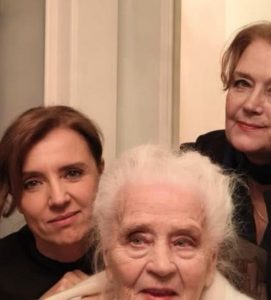 Part 4 — When I Read the Mother’s Confession in the Archive, One Silent Gesture Stopped Everyone in Irina Alferova’s Family
 My Disabled Sister’s Fall Was Followed by Violence, but When I Entered the House, My Mother’s Smile Suddenly Disappeared
 A Flat Tire Stopped Me at a Desert Diner, but When the Waitress Heard My Name, the Color Drained from Her Face
 My Father Was Fed by a Poor Woman at Night, but When I Followed Her Trail, a Stranger’s Face Suddenly Turned Pale
 An Unknown Man Humiliated Me in Front of Everyone, but the Restaurant Owner Looked at Me Only Once — and His Smile Immediately Disappeared
 I Went to the Cemetery with Five Children, and My Ex-Husband’s Gaze Suddenly Froze





