
The phone froze in my hand.
“Who are you?” I asked.
In response I heard only breathing.
Then the call ended.
Victor was still standing in the corridor, his weapon pointed at Mara. And Owen was kneeling on the floor between two security guards. His face had become white as paper, but his eyes were alive and piercing.
I raised the recorder.
“If you fire, this recording will be sent to every news channel in ten minutes.”
Victor chuckled.
“You are just a cleaner.”
“Not now.”
I had a pre-set message on my phone. If I did not press one button every ten minutes, the recording would automatically be sent to Nora, my lawyer, and the police. This idea belonged to Mara. In the stairwell, while they were looking for Owen, she quickly texted me the number of the police emergency department.

Victor slowly lowered the weapon.
“You do not know what you are doing.”
“I know that you have been drugging a man for two years.”
“I was keeping him alive.”
“No. You were keeping his silence.”
These words seemed to stop the room.
Far away, toward the elevators, the sound of a siren was heard.
Victor immediately turned toward Mara.
“Did you call?”
Mara did not lower her head.
“For the first time in my life.”
Victor took out his phone and called someone.
“Cancel everything. The doctor, the car, the accounts. Right now.”
After several seconds his face changed.
“No, this is impossible.”
His lawyer refused to help him. His name was already in the police record, and the bank had placed a temporary restriction on all the accounts.

The doors opened.
Detectives entered, then emergency doctors. The weapon fell to the floor and made a heavy sound. Victor raised his hands, but still tried to defend himself.
“That woman is lying!” he shouted. “Owen was not conscious, he heard nothing!”
I turned on the recorder.
His own voice sounded in the room.
“Double the dose. If he opens his eyes, everything is over.”
Victor fell silent.
I saw his face beyond the screen, like a person locked inside a mirror. For the first time he heard his own words as others listened to them. For the first time he understood that his voice no longer belonged to him.
“This recording has been edited,” he said in a whisper.
“Then you will prove it in court,” the detective answered.
I was not happy when they put handcuffs on him. I felt only tiredness. For two years this man had controlled everyone’s fear, but at that moment he simply looked like an old and empty person left in an empty room.
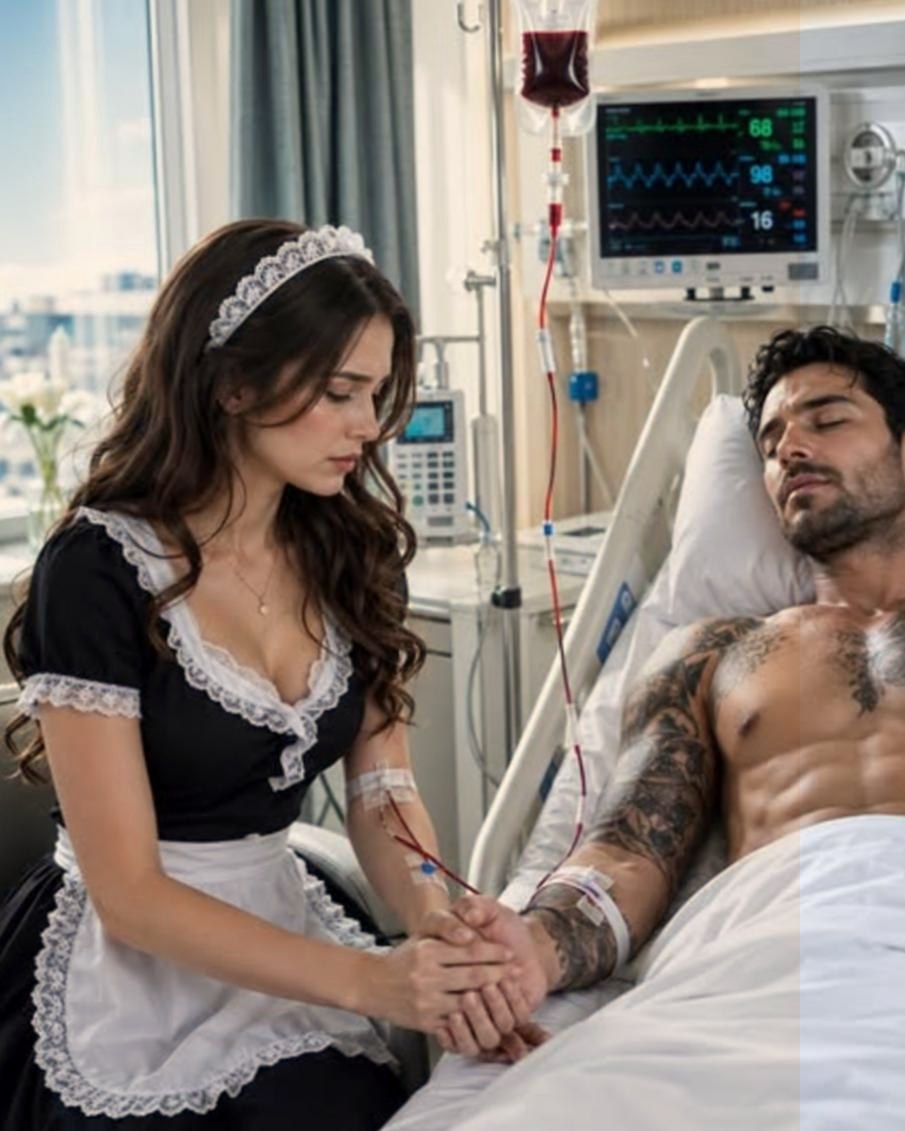
The doctors returned Owen to bed. They put a new bracelet on his wrist, and his breathing gradually calmed.
“You saved him,” Mara told me.
“No. He fought for himself.”
Owen opened his eyes.
“Elene, did you find the person who called you on the phone?”
“No. It was your voice.”
Owen looked at me for a long time.
“That is impossible.”

The next day I received an answer. In a photograph sent from an unknown number, my mother’s old passport could be seen. Beside it lay a hospital birth certificate, in which it was written that my biological father was Owen’s older brother, Alex Hartley.
When Owen saw the document, his face changed.
“Alex was killed twenty years ago,” he said. “But I knew about your existence.”
“You knew?”
“I was only eleven then. My father told me that the child had to be hidden in a foreign country, otherwise the Hartleys’ enemies could use you.”
For me this story resembled the door of my whole life, which opened all at once, and inside I found only emptiness.
I called my mother. She did not answer for a long time.
“Why didn’t you tell me?” I asked when I finally heard her voice.
“Because I thought silence would save you.”
“Silence only made me lose the truth.”
I heard her crying. But for the first time I did not try to add my own life to her pain.
Victor’s case moved quickly. The hospital doctors admitted the arrangement, while the security guards confirmed that Owen had been specially watched at night. Mara took over management of the company and handed all the accounts over to the police. The court sentenced Victor to a long imprisonment.

I went to court only once.
When Victor saw me, he lowered his head.
“You can change everything,” he told me. “Say that this was a misunderstanding.”
“No, Victor.”
“You would have taken money too.”
“I am taking freedom from you.”
That was the only revenge I wanted.
Three weeks later I left the hospital’s ninth floor. For the first time I arranged my small room as if I were going to live there for a long time. The closet no longer held the uniform that smelled of chlorine. And beside the bed I placed the same copper key that I had carried with me all my life.
In the room where Owen had lain, I found the bed empty. Only his wristwatch had remained on the sheets. Mara said I could sell it, but I did not take it.
“It belongs to you,” she told me.
“No. It counted the days, and I need to get time back.”
Six months later Owen was already walking independently. He sold most of his business and turned the rest into a legal foundation that helped victims of violence in families.
I opened a small cleaning service in Brooklyn. I hired three women who had lost their old jobs because of injustice. Every morning I drank coffee from the same white cup, and in the evening I called my mother—not out of obligation anymore, but out of desire.

In winter the first snow came.
Owen stood at my door, holding a small drawing. On it was a woman who held a door with one hand and a star-shaped key in the other.
“Who is this?” I asked.
“It is my niece’s drawing,” he answered. “I told her about you.”
“And what does she say?”
“She says that some doors must be opened from the inside.”
That evening Owen asked me once again to live with him. Not as an obligation, not as repayment of gratitude. He simply wanted us to live together.
I answered calmly:
“Being alone no longer frightens me, but I want to be with you.”
Just then I realized that fear no longer made the choice.
A year later I received a letter from Victor. He wrote from his cell that he regretted that no one had remained beside him and that perhaps someday I would agree to visit him.
I read the letter to the end.
Then I folded it and put it in the garbage bin.
Owen asked me nothing.
I explained nothing either.
Sometimes the answer is not silence, but the life you built without someone else’s permission.
That night I placed the copper key on the windowsill. The streetlight fell on its star-shaped scratch and drew a small, clear ray on the wall.
For the first time the key opened nothing.
For the first time the door was already open.
Missed the beginning?
Related posts:
 When I kissed the man considered helpless on the lips, his hand gripped my shoulder and fear seized the whole room
 When the Man I Loved Humiliated Me in Front of Everyone, Celeste’s Smile Suddenly Disappeared and Owen’s Hand Began to Tremble
 After my warning at the billionaire’s negotiation, the lawyer ordered the guards to remove me, but his smile suddenly disappeared
 My son brought his beloved home, but when I saw her, the serving spoon fell from my hand and Tyler suddenly fell silent
 An Unknown Man Humiliated Me in Front of Everyone, but the Restaurant Owner Looked at Me Only Once — and His Smile Immediately Disappeared
 I helped an injured man in an abandoned building, but after my six words, the smile disappeared from his face