
I opened the seal.
Such silence fell in the storage room that even the party music behind the wall could be heard clearly. There, several meters away, guests were laughing and clinking glasses. Here, I was counting my son’s breaths.
I took two sheets of paper and a small memory card from the envelope.
David immediately said:
“This may be fake.”
“Read it first,” I answered.
The paper bore the stamp of a private clinic. The doctor’s conclusion said that Elena had been brought to the clinic three years earlier with signs of severe dehydration and starvation. The child’s condition had been more serious. The doctor had to send a notification to social services, but the notification had been canceled.
The signature canceling it was Evelyn’s.
Elena lowered her eyes.
“That day Julian was losing consciousness,” she said. “We went to the hospital, but your mother told the doctor that we were her servants and brought us back home.”
“Why did you not call me?” I asked.
Elena smiled bitterly.
“Every time I called you, a message came from your number saying that you did not want to speak with me. Then your mother made me record your voice and edited it so that it sounded as if you were saying that I was stealing money from you.”
Cold spread through my body.
“My voice?”
I put the memory card into the phone. The recording started. It was my voice, but the words were crudely joined to one another.
“I no longer trust Elena… do not send any more money… Julian should stay with you…”
Then my mother’s real voice was heard, unedited and calm:
“If you contact Nikoloz, they will take the child away from you. Tell him that he himself does not want to return to you.”

Elena began to cry. Julian took her hand.
Victoria crouched against the wall.
“Mother, you told me this was only a temporary loan of money.”
Evelyn looked toward her.
“Be quiet.”
“You opened a company in my name too,” Victoria continued. “The debts remained with me.”
David heard the recording and put the bag on the table.
“I am no longer involved in this case,” he said.
“You have been involved for five years,” I answered.
“I prepared documents, not a crime.”
The phone rang. The number of the police station appeared on the screen. I had not called them myself, but it turned out that Elena’s doctor, who was mentioned in the envelope, had kept a copy for himself several years earlier. Today, when he heard my name, he alerted social services.
“Nikoloz,” a woman’s voice said to me from the phone, “the police are already on their way. Do not leave the place.”
Evelyn suddenly opened the door and ran into the yard.
Victoria followed her.
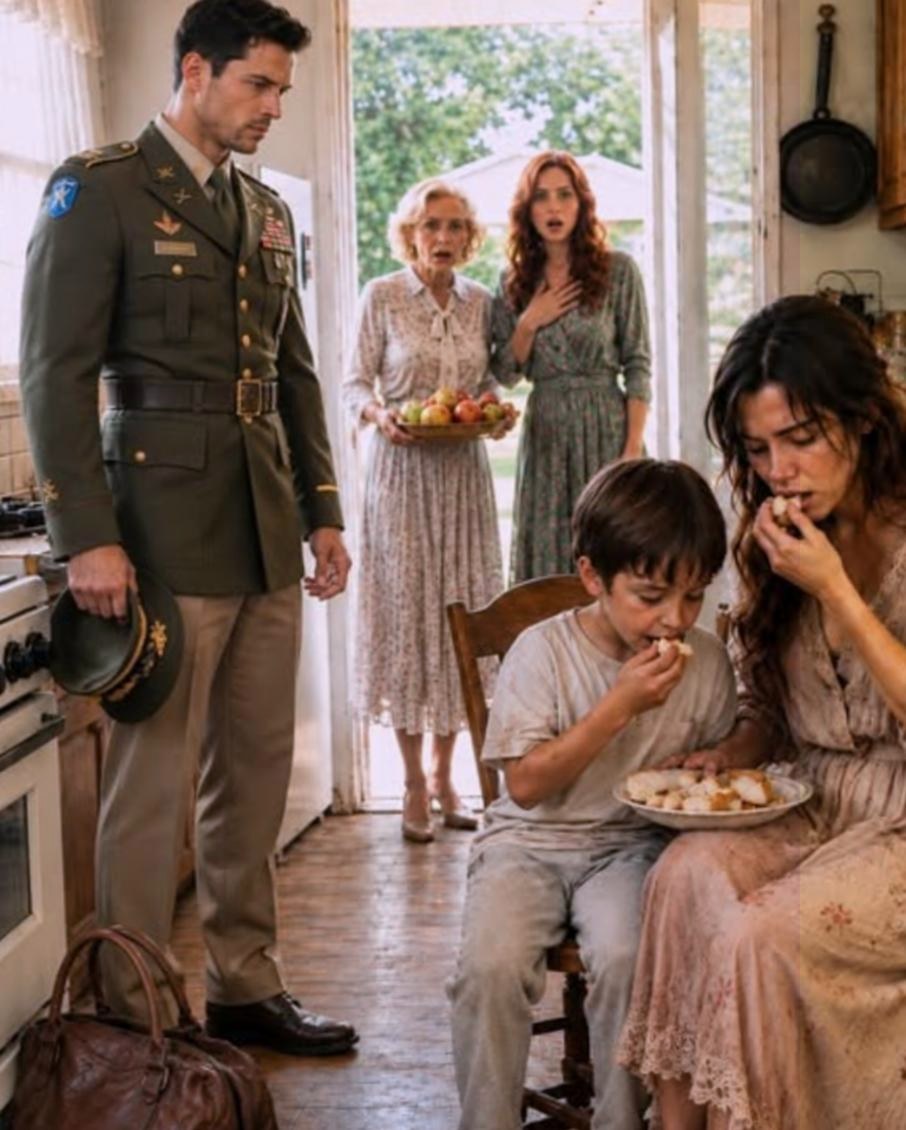
I picked Julian up in my arms. His body was light. Too light.
Guests were coming out of the mansion and could not understand why some were crying, why some were running, or why a police car was standing in the yard.
Evelyn got into the car, but the engine did not start. Smoke came out from under the hood. Within several seconds the police officers put handcuffs on both of them.

“Nikoloz, this is your family!” Mother shouted. “How can you treat me like this?”
I did not answer.
In my phone I could still hear her voice telling me that Elena was choosing poverty herself.
For the first time I understood how easy it had been to deceive someone else when the victim was far away and sent money on time.
That same night Julian and Elena were taken to the hospital. The doctor told me that the child had a severe nutritional deficiency, but help had come in time.
In time.
That word pierced my heart like a knife.
The next morning the lawyer called me and said that Evelyn’s accounts had been frozen, while a financial investigation had begun into Victoria’s company. The case concerned fraud, document forgery, coercion, and creating a threat to the child’s life.
I did not go to court to punish them.
I went to say what no one had heard for five years.
In the courtroom Elena spoke for the first time without being afraid of anyone.
“I did not want to leave my husband,” she said. “I simply wanted my child to survive.”
My mother sat with her head bowed. When the judge heard the recording, she said nothing more.
Victoria admitted that she had helped her mother transfer the money. She said that at first she only wanted to take money, but then she became so entangled in the blackmail that she thought there was no way back.
The judge sentenced both of them to imprisonment. Part of the money was returned. The mansion was sold. The rest of the money went toward Julian’s treatment and into a separate account for Elena.
But the hardest moment was not in court.
Three days later I entered the empty storage room alone. In the corner lay a cracked plastic toy car. The iron lock hanging on the outside of the door was still there.
I took my small copper compass from my pocket. Its needle pointed north, as if throughout all these years it had still not lost the way.
I put the compass on the floor and allowed myself to cry for the first time.

Six weeks later we moved to another city. Into a small, bright apartment, from whose window a school could be seen. Elena began working in a library. I became a technical supervisor at a construction company, but in the evening I no longer returned tired to a foreign country. I returned home.
Julian slowly grew stronger. The doctor wrote us a nutrition schedule, and every morning I arranged fruit on his plate. At first he hid food in his pocket.
“No one will take it away from you anymore,” I told him.
“Really, Father?”
“Really.”
One morning he drew a house on a sheet of paper. It had four windows, and beside the door he drew a small round object.
“What is this?” I asked.
“Your compass,” he answered. “So that you can find the way to us again.”
Several months later the first snow came. Julian ran in the yard, while Elena watched from the window. The smell of cinnamon stood in the kitchen. There were three plates on the table, and not one was empty.
That evening I received a letter from my mother. She wrote that she regretted it, that she was ill, that the family could start again. At the end she asked me to come to her.
I read the letter several times.
Then I looked at Julian’s old drawing.
Elena quietly asked me:

“Will you answer?”
“Yes.”
“What will you tell her?”
I folded the paper.
“That I will not return to her anymore.”
It was not revenge. It was a boundary that at last I drew.
In the letter I wrote only one sentence: “I can no longer save the consequences of your actions.”
Then I tore the envelope.
In the evening Julian took my compass and placed it on the table.
“Father, the needle is still looking toward the right side.”
I sat beside him and embraced him.
The compass’s small needle came to rest peacefully.
For the first time, the house truly looked like a home.
Missed the beginning?
Related posts:
 I Went to the Cemetery with Five Children, and My Ex-Husband’s Gaze Suddenly Froze
 My Mother Screamed When I Touched Her in the Bathroom, While Downstairs My Brother Smiled Strangely and Fell Silent at Once
 My husband humiliated me in front of everyone on his birthday, but the moment I took the microphone, his smile disappeared
 My Former Partner Accused Me of Selling the Song on Stage, but One Calm Question from Me Would Drain the Color from His Face
 A Flat Tire Stopped Me at a Desert Diner, but When the Waitress Heard My Name, the Color Drained from Her Face
 After My Husband’s and Daughter’s Funeral, My Mother Asked Me for the Insurance Money, but the Bag on My Table Suddenly Erased Her Smile





