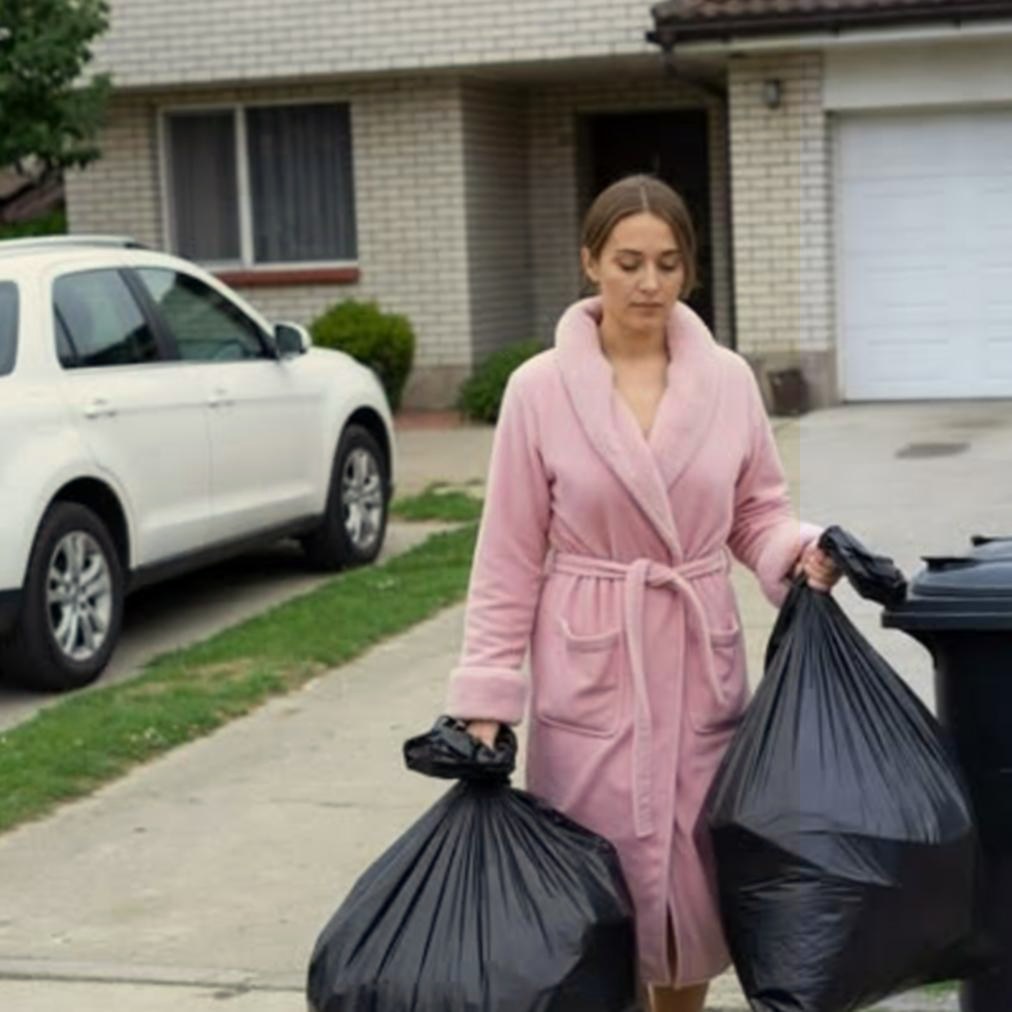

For a long time I could not touch the sheet Mara had placed on the table.
My address was written there.
Sara was sitting beside me, and her fingers were intertwined so tightly that her nails had dug into her palm.
“Is this Adrian’s handwriting?” Harris asked.
Mara nodded.
“I found it on his desk. Before he locked me in the basement, he often wrote lists like these.”
“Why me?” I asked.
Mara looked toward me.
“Because he saw you every morning. He thought you were a curious neighbor. He once said that such people disappear most easily.”
My blood froze.
Harris immediately took out his phone.
“I’ll send a patrol to your house.”
“Sara is not alone there,” I said.
“I already called,” he replied. “Our neighbor lady is staying with her.”
Evelyn was sitting on a chair and rubbing her hands on her knees.
“I should have called the police,” she said. “That very night. But Adrian told me that Mara would die because of me. And then… then I did everything he told me while he was alive.”
“And when he died?” I asked.
“Even then I continued carrying out his orders. Death does not kill fear.”
These words stayed with me the most.
Sometimes fear remains even after a person leaves the room.

The police went to Evelyn’s house. We followed them too. The morning light had already become cloudy, and drops of rain hung on the rose bushes. From the outside the house still looked perfect, as if no one had lived inside it for a year.
The basement door was hidden behind the kitchen cabinet.
Mara took out a key.
Exactly like the one I had found in the bag that morning.
When the door opened, a sharp smell of dampness and cleaning agent came out. A small mattress lay by the wall, and beside it were water bottles and old blankets. In the corner stood a plastic box containing Mara’s books and clothes.
Right there, beneath the floor, the police found a second door.
Behind it Adrian’s body had been hidden.
Evelyn lowered her eyes.
“I left him here because I needed to help Mara. But then I no longer knew how to begin telling the truth.”
Harris sat down in front of her.
“You must tell the truth now anyway. Everything. The bags, the recordings, Adrian’s threats, the weapon, and that night.”
Evelyn nodded.
They found the weapon in the small stone wall in the garden. The kitchen knife was hidden in a plastic pipe. Evelyn herself showed them the place.
Later, at the station, Adrian’s old recording was listened to once again. This time everything was officially recorded.
His voice sounded in the room:
“If anyone goes against me, I will take Mara too, and the neighbor who watches me from the window.”
These were his own words.
Evelyn heard them for the first time from outside.
She hid her face in her hands.
“I heard this in my head every day,” she said. “But now I realized that he really said it.”

Her lawyer called that same evening.
“Mrs. Evelyn, a suicide attempt is not possible. Do not hide anything from me, or your defense will become impossible.”
“If I tell everything, will I go to prison?”
“Possibly.”
Evelyn thought for several seconds.
“Then for the first time I will tell the truth without trying to escape the consequences.”
The case reached court. The examination confirmed that Adrian had planned violence against Mara, and lists for monitoring neighbors were also found in his house. It was also established that his death occurred that night, when he shot Mara.
Evelyn was not convicted of intentional murder. The court took self-defense and the concealment of evidence into account. She received three years of a suspended sentence and compulsory psychological assistance for the public.
Mara, meanwhile, moved to a special shelter.
In the first weeks she hardly spoke. She only pressed the music box with her finger and listened to its several broken notes.
One evening Sara told me:
“Perhaps we should buy her a new box.”
“No,” I answered. “This one must remain for now.”
Three months later Mara came to our house. She held a sheet of paper on which a house was drawn. In front of it stood a small woman, and beside her was a black bag crossed out.
“Now I no longer throw things away,” she said.
“What do you do?”
“I keep what is truly mine.”
Evelyn did not go to prison, but every week she sent Mara a letter. For a long time she did not open a single letter. Then one day she told me:
“I will forgive my mother, but I will no longer live in her fear.”
This forgiveness was not forgetting.
It was opening a door.

Six months later we moved to another neighborhood. We rented a small apartment where a park could be seen from the window, and in the mornings the sound of birdsong covered the noise of trucks. Sara still worked at the hospital. I returned to my old job, and in the evenings I taught Mara to ride a bicycle.
On the first snowy day Mara stood in our yard and made a snowball with her gloves.
“Nika, look!” she called to me.
Her laughter was still cautious, but real.
When I entered the house, I saw the music box on the shelf. Its lid was still broken, although the small copper-colored key hidden inside was in its place.
That same evening I received a letter from Evelyn.
“Nika, I know that I do not deserve forgiveness. I simply want you to know that Mara is well and that I am also trying to truly live for the first time. If you ever think you can see me, I will not lock the door.”
Sara read the letter and looked toward me.
“Will you answer?”
I looked at the sheet for a long time.
Then I wrote:
“For Mara, you can always be a mother. But this time I will decide when my door opens.”
It was not cruelty.
It was a boundary.
I put the letter into an envelope and left it on the shelf, beside the music box.
Outside, the first snow was falling quietly. Garbage bags stood at the edge of the street, but this time not one of them was so heavy that it made a person stop breathing.
Mara fitted the key to the music box.
The melody started.
This time it sounded to the end.
And for the first time I no longer wanted to throw away the past.
Missed the beginning?
Related posts:
 Every morning I saw my neighbor’s enormous garbage bags, but that morning one action of mine suddenly changed her face
 I accidentally entered the mafia boss’s meeting in wet clothes — but instead of getting angry, he came straight toward me, and everyone’s faces changed
 I helped an injured man in an abandoned building, but after my six words, the smile disappeared from his face
 My Husband Returned Every Gift, but That Evening His Right Hand Suddenly Turned Pale
 Three Little Boys Met Me with Humiliation, but When I Told Their Father the Truth, the Glass in His Hand Stopped Motionless
 She left her pregnant wife behind the palace gate, but a black SUV appeared behind my car and the guards lowered their eyes