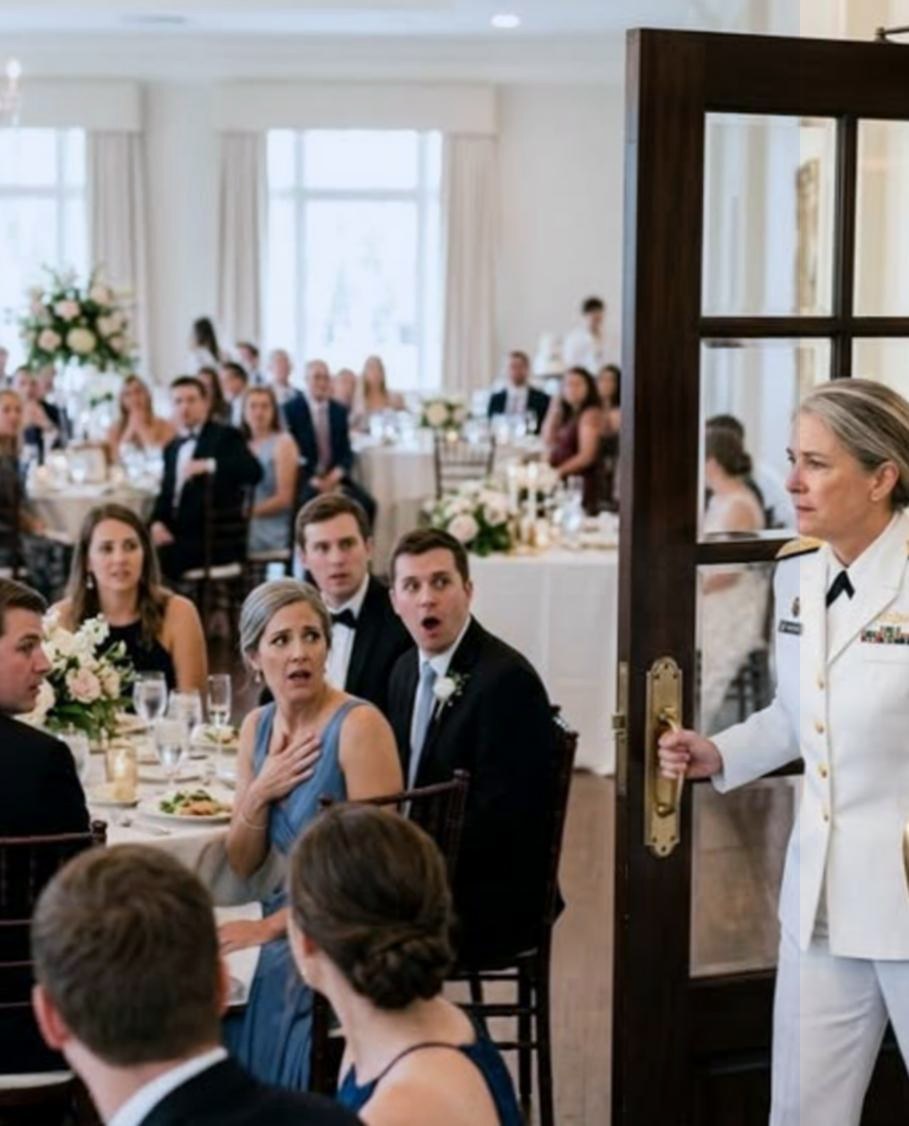

Before I answered the unknown number, Jack grabbed my hand.
“Do not answer. Not yet.”
The wedding music was no longer playing in the hall. A violin had been abandoned near the stage, and one string was slowly, unpleasantly trembling.
Father reached for the phone.
“I will call a lawyer.”
“I already called one,” Jack answered.
“You have no right to interfere in my family!”
“You brought this matter here yourself, Richard.”
Father put the phone to his ear.
“Edward, come down immediately. They have my accounts.”
Within several seconds, his face changed.
“What do you mean, you no longer represent me?”
Every word could be heard in the hall.
Father walked back and forth.
“You told me that the signature would be enough!”
The person on the other side said something.
Father stopped.
“No, that is not my voice.”
Jack placed the recorder on the table.
“Should I turn it on, or will you?”
The lawyer, who entered the hall at that moment, did not even look toward Father.
“Richard, my participation in this case is over. I did not know that there were forged signatures in the documents.”
“You told me Claire would not find out anything!”
Silence fell.
Father heard his own words.
Not through someone else’s interpretation. Not through my anger. In his own voice.
“Claire’s name is enough. The admiral’s seal will frighten people.”

The recording was turned on again.
Father sank into the chair. His hands lay on his knees, and his fingers were trembling so much that his ring touched the wooden floor.
“Turn it off,” he whispered.
“Not me,” I said. “You said it.”
Melanie came over to me. She was holding the paper taken from the folder.
“Why did you not tell me that you needed money?”
Father raised his head.
“You were a little girl.”
“I am twenty-nine years old.”
“I was protecting the family.”
“You were not protecting the family when you convinced my sister that I was an admiral only in name.”
Melanie stopped crying. In her eyes, for the first time, there appeared not fear, but a clear decision.
“The wedding is not canceled,” she said. “But I want nothing more from you.”
Two investigators appeared at the outer door. They had a court warrant in their hands. Nobody shouted in the room. Nobody applauded.
One of them said calmly:
“Richard Bennett, please come with us.”
Father looked at me.
“Claire, tell them this is a mistake.”
For a long time I looked at the man whose approval I had waited for all my life.
“This was not my decision,” I told him. “But this is the result of your choice.”


After that I returned home only once.
On Monday, at six in the morning, I entered the bedroom. Not a single photograph of me hung on the wall anymore. Empty hangers had remained in Father’s closet. Under the bed I found the old uniform garment bag that I had taken to the wedding.
I looked at that small metal button.
One corner of it was slightly broken, but it still shone.
My first senior officer used to tell me that a good uniform had to carry every scratch. Otherwise, it would only be clothing.
Three weeks later, a case against Father was officially opened. The investigation confirmed that money from the foundation had gone to cover his company’s debts. My signatures had been made on a typewriter, while several recommendations had been prepared by an entirely different person.
I gave testimony.
Calmly.
Not once did I say that I wanted to destroy him. I only said what I knew.
Melanie’s wedding still took place a week later. In a small garden, under Charleston’s old oaks. That day Jack stood beside me, while more than two hundred former special forces soldiers simply played the role of guests.
Nobody stood up because of my rank.
This time they stood up for Melanie.
Months later I rented a small house near the Virginia coast. Every morning I walked toward the harbor, drank black coffee, and helped new employees begin life after military service.
For the first time in my life, I was not trying to prove to anyone that I mattered.
One evening Melanie came to me. She was holding a drawing by a little girl.
“Lilia drew this,” she told me.
In the drawing, a woman stood in a white uniform. Beside her was a little girl holding a golden circle in her hand.
“What is that?” I asked.
“A star,” Melanie answered. “Lilia said that Aunt Claire is not in the sky. She is here.”
I attached the drawing to the refrigerator.

Several months later Father sent me a letter. Only three sentences were written.
“Come, let us talk. The lawyer says that your testimony can change a lot. I am still your father.”
I put the letter on the kitchen table.
Jack, who was with me that evening, asked:
“Will you answer?”
“I already answered.”
“What did you tell him?”
“That the truth in his case would change only if he admitted the truth. And I will not go back.”
Father called me two more times. Once he left a voice message, but he could not record it to the end. His breathing could be heard, and then a low voice:
“Claire, I just want you to be my daughter again.”
I did not touch that message.
I had always been his daughter.
I simply finally stopped abandoning myself.
On the morning of the first winter, when a thin layer of snow fell in the harbor, I took the uniform bag out of the closet. I removed the small metal button, placed it beside the drawing, and opened the window.
From far away, a ship’s siren sounded.
This time the sound no longer resembled pain.
I smiled and closed the door.
My life was no longer waiting for them to see me.
I was already seeing myself.
Missed the beginning?
Related posts:
 On the morning after the wedding, my husband threw a greasy cloth in my face and called me a servant, but after my calm smile, his mother turned pale
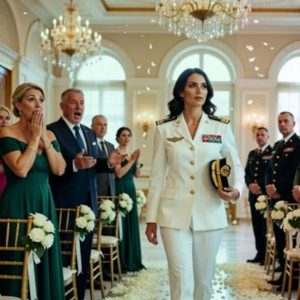 My family asked me not to wear the uniform, but when I entered the hall, my father’s face suddenly went pale
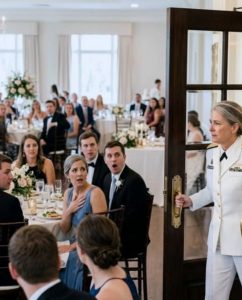 My Father Told Me Not to Wear the Uniform to the Wedding — But Hundreds of Sailors Stood Up the Moment I Entered the Hall, and Father Turned Pale
 My Fiancé Abandoned Me at the Altar, but a Strange Man Looked at My Daughter and His Smile Immediately Disappeared
 My Father Was Fed by a Poor Woman at Night, but When I Followed Her Trail, a Stranger’s Face Suddenly Turned Pale
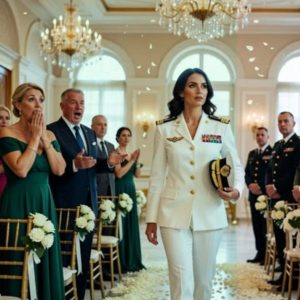 Part 4 — My family asked me not to wear the uniform, but when I entered the hall, my father’s face suddenly went pale