
That morning, when the lawns of the lakeside estates were covered by brown water, I felt no victory at all—only nausea overcame me.
Six weeks earlier I had explained to them exactly what would happen if they continued pouring concrete into the stream.
I am Jack Miller, forty-two years old, a former civil engineer. From my father I inherited twelve hectares: an old house, a barn, a wooden bridge, and a small spring-fed lake. One stream ran across our land. My father taught me to fish there, and I rebuilt the bridge with logs taken from the barn.
Back then no one complained. Everyone knew that this stream was not merely a beautiful sight. It carried water.
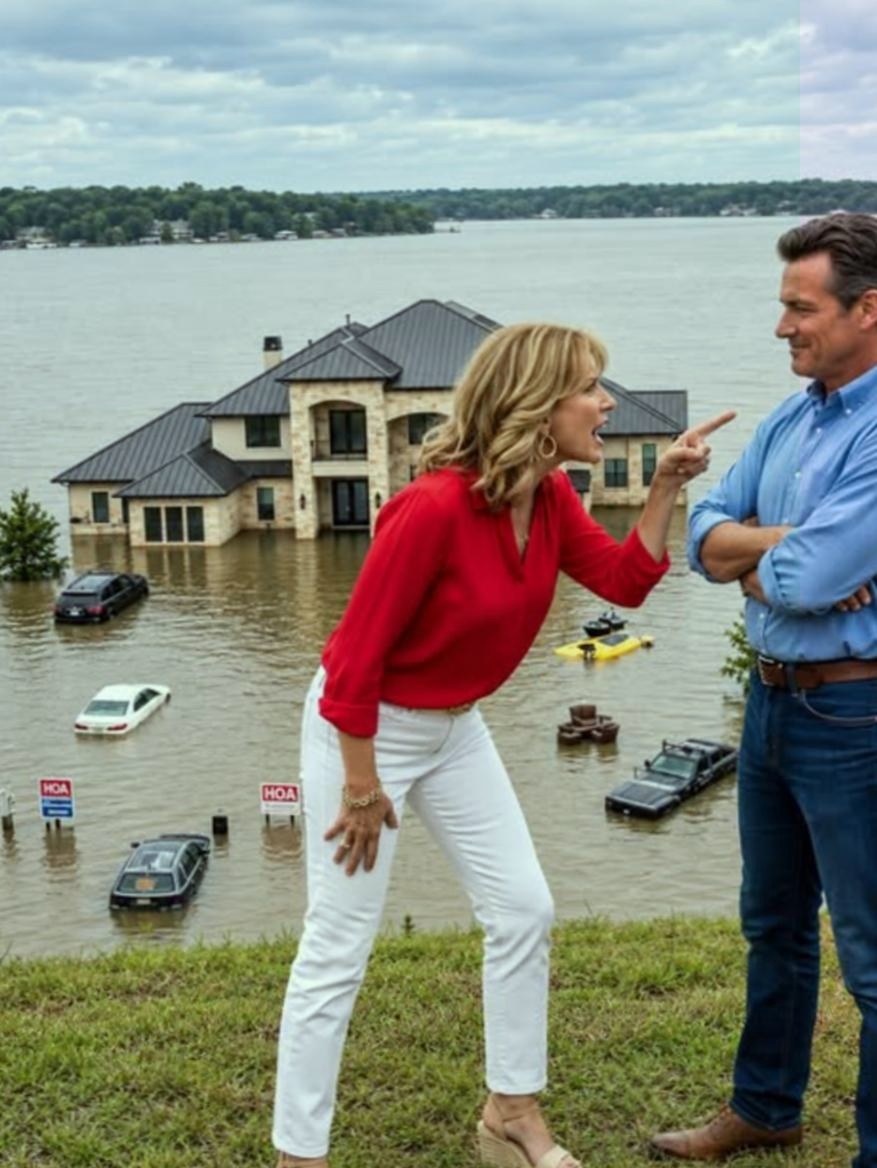
Five years ago, thirty-three luxury houses were built on the farm land below. Huge glass walls, stone terraces, private docks, and perfectly trimmed grass. Their association was led by Karen Adams—with short blond hair, large glasses, and a folder she never let out of her hands.
At our very first meeting she told me that my dock did not fit their “lakeside color palette.”
“My dock stood here before you,” I told her.
“We need a unified appearance.”
“And I need to catch fish.”
From that day on, Karen was annoyed by my existence.
I received letters about the grass, the firewood, and the bridge. Once I was informed that the bridge was “visually incompatible.” I kept everything, but rarely replied.
One morning in March, Karen came with two consultants. In her hands she held an unfolded, glossy plan.
“We are beginning to improve the stream,” she told me.
“What does improvement mean?”
“Strengthening the banks, narrowing the channel, controlling the flow, and partially redirecting it.”
I looked at the plan. It showed beautiful stones, a walking path, decorative plants, and a much narrower stream.

“You are reducing the water-carrying capacity.”
“We are improving the neighborhood.”
“This is not decoration. During heavy rain, water comes here from hundreds of hectares.”
Karen adjusted her glasses.
“You cannot own the water, Jack.”
“Not the water. But I own this land, and you cannot remake my stream.”
Three days later orange markings appeared on my land. Then came a demand that I remove the “incompatible vegetation.” The inspector saw everything and left. Then Karen’s workers began cutting the wild bushes along the bank.
“Get out of here,” I told them.
“We have orders from the association.”
“Now you have orders from me.”
They left, but that evening they blocked the shared access road.
I recorded everything: dates, photographs, videos. I did not yet know what I would need it for.

At the beginning of June the stream changed. The flow slowed, the water stood higher at the banks, and where clean stones had once been visible, thick sediment accumulated. For forty years I had watched the same water, and they could not slip something like this past me.
One morning I found the tracks of heavy tires on the bank. Gray powder lay beside them.
Cement.
I called my former colleague, Larry Daniels. He had worked on drainage systems for thirty years.
“Before you touch anything, photograph everything,” he told me.
The next morning I followed the stream downstream from the bridge. Beyond the trees, two workers stood knee-deep in the water. A form had been set up between them, and a new concrete wall was already blocking part of the stream.
“Do you have permission for this?” I asked.
Both of them froze.
“We are only following instructions.”
“Whose instructions?”
They did not answer.
I returned home and went to my father’s old cabinet. Behind the tax papers, in a yellowed folder, I found a 1948 agreement. It said that this stream was part of the regional rainwater system and that no one could obstruct the natural movement of water in its channel.
Larry looked at the document for a long time.
“If rain comes, the water will first return to your land,” he said.
That evening heavy clouds gathered in the western sky. I copied all the photographs from my camera and prepared letters for the county and the environmental protection service.

Then a notification came from my camera.
There was movement by the stream.
Karen was standing in the picture. She was pointing at the concrete wall with her finger, while two workers were loading more new bags.
In the second picture they already had a new form set in the water.
I gripped the phone so tightly in my hand that my fingers turned white. I realized they were not correcting the obstruction.
They were going to finish it.
I took the folder from the house and ran toward the door, but at that moment a black car entered the yard. A woman got out of the car, holding a document certified with an official seal, and walked straight toward me…
The woman stopped on my porch at seven in the evening. The first drops of rain were hitting the wooden railing.
“Jack Miller?”
“Yes.”
“I am a representative of the county water service. I need to speak with you today about what happened at the stream.”
I opened the folder.
“I was about to do exactly that.”
She placed her hand on the document.
“You must see this first. Karen Adams reported that you are arbitrarily changing the water channel and endangering the association.”
I wanted to laugh, but it got stuck in my throat.
“She poured concrete on my land.”

“We are checking that.”
At that moment Karen appeared at the far end of the yard. She was holding a white umbrella and had a calm smile on her face.
“At last, you are all here,” she said.
“Stop the workers today,” I told her.
“We are doing nothing on your land. This is a shared drainage strip.”
The woman pursed her lips.
“Ms. Adams, if you do not have permission, the work will stop.”
For the first time Karen had no answer.
Thunder sounded in the distance. The stream made a strange, low sound, as if something were awakening beneath the earth.
Karen looked at my folder.
“What do you have there?”
“What you are trying so hard to see.”
She held out her hand.
But before I opened the folder, the water-service representative looked at her phone and her face changed.
“I received a new notification,” she said. “The concrete work has already been completed, and someone sent them a permit in our service’s name…”
Karen’s smile disappeared immediately.
“That is impossible,” she said.
The woman was looking at the phone, and a copy of an email was visible on the screen.
“The letter was sent from our address, but no one issued such a permit.”

I opened the folder and took out the 1948 agreement. The dark stains left by my father’s fingers could still be seen in the corners of the paper.
“This is the genuine document,” I said. “This stream is part of the regional drainage system. Any artificial obstruction is illegal.”
Karen snatched the paper from me.
“You cannot frighten me with an old sheet of paper.”
“It is not an old sheet of paper, but a valid right of ownership and water use,” the woman said. “And now I see that you knew this.”
“I only wanted to improve the neighborhood!”
“Then why did you pour concrete without permission?” I asked.
“The engineers told me it was safe.”
“Which engineers?”
Karen fell silent.
At that moment Larry entered the yard. He was holding a measuring instrument, and water was dripping from his muddy shoes.
“I took measurements,” he said. “The channel’s capacity has been reduced by almost half.”
The water-service representative lowered her eyes.
“During the first heavy rain, the water will back up.”
“Onto my land,” I said.
“And then it will move toward the lakeside houses.”
Karen raised her voice.
“You have no right to put our houses in danger!”
“You put them in danger,” I replied.
Larry spread the camera pictures out in front of her. In one, Karen was pointing the workers toward the concrete form. In another, bags were being unloaded from the trunk of her car.

The color drained from the woman’s face.
“It was only a work meeting.”
“No,” I said. “This is your order.”
At that very moment lightning tore across the sky. Within seconds such rain began to fall that the stones in the yard looked like a glass surface.
The phone rang. Karen answered it.
“What happened?” she asked.
Shouting could be heard from the other side. She said nothing at first, then looked toward me.
“Water is entering the lower street,” she said quietly.
Larry raised his head.
“This is only the beginning.”
Karen disconnected the phone and came closer to me.
“Jack, I need your help.”
“You were warned six weeks ago.”
“If we do nothing now, my house and the entire neighborhood will flood.”
“My land is already flooding.”
For the first time she saw that I was no longer going to back down.
But then the water-service representative’s phone rang again. She heard several words and turned completely pale.
“What is it?” I asked.
She looked at me slowly.
“Someone entered a false document with your signature into the county system. And now the investigators are saying that you are the first official person responsible for the flood…”
კარენმა საკუთარი სიტყვები პირველად სხვებისგან მოისმინა…
ფინალში ყველაფერი იმაზე მძიმე აღმოჩნდა, ვიდრე წვიმა და წყალდიდობა. მე კი პირველად მივხვდი, რომ სიმართლის დაცვა შურისძიებას არ ნიშნავს.
„ჯერ ჯეკის მიწაა. მერე ყველაფერს მის წინააღმდეგ მივაბარებთ.“
კარენმა თვალები დახარა.
👇 ისტორიის ფინალი უკვე გახსნილია
Related posts:
 Karen blocked my truck on the road and told me she would move when she wanted — but she fell silent at my answer
 Part 4 — On My Land They Blocked the Stream with Concrete, and I Gave a Warning — Six Weeks Later Karen Froze
 La presidenta de la comunidad hizo retirar mi contenedor de madrugada, pero al ver quién llegó a mi puerta dejó de sonreír
 Three Weeks Before the Wedding, I Canceled Our House, but When I Asked Lukas One Question, His Smile Disappeared
 They Were Building a Twelve-Million-Dollar Fire Station on My Ranch, but When I Put the Old Document on the Table, the Mayor’s Face Suddenly Went Pale
 A Flat Tire Stopped Me at a Desert Diner, but When the Waitress Heard My Name, the Color Drained from Her Face