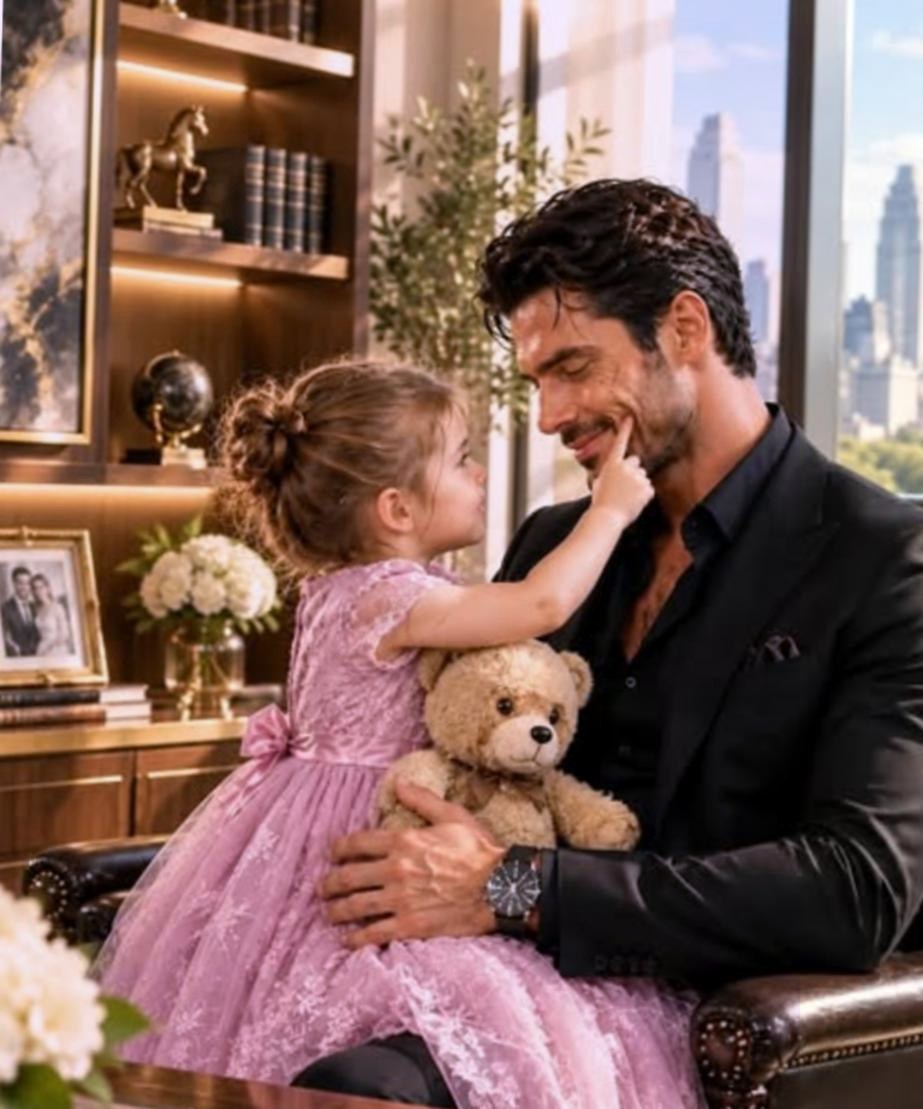

Jude squeezed the phone so tightly that his knuckles turned white.
“Who is it?” I asked.
“Tristan.”
The name sounded again in the basement, but this time nothing broke inside me. Only cold remained there.
Reggie stood by the door and had difficulty breathing.
“He knew I had the recording,” he said. “That is why he disappeared.”
“Where did he take the child?” Jude asked him sternly.
“I don’t know.”
Jude moved one step closer.
“That is the wrong answer.”
Reggie lowered his eyes.
“The old harbor warehouse. Number eight. But he will not be alone there.”
Jude called security, then called the police station and sent the recording directly to the investigator. I leaned against the wall. There was no strength left in my legs.
“I want to bring Brinley back,” I said.
“You will bring her back,” Jude replied. “But there you will walk behind me.”
“I am not hiding behind you anymore.”
His gaze met mine.
“I know.”

It was eleven twenty at night when the black cars set off toward the harbor. Rain struck the windshield as if someone outside were tapping their fingers. My hands rested on my knees. Between them I held Brinley’s one-eyed teddy bear.
Jude was behind the wheel.
“Are you afraid?” he asked me.
“So much that my teeth are chattering.”
“And you still came.”
“Mothers sometimes move even with fear.”
The warehouse was almost invisible in the fog. The iron door was half open. From inside, in the darkness, I heard a child crying.
“Mommy!”
I ran toward the door, but Jude caught my hand.
“Wait.”
Tristan came out of the darkness. Bearded, exhausted, and bloody. In one hand he held Brinley, and in the other a small knife.
Brinley was crying, but she was still clutching the teddy bear to her chest.
“One step and…” Tristan roared.
“Take your hand off my child,” I said.
“Give me the documents first.”
“Your documents are already with the police.”
Tristan’s face twisted.
“Mercer has poisoned your mind.”
“No. You told me the truth yourself. On the phone. Do you remember?”
He looked at me.
“What?”
Jude raised his phone and played the recording.
Tristan’s own voice, cold and confident, rang through the walls of the warehouse:
“A mother will sign everything when you threaten her child.”
Tristan froze.
For the first time I saw on his face not strength, but the fear I had carried for three weeks.
“This… this is another conversation.”
“Those are your words,” I said. “That is your voice.”
“Elena, listen to me. I needed money. Everything would have been fixed.”
“By killing my child?”
“I was not going to kill her!”
“But you were going to use her.”
Brinley lifted her head from his chest.
“Daddy, are you lying to Mommy?”
Tristan’s hand moved.
That was enough.
Jude acted with lightning speed. He grabbed the child, pulled her behind himself, and twisted Tristan’s wrist. The knife fell to the floor. Within several seconds, the police officers put handcuffs on Tristan.

I hugged Brinley to my heart.
Her hair still smelled of vanilla.
“Mommy, it hurts,” she whispered to me.
“I know, little one. Now we are going home.”
The police officer also brought Reggie out. He stopped beside me.
“You will not survive if you trust Jude,” he whispered.
Jude heard him.
“I ask nothing of her,” he said. “She has already saved herself.”
The next morning everything happened quickly. The documents concerning the debt were sent to court. Experts declared the signature forged. The bank froze the accounts. Tristan was charged with fraud, child abduction, and threats to life.
Reggie testified in order to lessen his sentence, but his lawyer refused to defend him when he saw the recording and the camera footage.
And Jude laid all the documents out with me on the kitchen table.
“You are free,” he told me.
“The job?”
“You do not need it anymore.”
“And the debt?”
“It was never yours.”
Right then he told me what I least expected.
“On the day your husband came, I refused to give him money. He took part in my brother’s death. I could have told you everything from the beginning, but I knew that a frightened woman would not see the truth. So I assigned protection to you and did not let Brinley leave the room.”
“But why did you protect us?”
Jude looked out the window.
“Because once I also believed a person who told me that he was protecting his family. In the end I lost my brother. I did not want you to be sacrificed to someone else’s crime too.”
Three days later I opened the door to the east wing. The room was empty. On the table lay only the little brass bell I had first seen. Jude had repaired it for Brinley and attached the bear’s lost eye with a new black thread.
Brinley hugged the teddy bear to her chest.
“Will he not be sad now?”
“Who?”
“Jude.”
I looked toward him. He stood in the doorway, but this time he had no weapon.
“Sometimes he will be sad,” I said. “But he will not be alone anymore.”
Jude said nothing. He only nodded.

Six weeks later I left Providence. Jude helped me find an apartment in a small coastal town, but I paid the rent with my salary. He opened a door to my life, but he did not enter inside without my permission.
In the mornings I worked at an elderly center. In the evenings I read books to Brinley. The sea could be seen from the window of our new apartment. For the first time in a long while, I no longer checked the door lock three times before going to sleep.
Brinley drew her first picture in kindergarten. Three people stood on the page: me, herself, and a very large man who had a crooked line on his cheek.
“Is it Jude?” I asked.
“Yes. He is not ugly anymore.”
“Why?”
“Because now he laughs.”
That same evening I received a letter from Tristan. Only two sentences were written: “Elena, I made a mistake. I miss Brinley. Meet me just once.”
I held the letter in my hand for a long time.
Then I asked Brinley:
“Do you want to meet your father?”
She looked at the teddy bear. The teddy bear’s new black eye stared directly at the ceiling.
“No, Mommy. I want to be home.”
I folded the letter and put it in the trash can.
I did not write to Tristan again.
Not because I wanted him to be punished.
I simply was no longer obliged to add my remorse to his crime.
Months later, on the first snowy morning, Brinley hung the brass bell by the window. The wind touched it, and a light tinkling sounded in the room.
That day Jude sent a short message: “I have not forgotten Brinley’s birthday.”
I answered: “Neither has she.”
In the evening a small package was waiting at the door. Inside were new paints, sea-colored sheets of paper, and one short letter: “If you ever need us, call me. If not, still be at peace.”
I placed the letter inside a book.
Brinley hugged the teddy bear to her chest and came to me.
“Mommy, why is the bell ringing?”
I went to the window. Snow was falling silently onto the street. The little brass bell swayed in the wind, but this time its sound no longer meant danger.
“Because someone closed the door,” I told her.
“Who?”
I kissed Brinley on the forehead.
“We did.”
The bell rang once more.
And for the first time, that sound resembled freedom.
Missed the beginning?
Related posts:
 My three-year-old daughter touched the most dangerous man’s face in the forbidden room — and his reaction froze everyone
 I Entered the Patient’s Room and Looked at the Unknown Millionaire Whose Car I Had Fallen Asleep In — His Mother’s Smile Suddenly Disappeared
 Part 4 — I Entered the Forbidden Compartment to Save a Child, but When the Billionaire Saw My Bag, the Color Left His Face
 Part 4 — I Entered the Patient’s Room and Looked at the Unknown Millionaire Whose Car I Had Fallen Asleep In — His Mother’s Smile Suddenly Disappeared
 I Entered the Forbidden Compartment to Save a Child, but When the Billionaire Saw My Bag, the Color Left His Face
 A Flat Tire Stopped Me at a Desert Diner, but When the Waitress Heard My Name, the Color Drained from Her Face