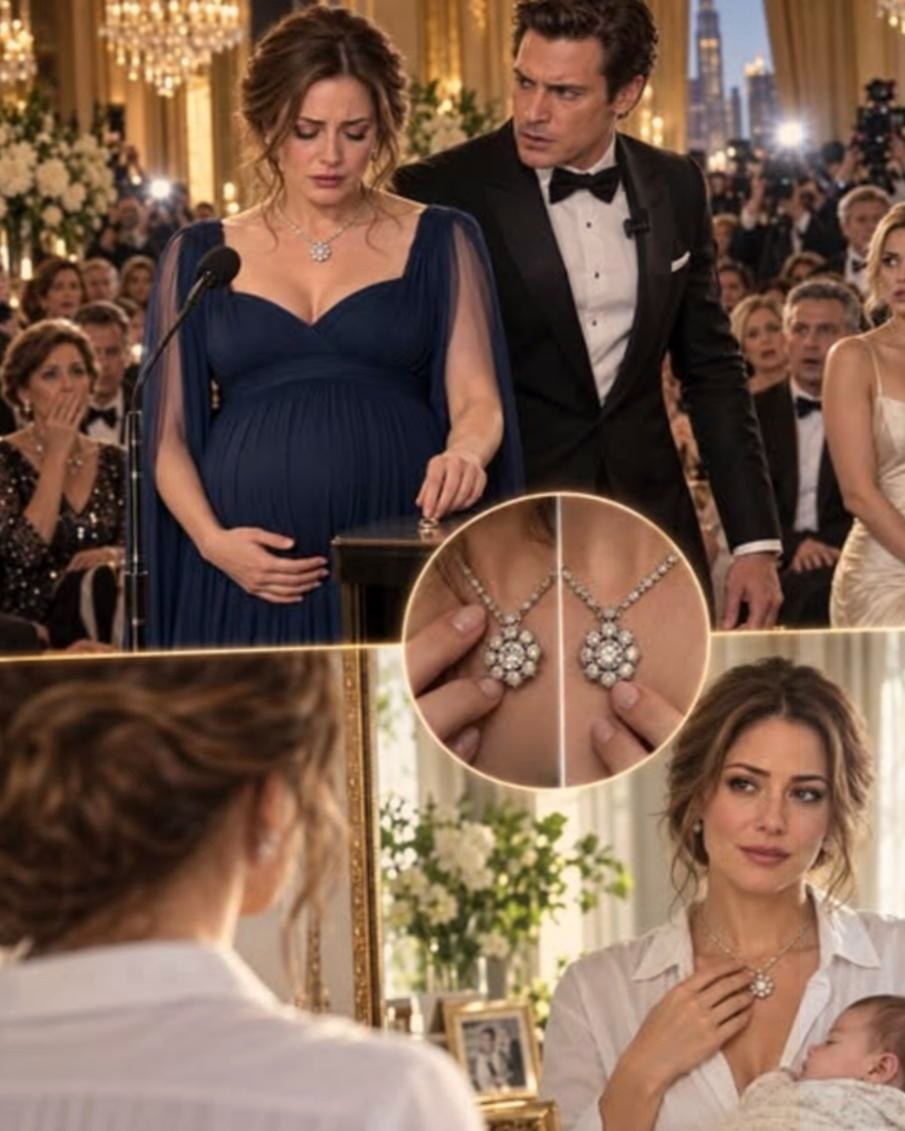

Carter still thought that his word would decide everything at the clinic.
But I left the hall together with Nora.
It was eleven o’clock at night. At the hotel entrance, rain broke apart into small silver lines on the asphalt. Security guards stood on both sides of the door. Journalists shouted questions.
“Mrs. Whitmore, is it true that your husband was planning to take the baby away?”
“Why was Vanessa wearing your necklace?”
“Is Carter guilty?”
I did not stop.
I still did not want revenge. I wanted only one thing: for my child to have a life where the truth would not be spoken in whispers.
As soon as I got into the car, the phone rang.
It was Carter.
I did not answer.
He called again.
Then Margaret called.
Then Carter’s lawyer.
Nora looked at the phone.
“Is he asking to meet now?”
“He probably wants to regain control.”
“Do not give him that opportunity.”

On the third call, Carter’s voice message was recorded.
“Emily, enough. All of this is a misunderstanding. Come home and we will settle everything.”
Then a second message arrived.
“If you do not come back, I will take care of the child’s safety.”
Nora lowered her eyes.
“That is a threat.”
“I know.”
The car headed toward the clinic.
At fifteen minutes past midnight, Dr. Rosen met us at the entrance. He held a brown folder in his hand. His hair was stuck to his forehead from the rain.
“The records were definitely changed,” he told me. “But that is not all.”
“What else did you find?”
The doctor opened the folder.
“After the last visit, the cameras recorded Carter’s mother. She entered the registration room and changed the instruction about the baby’s birth. But the most important thing is in another recording.”
He switched on a small device.
Carter’s voice sounded in the corridor.
“If the child is registered in my name, Emily will no longer be able to do anything. We will convince everyone that she is unstable.”
I had already heard this voice, but this time it sounded different.
Not like a husband’s whisper beside my ear.
Like a stranger’s confession.
Carter was saying it himself.
Every one of his words.
His breathing.
His laughter.
For the first time I heard my own pain from the outside and realized how long I had been trying to change its name for him. I called threats tension. Deception—care. Fear—a family problem.
“Will this recording be enough?” I asked.
Nora nodded.
“Used together with this, the financial documents, and the medical conclusion, it will be enough so that no lawyer can hide the truth.”

In the morning Carter came to the clinic.
He was still wearing the black tuxedo. Only the collar was slightly crooked. His eyes were red, but a remnant of the old smile still held on his face.
“Emily, come home,” he told me.
“It is no longer my home either.”
“It is our home.”
“No. It was a place where everyone was afraid of your words except you.”
Two investigators stood behind him.
Carter saw them and turned to Nora.
“This is a private family matter.”
“No,” Nora replied. “Forged signatures, embezzlement of funds, and an attempt to place a pregnant woman under forced control are no longer a family matter.”
Carter took a step toward me.
“You will regret this.”
I looked at him calmly.
“I already regret only that I believed you for so long.”
The investigator opened a folder in front of him.
“Mr. Whitmore, you must come with us to answer several questions.”
For the first time, Carter stopped giving orders.
“My lawyer will come.”
“You will wait.”
Margaret was arrested that same day on charges of embezzling foundation funds and forging documents. Vanessa gave testimony. At first she was afraid. Then she said that Carter had given her the necklace and told her that I would never ask for it again.
“I thought he had finally separated from you,” she told me.
“He had never separated from me,” I answered. “He simply wanted control over me.”

I entered Carter’s office one last time.
The room was empty. On the wall, only one bright rectangle remained where our wedding photograph had hung. In the desk drawer, however, I found a small velvet box.
My grandmother’s necklace box.
Empty.
At that very moment I understood that Carter had never intended to return the item. He wanted me to find an empty place every day and begin doubting my own memory.
The necklace, however, was recovered by the police from Margaret’s safe three days later.
When I held it in my hands, the diamonds were cold. As cold as my fingers had been that night when I discovered the empty box.
But now my hands were no longer shaking.
Three months later my daughter was born.
It was five o’clock in the morning in the clinic room. The first snow was falling outside the window. A little girl lay on my chest and clung to my robe with her fingers.
Nora stood by the window.
“Have you decided on a name?”
“Lea.”
“That is a beautiful name.”
“It was my grandmother’s middle name. She believed that a person must always have a place they can return to.”
Lea opened her eyes and looked at me as if she already knew me.
“You will no longer need to return,” I whispered. “We will leave from here.”

Several weeks later I rented a small apartment in the northern part of the city. Trees could be seen from the window. In the morning I prepared Lea’s milk bottle, and then went to my new job.
I was no longer only Carter Whitmore’s wife.
I began working in the charity foundation’s audit group. I helped people whose money had been stolen by others. With my first salary, I bought Lea a small wooden bed. I hung her drawing on the wall: three figures, a yellow sun, and a house that had a large door.
“Who is this?” I asked.
“Me, you, and the house,” Lea told me when she was already four years old.
“Why is the door so large?”
“So that no one can lock us in.”
Her answer struck me so hard that for several seconds I could not make a sound.
The court sentenced Carter to imprisonment and confiscation of part of his property. The foundation’s money was returned to the victims. Margaret never apologized. Vanessa left the city and once sent me a letter in which there was only one sentence: “That night I understood for the first time whose side I was standing on.”
I did not write an answer to her.
Years passed.
One winter evening, when Lea returned from school, I found an envelope at the door. I recognized Carter’s handwriting.
“I want to see my daughter. Now I understand everything. People have changed. I have changed too.”
I held the paper in my hand for a long time.
Earlier, I would have cried all night over such a letter.
Now I sat down at the kitchen table and looked at Lea’s drawing.
Then I called Nora.
“Should we send an answer?” I asked.
“The decision is yours.”
“Then it will be short.”
I sent Carter only one sentence.
“My daughter’s peace is no longer your right.”
I tore the envelope and put it in the trash bin.

That night I placed my grandmother’s necklace in a small wooden box. I no longer kept it in a safe where someone else could hide my things. Lea opened the box and looked at the diamonds.
“Is this yours?”
“Now it belongs to our family.”
“Then I will keep it.”
“No,” I smiled. “You will wear it when you yourself want to.”
Outside the window, snow was falling silently. Lea’s fingers were in my hand. And my grandmother’s necklace glittered beneath the lamp as if all this time it had been waiting for one thing.
For me to become myself again.
This time I left the door open.
Missed the beginning?
Related posts:
 I took off my wedding ring while receiving a charity award on stage, and my husband’s smile immediately disappeared
 When my husband spoke about me in English to his family, I understood everything and watched his smile disappear
 For years, my family did not invite me on vacations, but when they saw my villa, Lea fell silent and her face changed
 The Video Sent on Our Wedding Anniversary Revealed My Husband’s Betrayal, but One Reflection Suddenly Erased His Smile
 When They Mocked My Mother’s Truth in the School Hall, the Admiral Saw My Name and Immediately Turned Pale
 My Fiancée Was Not Given a Place on the Family Vacation, but After My Response, the Smile Disappeared from Her Mother’s Face