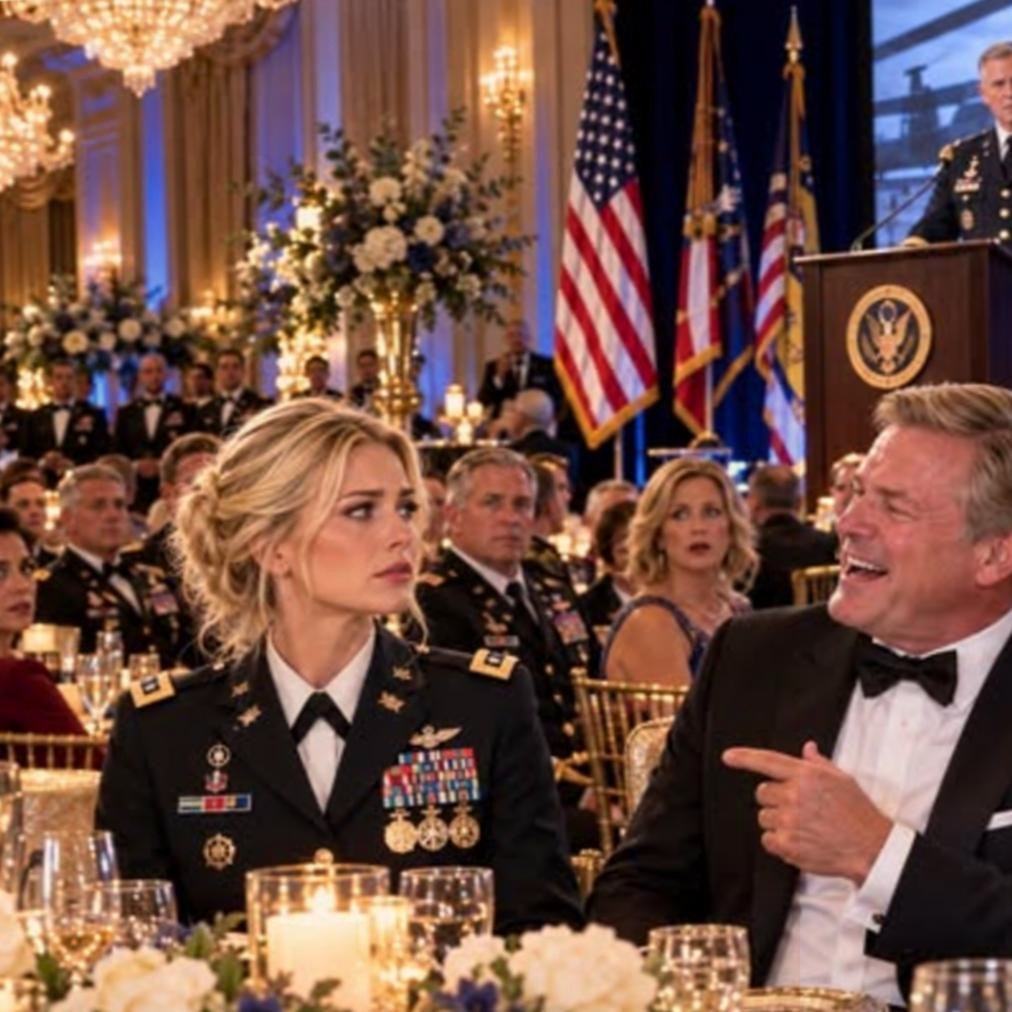

My hand froze around the phone.
My father looked at me immediately.
“Show me.”
“No.”
“Harper, this could be a threat.”
“You care now?”
Caldwell held out his hand.
“Give it to me. I will immediately hand it over to security.”
I gave him the phone. Carter had already checked the doors and called security. Guests in the hall were whispering. Several people were heading toward the exit, as if the danger had touched them too.
My father stood beside me.
“I will handle it.”
“What will you handle?”
“I will call lawyers.”
“That is your usual answer to everything.”
He took out his phone and dialed the first number.
“Richard, I urgently need your help.”
He received an answer after several seconds. My father spoke quietly, but control was slowly falling apart on his face.
“No, this is a family matter… no, I do not want the police here… Richard, listen to me.”
A little later the call ended.
“What did he say?” I asked.
For the first time my father could not answer me.
Caldwell told me that the message was not simply a threat, but had been written using the internal code of the old operation. Only the crew, the command, and the authors of the report had this code.
“Someone wants you to stay silent,” he said.
“I have already been silent for four years.”

At that moment the recording started playing on the screen again. The technician had accidentally left not the full video, but the audio. My voice rang out in the hall.
“We are not turning back.”
Then another voice was heard. A man’s. Stern, recorded from far away.
“Quinn, leave the valley immediately.”
I answered:
“There are people on the ground.”
“That is an order.”
“Then come yourself and tell them to wait for death.”
The hall fell silent.
Those were the words I had never heard about myself. Now they reverberated from the walls and forced themselves upon me in front of everyone’s eyes.
My father sank into a chair.
“I did not know this.”
“No,” I said. “You did not want to know.”
Caldwell announced to me that the Department of Defense would open an official investigation. But before it was completed, I had to give a written statement.
“I will give it,” I said.
At that very moment two investigators entered the room. One of them held a sealed folder.
“Harper Quinn?” the woman asked.
“Yes.”
“This is a statement prepared years ago in your name. You never signed it.”
She opened the folder and handed me the first page. It said that I had intentionally ignored the order in order to appear as a hero.

My father looked at the document.
“Who signed this?”
The investigator turned over the sheet.
“Your company’s law firm paid the report’s ‘consulting expenses.’”
My father stood up.
“That is impossible.”
“Then explain why money was transferred from your company’s account to the account of a military contractor.”
His face went pale.
And for the first time I realized that in this story it was not only my military service that he had belittled. Someone had turned the story of my life into money.
I did not go home that night. Carter left me in a small hotel room while the investigators questioned me. At four in the morning my father called me.
“Harper, please come home.”
“Why?”
“Your mother’s room is still empty. I looked through your things.”
“Now you remember that I lived there?”
He was silent for a long time.
“I do not know how to fix this for you.”
“You cannot fix it. But you can stop hiding the truth from me.”
Over the following weeks everything fell apart without a trial, but with grim precision. My father’s lawyer refused to defend him when the bank transfers were discovered. The military investigation established that two senior officers had participated in falsifying the report. A case was opened against them.
My father was not arrested. His crime was financial, but the heaviest punishment turned out to be something else: all the people before whom he had appeared as a strong man his entire life saw with their own eyes how he tried to hide the truth.


A month later, at an official meeting, the investigators played me the recording. My father was sitting in the room too.
My voice rang out:
“We are not turning back.”
My father lowered his head.
“You said that?” he asked me.
“Yes.”
“So calmly?”
“In fear, calm was the only weapon I had left.”
He closed his eyes. For the first time he saw not his daughter, but a person whom he had failed to understand and could no longer make smaller.
Three months later I left my father’s house. My room was almost empty. On the top shelf of the closet only one thing remained: an old plastic pass that still had Afghan sand in its corners. A small red helicopter was drawn on it. Carter had given it to me from my first crew and told me that if I ever got lost, I should at least know where I came from.
I took the pass in my hand and looked at the door one last time.
My father was standing in the hallway.
“You can stay,” he told me.
“No.”
“This house is yours too.”
“A house where no one heard my voice is not mine.”

He lowered his head.
Six months later I was teaching the training of military pilots in Washington. In the mornings I brewed my own coffee, and in the evenings I drew routes on the classroom board. Sometimes new trainees asked me whether I really was the pilot whose recording everyone listened to.
“I was,” I answered.
One day a small boy, my nephew Luka, came to visit. He sat on the floor and drew me a helicopter on a sheet of paper. He drew black dots near the windows.
“Are these bullets?” I asked.
“No,” he told me. “They are stars. So that you would not lose the way.”
His words struck me more powerfully than any award.
That same evening my father sent me a letter. It was short.
“I want us to start over.”
I looked at the screen for a long time. Then I replied:
“We cannot start over. But you can continue with the truth. And I will follow my own path.”
I sent the letter and set the phone aside.
Snow was falling by the window. On the table lay that old pass, with a red helicopter and a small trace of sand in the corner.
That night my face did not hurt for the first time.
I found the way.
Missed the beginning?
Related posts:
 My Father Was Fed by a Poor Woman at Night, but When I Followed Her Trail, a Stranger’s Face Suddenly Turned Pale
 My Father Dropped My Military Medal into Mashed Potatoes, but the General Who Came to the House Suddenly Turned Pale
 After My Husband’s and Daughter’s Funeral, My Mother Asked Me for the Insurance Money, but the Bag on My Table Suddenly Erased Her Smile
 An Unknown Man Humiliated Me in Front of Everyone, but the Restaurant Owner Looked at Me Only Once — and His Smile Immediately Disappeared
 A Flat Tire Stopped Me at a Desert Diner, but When the Waitress Heard My Name, the Color Drained from Her Face
 I helped an injured man in an abandoned building, but after my six words, the smile disappeared from his face