
When the doctor asked who had given me the bruises, my daughter smiled and told him I fell so often that I was becoming a danger to myself.
My name is Margaret Hayes. I was seventy-one years old, sitting in a wheelchair beneath the harsh white lights of a Connecticut urgent care clinic, with one eye swollen purple and a deep ache beneath my ribs. Yellow fingerprints circled my wrist like a fading bracelet.
Claire stood behind me in a cream-colored coat, one manicured hand resting on my shoulder. She looked like the devoted daughter people praised in grocery store lines.
“She loses her balance constantly,” Claire said softly. “I’ve begged her not to walk around the house alone.”
The doctor glanced at me. “Mrs. Hayes, is that what happened?”
I lowered my eyes.
Silence had become the safest answer.
After my husband, Thomas, died, Claire and her husband, Ethan, moved into my house “temporarily.” They brought casseroles, flowers, and a file of documents they said would make my life easier. Then my medication changed. My phone vanished. My housekeeper was dismissed. Friends who had known me for decades suddenly stopped calling.
Claire told them I was confused. Ethan told me I was forgetful. Together, they turned my own home into a locked room.
“Just sign here, Mom,” Claire would whisper. “It’s routine.”
I signed powers of attorney, bank forms, and papers I was too frightened to read. When I finally refused to transfer the house, Claire’s gentle voice disappeared.
The first time she shoved me into the kitchen counter, she cried afterward and blamed exhaustion. The second time, Ethan watched from the doorway without moving.
That was when I understood the rules. Eat when instructed. Sleep when allowed. Never argue.
But Thomas had prepared me for a day like this. Years earlier, he made me memorize the number of our lawyer, Michael Grant. He repeated it every night until I could say it in my sleep.
Three days ago, I found Claire’s purse open beside the telephone. I copied Michael’s number onto the back of a grocery receipt, folded it into a square, and hid it beneath my sleeve.
When the nurse entered alone, I pressed the note into her palm.
Her name tag read Emily. She looked at the paper, then at my face.
“Mrs. Hayes,” she whispered, “do you feel safe at home?”
“No.”
Claire’s heels clicked toward the door. It opened, and two police officers stepped inside behind her.
“Thank goodness,” Claire announced, her voice trembling with practiced concern. “She’s having another episode. She may be a danger to herself.”
Emily slid the note into her pocket, then turned toward the officers and reached for the sealed gray folder beneath the examination table…
PART 2
Emily slid the note into her pocket, then turned toward the officers and reached for the sealed gray folder beneath the examination table…
“Before anyone takes Mrs. Hayes anywhere,” she said, “you need to look at this.”
Claire’s expression flickered. Only for a second, but I saw it. The perfect daughter’s mask slipped, revealing something cold beneath it.
One officer, a broad-shouldered woman named Alvarez, stepped closer. Emily gently pushed up my sleeve. The bruises around my wrist were almost gone, but the shape of each finger remained clear.
“These are not consistent with a fall,” Emily said. “They’re defensive injuries.”
Claire gave a short, disbelieving laugh. “She grabs furniture when she panics. She bruises easily.”
“Then why did she give me a lawyer’s number?” Emily asked.
The room went still.
Claire turned toward me. “Mom, what did you tell her?”
For months, I had watched her control every conversation by speaking before I could. This time, I lifted my head.
“I told her the truth.”
Ethan moved forward. “She doesn’t know what she’s saying. She’s under medication.”
Emily opened the gray folder. Inside were printed photographs, copies of prescription changes, and a handwritten log of every injury I had described to her in private. There was also a page showing that my medication had been altered twice without my doctor’s authorization.
Claire’s voice sharpened. “This is ridiculous. My mother is unstable, and these people are encouraging her delusions.”
Officer Alvarez studied the papers. “Who has access to her medications?”
Claire stopped breathing for half a heartbeat.
Ethan answered too quickly. “We both do.”
Emily looked at me. “Mrs. Hayes, can you identify the person who hurt you?”
I stared at the blue thread hanging from Claire’s coat sleeve. I remembered it snagging on my cardigan the night she twisted my arm. I remembered Ethan standing beside the refrigerator, saying nothing while Claire hissed, “You will sign the house over, or you will lose everything.”
“Yes,” I said. “I can identify both of them.”
Claire’s face turned gray. “You’re making a terrible mistake.”
“No,” I replied. “I made the mistake when I believed your tears.”
At that moment, the clinic doors opened. Michael Grant entered carrying a black briefcase. He looked older than I remembered, but his eyes were steady.
Claire stepped between us. “You have no right to be here.”
Michael placed the briefcase on the counter and removed a thick bundle of documents tied with red string.
“Actually,” he said, “I have every right. And before the officers ask you another question, there is something you both need to know.”
He turned the first page toward them. Claire leaned closer, and the color drained from her face.
Then Michael looked directly at me and said, “Margaret, are you ready to hear what Thomas left behind?”…
PART 3
“Margaret, are you ready to hear what Thomas left behind?”
I nodded, though my hands were shaking.
Michael turned the page. “Thomas suspected someone might try to exploit you after his death. Six months before he died, he amended the family trust and placed the house, your accounts, and the remaining investments under independent protection. Claire could not legally sell or transfer anything.”
Claire stared at him. “That’s impossible. Ethan has power of attorney.”
“The document you used,” Michael said, “was signed while Margaret was heavily sedated. The signature was forged, and the witness listed on the form has been dead for two years.”
Ethan’s mouth opened, but no words came out.
Michael continued. “I also received a coded message from Margaret three days ago. She used a phrase Thomas taught her when they first married. I knew immediately that she was asking for help.”
He placed a small recording device on the counter.
Claire’s voice filled the room. “Sign the deed, or I’ll have you declared incompetent. No one will believe you.”
Then came Ethan’s voice, low and impatient. “If she fights, increase the medication.”
I closed my eyes. I had spent months wondering whether I was imagining things. Hearing their voices made the truth solid.
Officer Alvarez looked at Claire. “You’re both being detained while we investigate suspected elder abuse, unlawful restraint, medication tampering, and financial fraud.”
Claire lunged toward me. “Mom, please! I’m your daughter!”
The officer caught her arm before she reached the wheelchair. The blue thread on Claire’s sleeve pulled loose, dangling like a tiny flag of surrender.
“You were my daughter long before you became my jailer,” I said. “But you stopped being my family when you decided my fear was worth more than my life.”
They took Claire and Ethan away in handcuffs. Michael stayed beside me while the clinic staff arranged a protected hotel room and secured every account Claire had tried to access.
The next morning, I returned home. The locks had been changed. My housekeeper came back carrying a paper bag of lemon cookies, and Emily visited with a bouquet of yellow tulips.
Recovery was not instant. Bruises faded faster than fear. For weeks, I woke whenever the floorboards creaked. But slowly, my rooms began to feel like mine again.
Claire and Ethan eventually faced charges for abuse, fraud, and forged documents. The evidence Thomas had preserved—and the note I slipped to Emily—kept them from erasing me.
At sunset, I sit on the porch Thomas built decades ago. His old blue jacket hangs beside the door, still carrying the faint scent of cedar.
My name is Margaret Hayes.
My voice is mine.
And the house is quiet now—not because I am afraid to speak, but because no one is left who can make me silent.
Related posts:
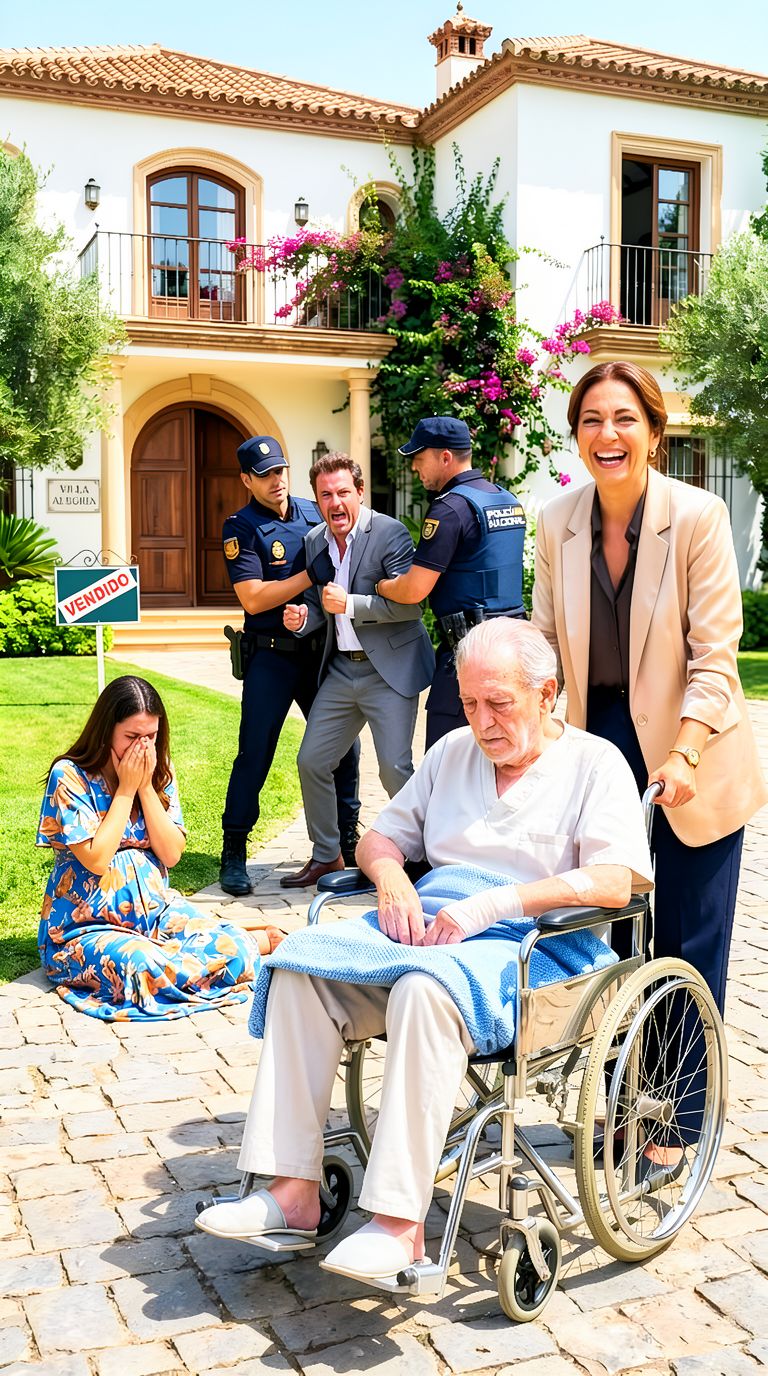 I signed my former father-in-law into emergency surgery while his own son called him too old to save—and then my ex stopped smiling
 Tizenkét napig mozdulatlanul feküdtem a kórházi ágyon, miközben a férjem és a nővérem a halálomra vártak, hogy elrabolják a fiamat és megszerezzék mindenemet
 My husband pushed me from a frozen cliff, then complained at my funeral that I had taken too long to die—and someone went pale
 Enterré a mi esposo y al día siguiente su abogado llegó con una caja de madera; cuando la vio, su rostro perdió todo color
 Mein Mann stellte mir seine Geliebte vor und erklärte mein Leben für gekauft, doch als er den grauen Umschlag sah, erstarrte er
 My Mother Slapped Me in a Hospital Bed When I Refused to Give My Brother $250,000 for His “Business”—Then a Stranger in a Dark Suit Opened the Gray Envelope They Were Desperate to Hide