
“Who requested the loan?” I asked.
The bank employee was silent for several seconds.
“The application was made in Kylie’s name, but your personal information was used.”
Daniel stood by the window. It was no longer raining outside, although the water on the street still glittered.
“Kylie would not dare do this,” he said.
I looked at him.
“She already dared.”
I immediately called the lawyer. In ten minutes he sent me a new letter: we had to submit the video, the camera recordings, and the messages sent by Kylie to the bank.
“They want to regain control,” the lawyer said. “First they disconnected the accounts, and now they are trying to take on a debt in your name.”
“And if we refuse?”
“Then their lawyer will have no way out.”
That same evening Brenda came to our gate. She was holding a new phone in her hand. Kylie was sitting in the car and did not turn off the engine.
I was not going to open the door, but Daniel said:
“Let’s listen at least once.”
Brenda stepped onto the threshold. On her face there was no longer that confident smile I had known for years.
“Mariana, everything has gone too far,” she said.
“You started with a party and continued with a loan in my name.”
“Kylie handled the loan. She made a mistake.”

Kylie looked out from the car.
“I only filled out the documents.”
“Without my consent,” I said.
“You are still our family.”
“Family does not take someone else’s money without permission.”
Brenda opened her bag and took out several papers.
“Your signature is here. No one can prove that I did not know.”
The lawyer stepped forward.
“That is exactly why everything will be proven.”
Brenda turned around.
“Who are you?”
“The person who will stand against you in court tomorrow.”
Kylie got out of the car, but the electronic lock of the gate lit up red.
“My code doesn’t work anymore?” she asked.
“It will never work again,” I answered.
The next day, Monday, at ten in the morning, we met at the police station. There Brenda and Kylie were made to listen to their own recording. A small speaker stood in the room. The metal chairs touched our backs coldly.

In the recording Brenda’s voice could be heard clearly:
“Tomorrow Mariana will come back and we’ll blame everything on us.”
Then her laughter.
Then Kylie’s voice:
“If we make her sell the pool, you will cover the debts too.”
Brenda froze in the chair.
“I didn’t say it like that,” she whispered.
The police officer looked at the voice recorder.
“That is your voice.”
Kylie gripped her hands on her knees.
“Mom, tell them something.”
For the first time Brenda could not help her. She was silent.
When we came out of the hearing, Daniel stood on the sidewalk for a long time.
“All my life I thought helping my mother was my duty,” he said.
“Helping and destroying yourself are not the same thing.”
He nodded.
“I know. I just realized it late.”
The following weeks filled with calls, bank letters, and meetings with the lawyer. Brenda first sent me an apology letter. Then an angry message. Then another apology.
“Let’s settle everything as a family,” it said at the end.
I did not answer.
The case ended simply in court. Because of the video, the damage bill, and the false statement, Brenda and Kylie were ordered to pay the pool repair costs, legal expenses, and the fine imposed for insurance fraud. The debt on their house increased, but my house and my name remained protected.


I was not happy about punishing them.
I simply was no longer going to pay the consequences of their decisions myself.
The hardest moment came after the court. The lawyer played an old voice message from Brenda in which she said:
“Mariana will pay anyway. She loves the family more than herself.”
Brenda listened to her own voice and could no longer look us in the eyes.
Daniel lowered his head.
And for the first time I understood how long I had been humiliating myself in the name of peace.
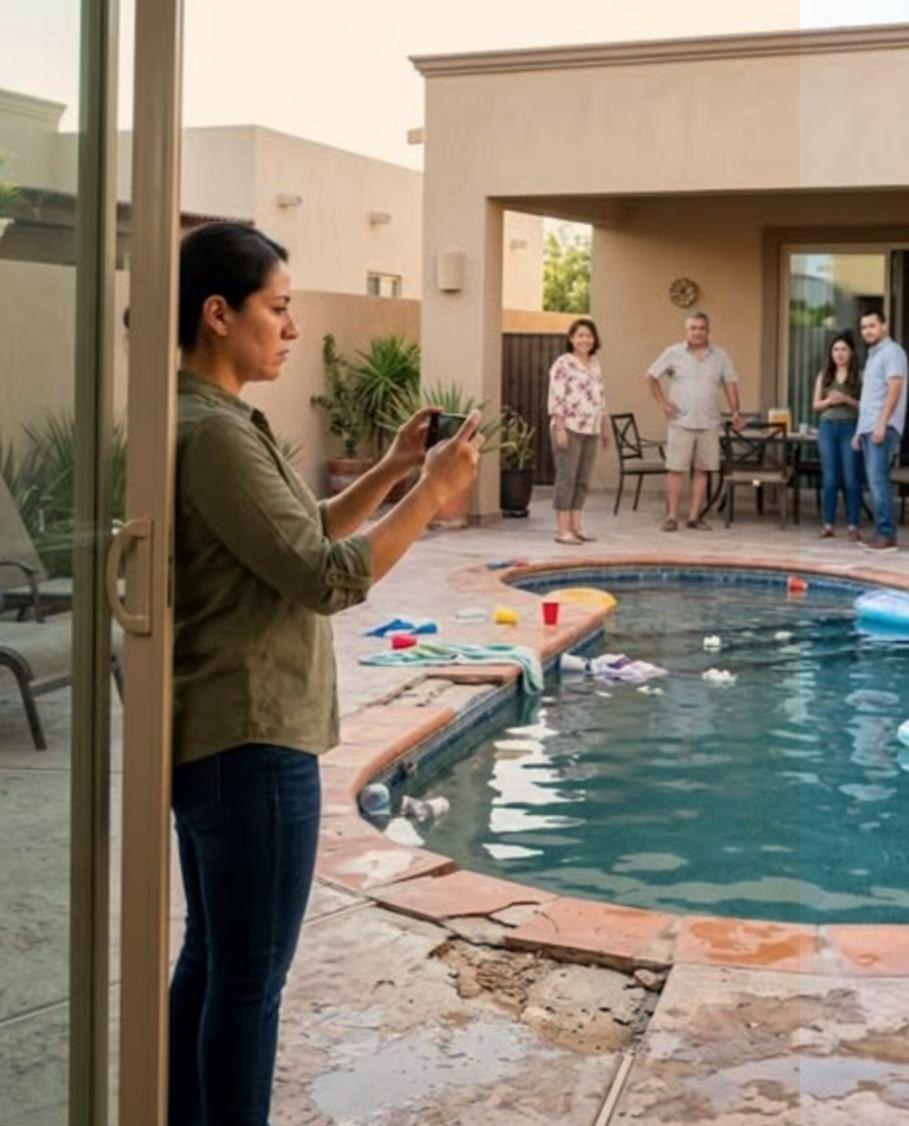
A month later the pool became transparent again. We replaced the filter. We cleaned the stone floor. But the doors to the guests were no longer opened to everyone.
Only one thing remained in the yard: Brenda’s golden glasses, which I found by chance in the box of belongings. The police returned them to me as evidence. I put them on a small shelf, not to punish Brenda, but so that I would never forget where I drew the line.
Three months later we moved to a neighborhood in a new city. Daniel found another job. I enrolled in accounting courses and worked four days a week at a small architectural company. In the evenings I picked Leo up from school.
One cold morning, when the first snow came, Leo put a drawing on my desk. In the drawing was our yard. He had colored the pool blue, and beside it stood a small tent.
“This is our house,” he told me. “Anyone who comes here must ask first.”
“Yes,” I smiled. “That is exactly how it is.”
He thought for a little while.
“Mom, are you sad again now?”
I looked at the snow through the window.
“Sometimes. But I am no longer afraid that someone will get angry if I protect myself.”
Several weeks later I received Brenda’s last message.
“I miss Leo very much. Maybe he could come for at least an hour. We will forget everything.”
I looked at the message for a long time. Then I calmly wrote back:
“Forgetting is not the solution. If you ever earn trust, time and actions will show it. But now the answer is no.”

I put the phone down.
Leo sat in the living room and was drawing a small tent with colored pencils. Outside, the snow began falling more heavily.
I went to the shelf. The golden glasses were still there. I picked them up, put them in the small cloth bag, and placed the bag beside Leo’s drawing.
That day I understood that a house does not begin with a pool, a gate, or doors.
A house begins where a child can calmly ask, “May I?”—and know that he will not receive mockery in reply.
Leo put the pencil aside.
“Mom, the tent is ready.”
I smiled.
“Me too, my son.”
The golden glasses no longer shone in someone else’s yard.
Now they lay in my house.
And the door was truly mine for the first time.
Missed the beginning?
Related posts:
 They Mocked My Son’s Tent, Then Held a Party in My Pool — In the Morning, My Husband Looked at His Phone and Turned Pale
 The son left his granddaughter alone in the storm, but when I learned the real reason for the cruise, the smile disappeared from his face
 My sister took my son’s birthday present and promised to return it on a strange condition — the father’s smile disappeared
 On the morning after the wedding, my husband threw a greasy cloth in my face and called me a servant, but after my calm smile, his mother turned pale
 When I Delivered a Warning to the Vampire King in a Dark Restaurant, His Fiancée Suddenly Stopped Smiling
 My Mother Did Not Invite Me to Her Birthday with My Child, but Her Face Lost Color When She Read My Reply