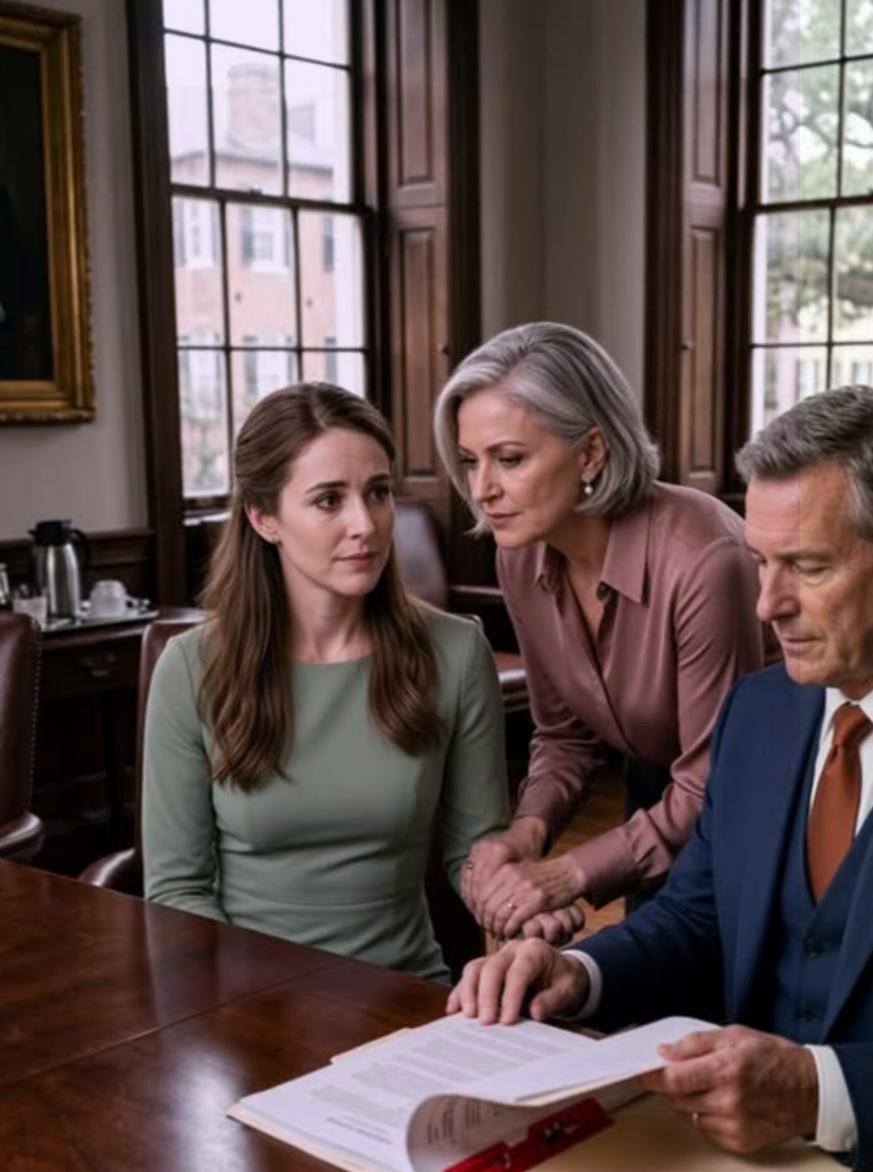

“Do you know why your grandmother left the camera turned on before leaving the house?” the policeman repeated.
“No,” I answered. “But I am going now.”
Mother looked toward the door.
“You cannot go there.”
“It is my house.”
“Not yet.”
Attorney Thorne calmly picked up the phone.
“It already is, Diana. The agreement came into force on the day of Grandma’s death.”
Mother looked at him as if she expected an answer. Then she took a phone from her bag and called someone.
“Mark, come right now. Everything has changed.”
In a few seconds her voice changed.
“No, I do not care about the price. The house must be empty when I arrive.”
Thorne shook his head.
“Do not call your lawyer anymore.”
“What does it mean, not to call him anymore?”
“He told me half an hour ago that he would no longer participate in this case. Your conduct already contains criminal-law risk.”
Mother let the phone slip from her hand. When it fell to the floor, the screen cracked.
But I was still thinking about Grandma’s recording.

I was going toward Charleston in the police car when Thorne handed me a flash drive.
“It is the camera recording,” he told me. “Are you ready to listen?”
“No.”
“You still have to listen.”
When we arrived at the house, two policemen were standing in the yard. The porch light was still off. The door handle looked scratched, and there were wood chips scattered on the stairs.
One of the policemen looked at Mother.
“Did you tell this man that he could enter the house?”
Mother pressed her lips together.
“I just wanted to take out my things.”
“We arrested this man while he was breaking the lock.”
“My things were in there!”
“The house is no longer yours,” I said.
Mother turned toward me.
“Are you doing this? Calling the police on your own mother?”
“I did not call them. Grandma left you evidence.”
At these words she stopped shouting for the first time.

Later, in the living room, we played the camera recording. Mother appeared on the screen. The date was three days before Grandma’s death. She was holding a bundle of my letters in her hands.
“Do not send these anymore,” she was telling Tom. “If Sarah comes here, Mother will tell her everything.”
Tom’s voice was trembling.
“Diana, enough. She is your daughter.”
“She is my daughter, and that is why I know how to stop her.”
On the screen Mother threw the letters into the fireplace.
I watched my own handwriting fold in the fire. Each sheet had the children’s names on it, their little stories, my longing.
Mother stood in the corner of the room.
“Turn it off,” she said.
“You said all of this yourself.”
“I was angry.”
“Six months?”
She could not answer.
At the end of the video Grandma appeared. She was lying in bed and looking toward the camera.
“If you are watching this recording, I can no longer protect you, Sarah. But you must no longer protect them from me. The truth is not their punishment. The truth is simply opening a door.”

That same day the police took Mother and Tom in for questioning. They were charged with deliberately hiding the letters and attempting to unlawfully seize the property. I stood in the courthouse corridor, turning both halves of Grandma’s key in my hand.
Mother spoke to me without a lawyer.
“If you change your statement, I will give you everything back.”
“What everything?”
“The house. The money. The jewelry. Just say that you misunderstood me.”
“You left Grandma without me for six months.”
“I thought you would come back anyway.”
“I came back. You locked the door on me.”
She lowered her head. For the first time she no longer looked like a strong woman. She was simply a person who could no longer take back her own words.
The trial took place three months later. Mother admitted guilt, and Tom testified. He said he had not wanted to burn the letters, but he was afraid of Mother.
The judge confirmed the transfer of the property and issued a protective order against them. I felt no revenge. Only exhaustion.
On the upper floor of Grandma’s house, I found her room almost empty. Only one thing lay on the bed—a folded piece of pale-yellow curtain that had covered the porch light. Beside it was a small card: “Leave the light on even when no one is waiting for you at home.”

Six weeks later I returned to second grade. The children drew a big house on the board with chalk. Yellow light burned in the windows.
“Is this your new house?” Luka asked me.
“Yes,” I told him. “And the door is always open for those who are looking for the right path.”
In the evenings I lived in Grandma’s house. In the morning I drank coffee on the old balcony, corrected the children’s notebooks, and checked the porch light.
Tom sent me a letter once. He apologized and said that he could no longer look at Mother as he had before. I did not write back. It was his regret and his burden.
And four months later Mother sent me a short message: “I miss you. Come, let us start everything over.”
I stared at the screen for a long time.
Then I wrote: “Starting over is impossible where the truth is still standing at the door. I wish you peace, but I will not go back.”
Mother did not write to me again.
The first snow came in December. In Savannah it was a rare sight. The children went outside into the yard, while I stood on the porch and watched the snowflakes.
I held that small copper key in my hand. Grandma had left me its other half because one part alone was not enough. Now I had both together.
In the evening I turned on the light.
Its yellow light fell on the snow, and for the first time Grandma’s house no longer seemed to me like a place where I was waiting for someone.
It was already my house.
And I left the door open.
Missed the beginning?
Related posts:
 They Took Grandma to Dinner and Abandoned Her in a Nursing Home, but Dad Suddenly Turned Pale When He Heard My Decision
 Before Reading Grandma’s Will, Mom Grabbed My Wrist and Threatened Me, but the Lawyer’s Smile Suddenly Disappeared
 My Parents Were Celebrating Selling Their Eleven-Year-Old Granddaughter’s Cello, but Grandma Opened a Folder and Father’s Face Changed
 I always protested leaving three children for free, but after my calm answer Sloan’s smile suddenly disappeared
 I took my mother from the house, but when my brother opened her room with a duplicate key, the color drained from his face
 They Left Grandma Beyond the Gate at the Wedding, but When I Saw the Paper in Her Hand, My Stepmother’s Smile Disappeared





