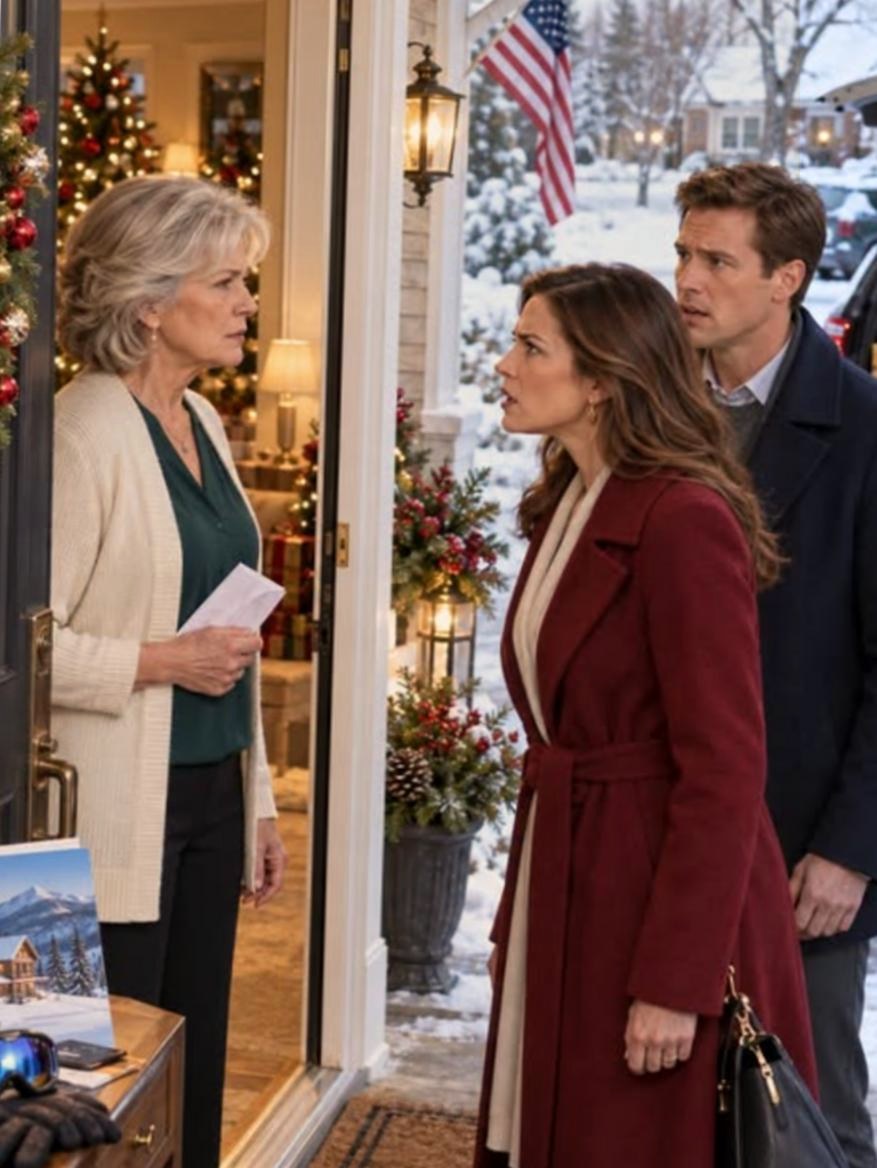

Iveta deleted the message immediately, but it was already too late.
I saw it.
Carter saw it too.
“Who is this?” he asked.
Iveta leaned against the wall.
“Nobody.”
“Nobody writes ‘I am coming to take the child,’” I said.
Carter snatched the phone from her hand. Only a few words of the message remained on the screen, but they were enough.
Then the calls began.
To the clinic.
To the lawyer.
To Marlene.
Iveta walked from room to room, telling everyone that this was a misunderstanding, a mistake, a malicious joke. Her voice became faster and faster.
“Tell him that the result is wrong!”
“Who?” Carter asked.
“Everyone!”
“I can’t deceive everyone.”
“You deceived everyone for four years, and now you have developed a conscience?”
Carter fell silent.
I stood at the kitchen counter and watched the phone clutched in his hand. The clinic’s number was still visible on the screen.

Iveta called her lawyer.
“Len, you must come immediately. Rosalind found some document and is telling Carter everything.”
She received an answer after only a few seconds. Iveta’s face changed.
“No, don’t tell me now that you can’t help me.”
A pause.
“You yourself told me that this result existed?”
Another pause.
“Len, please.”
The lawyer refused to defend her until he fully understood how the signature and medical records had been used. Iveta threw the phone onto the sofa.
“Everyone is against me.”
“No,” I said. “For the first time, no one is simply covering for you anymore.”
At these words Carter raised his head.
“Mom, what do you want?”
He had asked me this question four years too late.
I looked at him and felt an enormous, invisible weight slip from my shoulders.
“I want nothing. Neither money. Nor an apology. Nor for you to stay with me. I want you to deal with your own decisions yourself.”
“But Noel is my son,” he said.
“You may not have been his father, but fatherhood is not only blood. Now decide who you want to be after the truth.”

At that moment someone knocked on the door.
Two people stood outside. One was a clinic social worker, and the other was a tall man holding an old photograph of a child.
Iveta stepped back when she saw him.
“Don’t come in.”
The man said calmly:
“My name is Daniel Hart. I am Noel’s biological father. I have already filed an application with the court concerning the child’s safety and temporary visitation.”
Carter stood up from the chair.
“You knew he existed?”
Daniel lowered his head.
“I knew Iveta was going to have a child. She told me there was no place for me in the child’s life. Then she stopped answering my letters.”
Iveta shouted:
“You disappeared!”
“Because you told me Carter was the father and that your family needed peace. Years later I accidentally learned that the child’s medical data matched my surname.”
The social worker opened a folder.
“From this moment, the child must remain in a safe environment. Ms. Iveta, please come with us.”
“You cannot take Noel away from me!”
“No one is taking him away. We are simply checking the situation temporarily.”
Carter approached Iveta.
“Go with them. I will go get Noel.”
Iveta looked him in the face.
“Are you abandoning me too?”
“No. For the first time I am trying not to lie to the child.”

Then Daniel sent Carter an audio recording on the phone. The recording had been made on the evening when Iveta called a friend. Carter played it.
Iveta’s own voice sounded in the room:
“If Carter finds out the truth, he will lose everything. And his mother will pay again. We simply have to convince him that he is not interested in the result.”
At the end of the recording she also mentioned my name.
“Rosalind always pays when I mention the child.”
Iveta froze.
Carter listened to the recording to the end. His face gradually emptied.
“Did you say this?”
Iveta moved her lips.
“I was angry.”
“But you said it.”
For the first time she heard her own words in someone else’s voice.
And for the first time she saw what her life sounded like.
That evening the house became almost empty. The social worker left with Iveta. Daniel opened the car door for her. Carter remained on the sofa, his face buried in his hands.
The Christmas bell was no longer hanging by the fireplace.
I carefully took it down when their noise knocked James’s memory from the walls. The small “R” still shone on the copper surface.
Carter looked at the bell.
“Did Dad make it for you?”
“Yes.”
“Why did you never tell me about it?”

“Because I thought that in our family love did not need to be explained.”
That night Carter went to a hotel. The next morning my lawyer came. Together we documented the payments, letters, clinic documents, and audio recording. I did not go to court for revenge. I simply no longer wanted my silence to be the support of someone else’s lie.
Three weeks later the court arranged Noel’s temporary custody between Carter and Daniel. Iveta was given supervised visits, because it was found that she had indeed forged a signature in the medical documents and had hidden letters from the child’s biological father for four years.
Carter lost neither the house nor his child. He simply lost the life he had built on a lie.
Marlene called me a few days later.
“Rosalind, everything was not as it looked in the video.”
“I know.”
“We bought the gifts with borrowed money.”
“That no longer matters.”
“Iveta needed help.”
“I needed help too, Marlene. You simply never asked how I was.”
In response, I received silence.
A month later I went to Laurentia anyway.
Not to the big house.
To a small three-bedroom house, where snow gathered on the windowsill and an old pot leaked slightly in the kitchen. Cordelia was with me. Carter brought Noel too, and Daniel joined us the next day.
At first Noel sat silently.
In the evening I put pencils in front of him.
“Will you draw something?”
“What?”
“Whatever you want.”

On the white sheet he drew four people. One was small, two were tall, and one stood to the side holding a yellow sun in his hand.
“Who is this?” I asked.
“Everyone who tells me the truth now.”
His answer struck me more strongly than any words in court.
In the following months my life slowly changed.
I worked four mornings a week at the local library. I held story-reading hours for children. When I returned home, I made tea and no longer turned the phone face down on the table.
Cordelia told me that for the first time I looked calm.
“Because I no longer wait for anyone,” I replied.
“That sounds sad.”
“No. Free.”
In March I received a letter from Iveta. It was three pages long. She wrote that she had made mistakes, that she missed the family, and that perhaps someday I might be able to forgive her.
The last sentence was the calmest:
“Can you help me again while I fix everything?”
I read the letter several times. Then I wrote a reply.
“I hope you fix your own life. But I will no longer do that for you.”
I sent the letter and, for the first time, did not hide my phone.
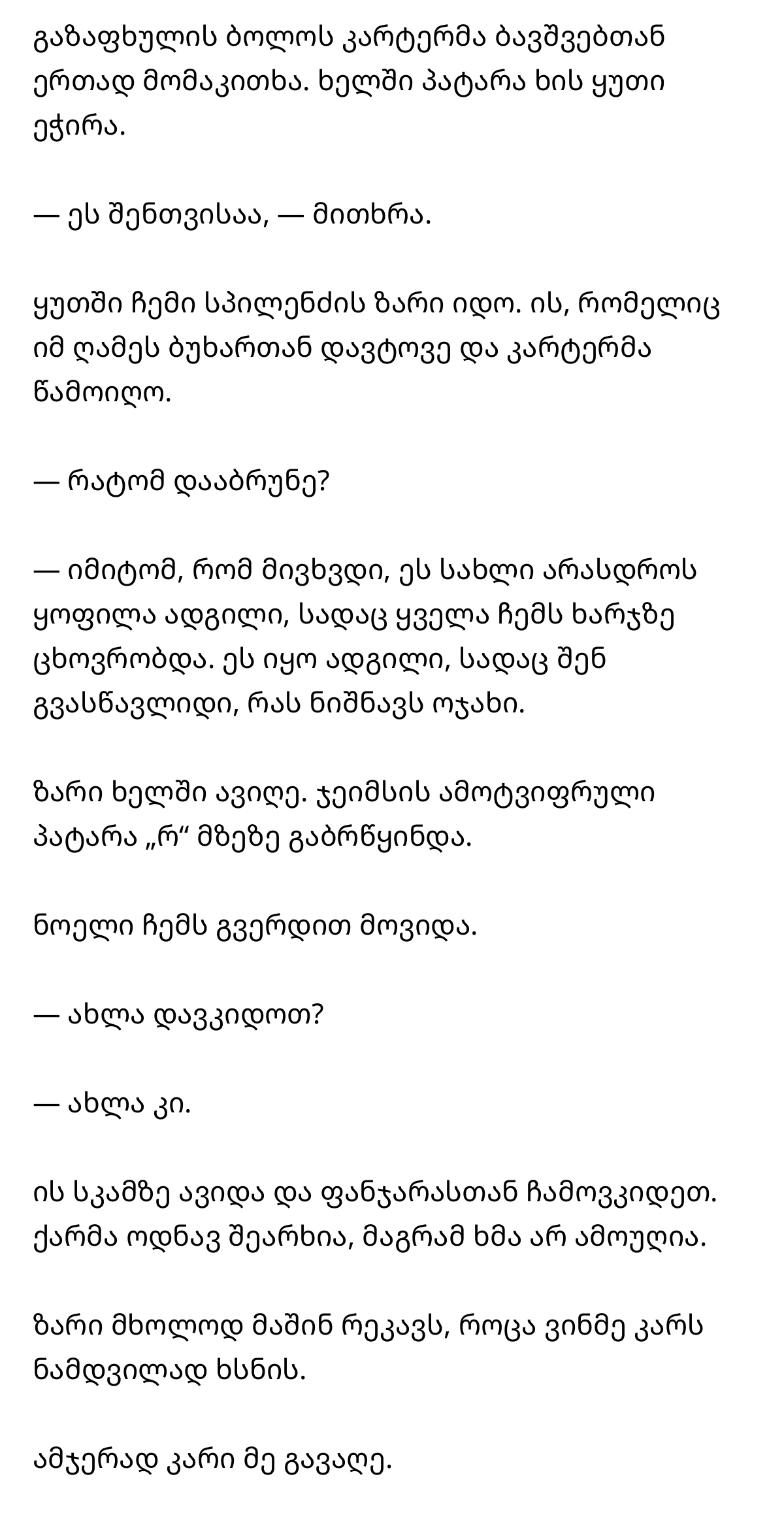

At the end of spring Carter came to visit me with the children. He held a small wooden box in his hand.
“This is for you,” he said.
Inside the box was my copper bell. The one I had left by the fireplace that night and Carter had taken.
“Why did you bring it back?”
“Because I realized that this house was never a place where everyone lived at my expense. It was a place where you taught us what family means.”
I took the bell in my hand. James’s small engraved “R” shone in the sunlight.
Noel came to stand beside me.
“Should we hang it now?”
“Now we should.”
He climbed onto a chair and we hung it by the window. The wind swayed it slightly, but it made no sound.
A bell rings only when someone truly opens a door.
This time I opened the door.
Missed the beginning?
Related posts:
 My daughter-in-law told me we no longer had money for gifts, but when I looked at her mother’s gifts two days later, she began to turn pale
 When my husband spoke about me in English to his family, I understood everything and watched his smile disappear
 When They Mocked My Mother’s Truth in the School Hall, the Admiral Saw My Name and Immediately Turned Pale
 An Unknown Man Humiliated Me in Front of Everyone, but the Restaurant Owner Looked at Me Only Once — and His Smile Immediately Disappeared
 Rowan seated a secretary in my place and told me, “Remember your place” — but he turned pale at the sight of my calm smile
 I took off my wedding ring while receiving a charity award on stage, and my husband’s smile immediately disappeared





