
The former engineer did not tell me his name. He told me only one thing.
“I have a recording.”
Then the call ended.
Vicky was watching my face.
“Who was it?”
“A man who has more information about you than you do.”
“Don’t threaten me.”
“I am no longer threatening you. I am simply no longer silent.”
That same evening Harlan called me from his office. His voice was lower than usual.
“That man is serious. He will come tomorrow morning.”
“What does he have?”
“I don’t know yet. But he says he has the record of a meeting of the developer’s board of directors.”
“And what is in it?”
“We will find out tomorrow.”
I barely slept that night. The old maps still lay on the kitchen table. Margie’s empty chair stood by the window. My leather work hat hung on its back.

At dawn the man called me and said that he was waiting for me in a small café in the city.
I went with Harlan.
The man turned out to be about fifty. His face showed fatigue, and he held a small iron box in his hands.
“My name is Ethan Moore,” he said. “Six years ago I led the road and utilities project.”
“Why did you come now?” Harlan asked.
Ethan put the box on the table.
“Because I kept silent then. Now I know that this silence harmed many people.”
He took a storage device from the box and handed it to Harlan.
The recording was old, but the voices could be heard clearly. Three men were speaking in the room. One was the developer’s director. The second was a lawyer. The third was Vicky’s present lawyer, Bradley Stokes.
“If the Dawsons ever see this easement, we will say that it is used only for drainage purposes,” Bradley was saying.
“The right to consent to the road is written in the text,” the engineer replied.
“No one can read the text if no one looks for it.”
The recording stopped.

For a long time I could not speak.
Harlan closed his eyes.
“This is already deliberate concealment.”
Ethan lowered his head.
“Vicky was a consultant on the project at that time. She knew everything.”
Such silence fell over the café that the hum of the coffee machine seemed excessively loud.
“She knew?” I asked.
“She knew that the road passed over your land. She knew that you had never been told. Then, when the residential settlement was sold, she moved here.”
Those words struck me harder than I expected.
Vicky had not simply been a rude neighbor. She had participated in the affair that she was now using against me.
Harlan officially copied the recording. Then he sent the police the old files from my cameras as well, including Vicky’s false statement and her words about turning the ranch into a parking lot.
That very day everything accelerated.
Vicky’s lawyer first said that the recording had been obtained illegally. Then it became clear that the meeting had taken place in a room belonging to the developer and that its storage was permitted by the company’s rules.


Then Bradley Stokes called me himself.
“Mr. Dawson, I want to tell you that I am withdrawing from Vicky’s case.”
“Why?”
“Because she hid information from me too.”
For the first time I heard fatigue in his voice.
“She told me that the easement concerned only the drainage strip. Now I see that the document is broader.”
“You are also in the recording.”
A long silence fell.
“I know.”
This was Vicky’s greatest mistake. She thought that every person would defend her story to the very end. But as soon as the truth returned to them in their own voices, they could no longer escape from it.
The next day the court issued a temporary order. Vicky’s car was removed by a special lifting machine. They first needed my written consent for this. She signed it.
While signing, she held the pen as if her fingers no longer obeyed her.
“This is not over,” she told me.
“For me, the part where I waited for your permission is already over.”
“I will take everything back.”
“I took nothing from you.”

The court hearing took place several weeks later.
I felt no one’s victory when the judge announced the decision against the developer. I simply listened.
The settlement was ordered to legally re-register the road, pay compensation for its use over the years, and make a permanent agreement with me. A case was opened against Vicky for false statements and concealment of documents. She was no longer entitled to hold the position of association head.
Her last attempt was to blame everything on Todd.
“He knew,” Vicky said in the courthouse corridor.
For the first time Todd did not lower his head.
“I knew only what you told me.”
Then he turned toward her.
“And that was enough for me to live for years together with your lies.”
Vicky fell silent.
That was the first time she heard her own voice through someone else’s mouth.
Several days later silence returned to my ranch. I straightened the old gate. The ditch remained—it carried water away from the road and protected the lower pasture.
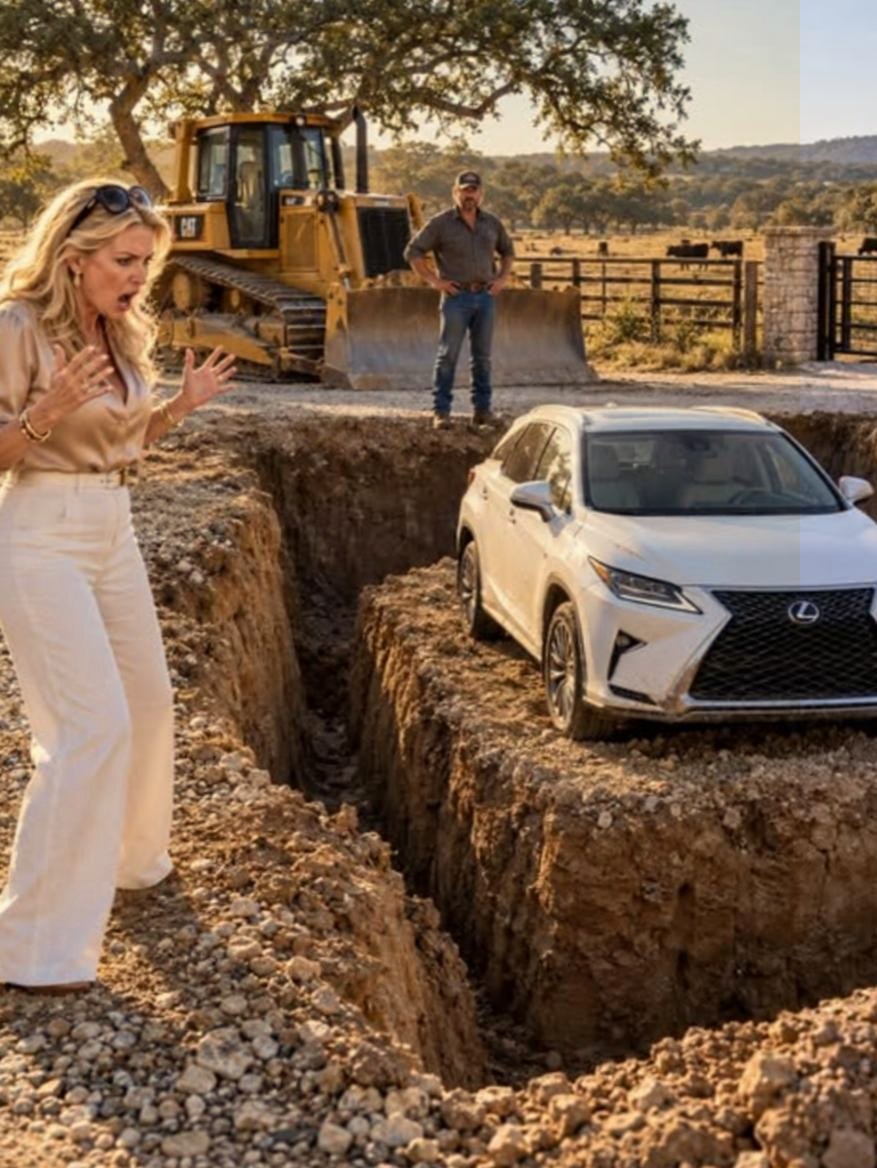
The white Lexus was no longer standing there.
Only two deep tire tracks remained in the earth.

Vicky’s former office in the settlement was empty. Her professional photograph still hung on the wall—a white blouse, pearl earrings, and a smile as if the whole world had been arranged for her.
But there were no longer business cards with golden letters on the desk.
Nor a notebook.
Nor a phone.
Only one dust-colored circle remained where her favorite cup had stood.
Three months passed.
On the first morning of autumn my daughter Elena came to the ranch. A little boy named Noah accompanied her. Noah was six years old and loved drawing on the ground.
“Grandpa, is this your new ditch?” he asked me.
“Not mine. It belongs to the land.”
“Does water live here?”
“When it rains, yes.”
With a stick he drew small lines in the mud.
“Then don’t block the road.”
I laughed.
“I won’t block it.”
Elena put a hand on my shoulder.
“Are you at peace?”

I could not answer that question immediately.
For a long time, being at peace had seemed to me like surrender. Now I understood that sometimes peace is the moment when you no longer need to prove your truth by shouting.
“Yes,” I said at last. “Now I am at peace.”
I also began new work. Three days a week I helped nearby farmers level their land. In the mornings I still woke early, made coffee, and checked the bulldozer. But now the camera stood at the gate not because of fear, but because of habit.
The neighbors changed.
Some apologized.
Some simply nodded at me on the road.
Once Todd stopped me at the mailbox.
“She left the city,” he told me.
“I know.”
“She says everything was your fault.”
“It is probably easier that way.”
Todd looked at the ground for a while.
“I should apologize to you.”
“It is late, but it still matters.”
He nodded and left.

The first snow came in December. It was rare, light, almost silent. In the morning I went out onto the veranda and saw my leather hat, still hanging on the same nail.
The letters embroidered by Margie had faded slightly. I touched them with my finger.
That evening I received an unknown envelope. Inside was only a letter from Vicky.
“We can start over. I made mistakes. You also know that everything between us was not only hostility.”
At the end she asked me to meet.
I looked at the paper for a long time. Then I folded it in half and put it in the trash can.
I was not angry.
Nor did I feel victorious.
I simply no longer wanted to open the door for the person who, for years, had occupied in my life not only the entrance road but the entire house.
The next morning Noah brought me his drawing. On the paper was a yellow bulldozer, and behind it a green field and a small red house.
Above it was written one sentence: “Here everyone goes on their own road.”
I attached the drawing to the refrigerator.
Then I took my leather hat, put it on my head, and went toward the gate.
The earth was breathing.
And for the first time, I was no longer waiting for anyone.
Missed the beginning?
Related posts:
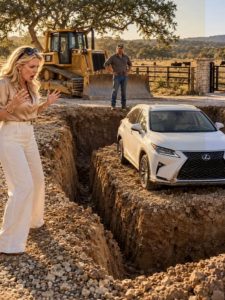 His car blocked the road at my gate, but when I started the bulldozer, Vicky’s smile disappeared for the first time
 A Flat Tire Stopped Me at a Desert Diner, but When the Waitress Heard My Name, the Color Drained from Her Face
 My Father Was Fed by a Poor Woman at Night, but When I Followed Her Trail, a Stranger’s Face Suddenly Turned Pale
 An Unknown Man Humiliated Me in Front of Everyone, but the Restaurant Owner Looked at Me Only Once — and His Smile Immediately Disappeared
 The Video Sent on Our Wedding Anniversary Revealed My Husband’s Betrayal, but One Reflection Suddenly Erased His Smile
 The Mafia Boss’s Car Fell into the Abyss, and I Tried to Save Him—but His Guards Pulled Out Their Guns