
At 2:52 at night my boss called me and told me that at seven in the morning I would be left without a job, while I was still driving the banks’ payments. Beside the laptop stood cold coffee, and on my shirt there was dried glue left from my seven-year-old daughter’s science project.
“Kala, your contract ends at seven in the morning,” Derek Miller said. “We will not continue it.”
The city slept beyond the window, while red notifications blinked on my screen. Chicago’s main processing center had gone down. The cards no longer worked, and in a few minutes thousands of people would see a declined payment at the checkout.
“This really cannot wait now,” I said and gripped the mouse more tightly.
“It is an administrative courtesy that I told you myself.”
For four years I had been an infrastructure engineer. When the system was collapsing and the others no longer knew where to begin, they looked for my number. That evening Mia was assembling a volcano. Julian was making coffee in the kitchen and was standing by the doorframe when he heard my frightened voice.

“Did something happen again?” he asked.
“Chicago.”
He only nodded. We both knew what that word meant.
I found a routing flaw, and then discovered something more serious: the automatic activation of the backup process had been disabled during technical work and no one had restored it. I began manually diverting the traffic to Denver. I checked each step twice. Hurrying could have brought down two centers instead of one.
At 3:19 I received Derek’s letter: the contract would continue until the end of the week and emergency compensation would also be assigned to me. I saved the letter together with the incident records and continued working.
“They cannot let you go just like that,” Julian said quietly.
“I have not yet decided whether this is an insult or a gift.”
At 5:30 Chicago’s system started working again. In the morning, when I opened the maintenance history, the cold coffee had already turned into a dark stain at the bottom of the cup. Right there I saw a record that froze my fingers: six days earlier someone had disabled the backup process to reduce costs. The instruction had a date, a recipient, and a signature attached.

I put everything into the report. I did not exaggerate. I wrote only the times, commands, and results.
That same afternoon Derek appeared at the review. Behind him was a perfectly arranged cabinet, as if nothing in the world was collapsing.
“We are moving to external service,” he said. “More coverage, less cost.”
“And my contract?” Andrew asked.
“It ends on Friday.”
Andrew protested immediately, but Derek raised his hand.
“The decision has been made. Kala, you have to transfer the knowledge accumulated over four years to the new team in three days. Your cooperation will be reflected in the recommendations.”
His smile was calm. He thought I no longer had a choice.
That night I began preparing a three-hundred-page document. I wrote the cause, frequency, and result beside each flaw. I also added what never appeared in presentations: which notification could wait until morning, which one required an immediate call, and that Baltimore’s old system had to be rebooted every seventy-two hours in a precisely established sequence.

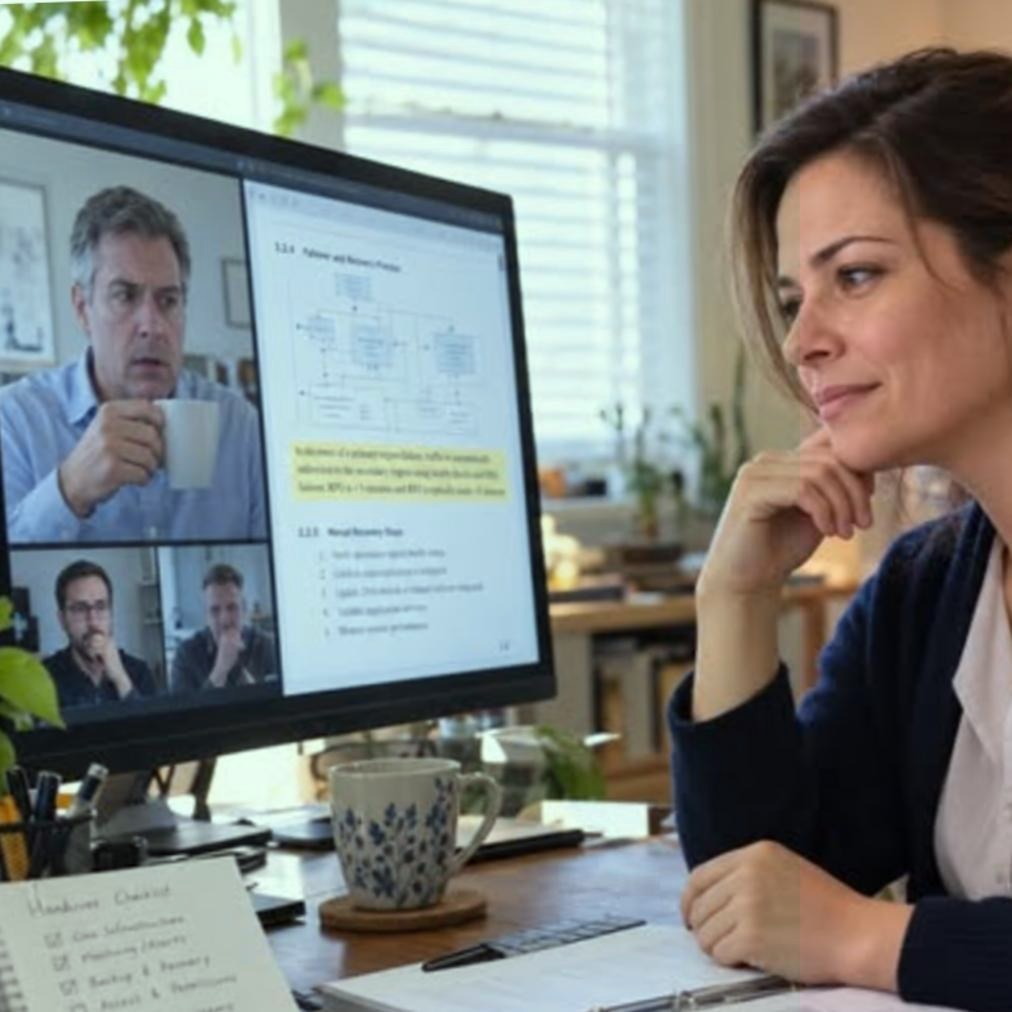
The handover meeting was scheduled for Friday morning. Warm coffee stood on the table, and the printed checklist was beside it.
Derek entered first. Then Andrew. Finally the new engineers, Flynn and Oscar, appeared. Not one of them looked toward the camera.
“For a smooth transition, we need only the final confirmation,” Derek began.
Flynn interrupted him.
“Before we confirm this, there is one matter we need to discuss.”
He shared the screen. My document appeared, opened on page 147. Derek’s hand was moving toward the coffee cup, but stopped on the way. Flynn moved the cursor to the reboot rule and then opened the morning letter.
“Derek, before Kala leaves, we will have to clarify this,” he said, leaning toward the screen…


Flynn read the letter aloud. It said that the Baltimore reboot procedure was an unnecessary expense and that the new team would no longer perform it.
“We received this instruction from you,” Oscar said. “If we continue like this, the system will stop in a few days.”
Derek cleared his throat.
“It is probably a record taken out of context.”
“No,” I said. “Because of that same instruction, Chicago’s emergency chain was activated. Everything is in the records with dates.”
Andrew looked at Derek for the first time.
“Why did you not tell us that you disabled the backup process?”
Derek turned off the camera. For several seconds only the silent room and my computer’s fan could be heard.
Then a message came to my phone from an unknown number: “If you want to find out why you were really let go, come to the old archive this evening. Alone.”
I looked at the message for a long time. Derek was no longer visible on camera, but I still heard his voice.
“Kala, do not go to that archive.”
He did not know that I had already realized: someone was afraid not that I would leave, but that I would find them…

At six in the evening I went to the company’s old archive. On the lower floor of the building there was the smell of dust and heated electrical wires. Andrew came with me, despite the fact that I asked him to wait outside.
“They asked me to come alone,” I said.
“That is why I will not let you come alone.”
On a shelf we found a small metal box. My name was written on it by hand, in black ink. Inside were printed letters, records of meetings, and a card confirming an audio recording.
“Who left this?” Andrew asked.
“Probably the one who knew Derek would erase everything.”
I started the recording on the laptop. I recognized Derek’s voice immediately.
“If Kala stays, every reduction decision will be called into question,” he was saying. “He cannot prove that we ignored the system warnings if access is taken away from him.”
The second voice, that of the company’s financial director, asked me:
“What if an accident happens?”
“We will blame the old system. Kala is already an excessively expensive employee. We will transfer responsibility to the new service provider.”
I stopped the recording. The room seemed to become smaller.
“They decided to let me go after the accident,” I said.
“No,” Andrew answered. “They calculated the accident in advance.”
There was one more file in the box. It contained my warnings from eight months, which had been sent to Derek and left without an answer. On the last page was his signature: “Confirmed, reducing costs is the priority.”

At that same moment Derek called me.
“Where are you?” he asked.
“Where your deleted decisions are kept.”
Silence fell.
“These files belong to the company.”
“The records you used against me now serve to protect me.”
“If you distribute all this, I will destroy your career.”
Andrew looked at the phone.
“The one who is already destroying the career is the one who deliberately puts his own team at risk.”
Derek hung up. In a few seconds my phone rang again, this time it was the lawyer from the human resources department.
“Ms. Rodriguez, there will be an emergency review tomorrow morning,” she said. “Derek claims that you have no right to keep these materials.”
“And does he have the right to disable the company’s security processes by personal order?”
The lawyer could not answer.
That night Mia sat on my knees at home and showed me a new drawing of the volcano. Julian was quietly arranging plates in the kitchen.
“Mom, are you going to work tomorrow?” Mia asked.
“I do not know yet.”
A new message appeared on the phone. This time it was not anonymous. It was the chairman of the company’s board.
“Kala, before the meeting in the morning you need to know one thing: the audio recording is not complete. The remaining part is in Derek’s personal storage. And he already knows that we know about it…”
დერეკმა საკუთარი ხმა მოისმინა და პირველად გაჩუმდა…
მეგონა, რომ ყველაფერი უკვე ვიცოდი. მაგრამ ბოლო ჩანაწერმა მთელი ღამე და ყველა გადაწყვეტილება სხვა სინათლეში დამანახა.
„შენ არჩევანი გააკეთე.“
დერეკმა პასუხი ვეღარ იპოვა.
👇 ისტორიის ფინალი უკვე გახსნილია
Related posts:
 Part 4 — At seven in the morning they terminated my contract, but when the screen turned on at the handover meeting, the director suddenly stopped smiling
 Entré a la fiesta de la empresa con la mano de otro hombre entrelazada con la mía, y mi marido dejó de sonreír
 Ich gab dem gefürchtetsten Mafioso Brooklyns meine letzten fünf Dollar, damit er meine Mutter rettete – dann öffnete sich die Wagentür
 My four-year-old son called me crying, but when I got home, the fear I saw on Derek’s face froze me
 My Parents Were Celebrating Selling Their Eleven-Year-Old Granddaughter’s Cello, but Grandma Opened a Folder and Father’s Face Changed
 When my husband’s family broke my leg and my husband told me to submit, the smile vanished from his face three days later.