Part 4
The most dangerous part was beginning now, because Salome was hiding and Revaz knew where to look.
The police immediately took him into an interrogation room.
I stood behind the two-way mirror. The box sat on the table alongside Mira’s wooden whistle, which Nurse Nino had taken from the girl’s hands when Revaz tried to approach her.
— “I am waiting for my lawyer,” Revaz said.
— “Your lawyer is already trying to defend himself,” the investigator replied.
— “You have nothing on me.”
The investigator played the recording.
Salome’s voice echoed through the room once more: “Revaz told me that if I go to the police, he will kill them both.”
Revaz lowered his head.
— “That isn’t my voice.”
— “We haven’t told you yet that it was your voice in the recording,” the investigator said calmly.
Revaz stared at him, frozen.
Hearing your own words through someone else’s ears is a different experience entirely. When a person lies, they believe the lie disappears into their voice. But a recording forgets nothing. Not the terrified pause. Not the slamming of a door. Not the quiet threat that touched a little girl’s future ten years ago.
Revaz pushed his chair back.
— “I never laid a hand on her.”
— “In the recording, you say you will kill the children.”
— “It was said in anger.”
— “You searched for the children for ten years using forged documents.”
— “They are my children.”
— “A child does not belong to a parent simply because they desire power over them.”
For the first time, Revaz had no answer to offer.
Ten minutes later, his attorney walked into the room, looked down at the box, and then at his client.
— “I am no longer taking this case,” he said.
— “What is that supposed to mean?”
— “It means you tried to hide the truth even from me.”
— “I paid you!”
— “And now that money cannot buy your freedom.”
The attorney walked out.
Revaz stared at the door for a long time, as if holding onto hope that someone would come back and take responsibility in his place.
Nobody returned.
That same evening, the police located Salome at a temporary shelter. She sat in an upper room of an old warehouse, clutching a small bag, flinching at every sound near the door.
— “I wanted to go to the children,” she told me. “But Revaz saw me.”
— “You are safe now.”
— “They told me that ten years ago as well.”
— “We have evidence now. And the children know the truth.”
Salome lowered her eyes.
— “Does Mira love me?”
That wasn’t a question for me to answer.
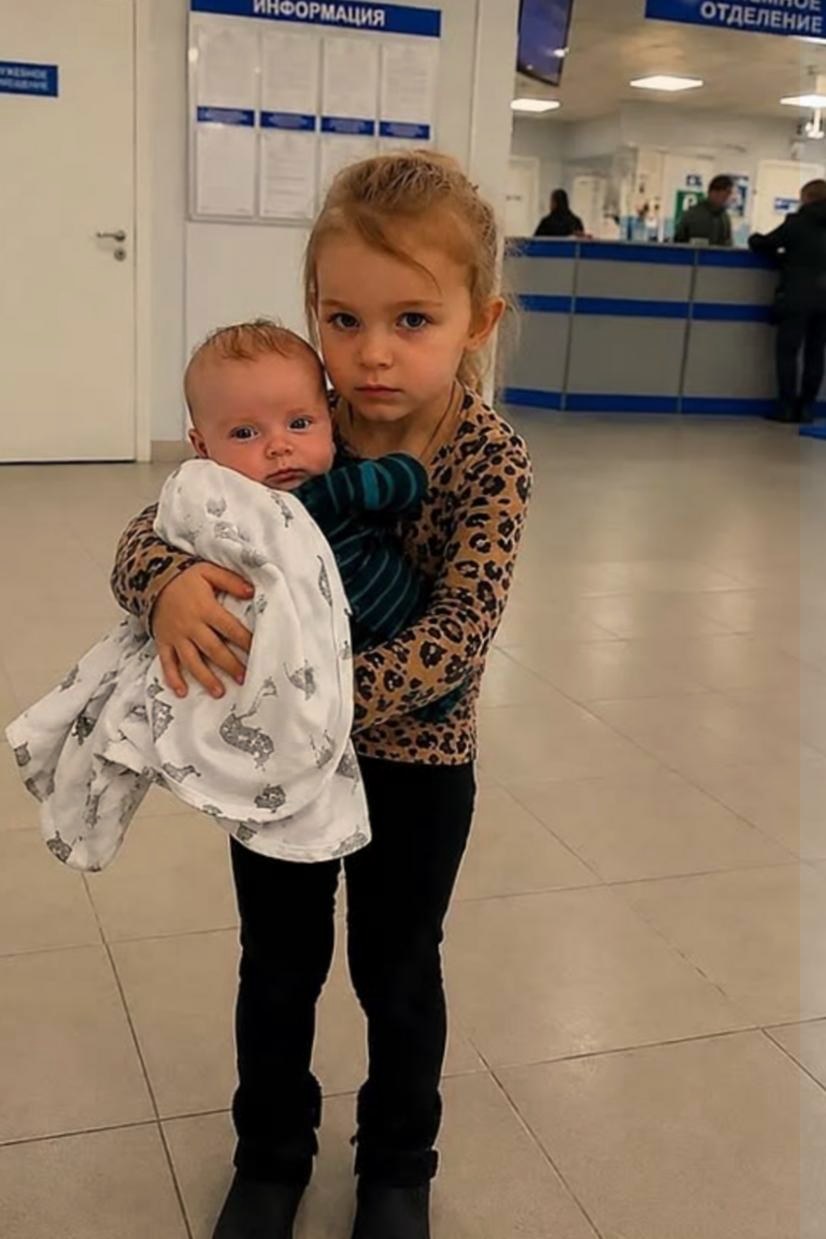
When I returned to the hospital, Mira met me in the hallway. A small white bandage was stuck to her hairline because she had bumped into the wall while playing with Nino.
— “Will she come?” she asked me.
— “If you want her to.”
— “I want to see her from a distance first.”
Salome stood beyond the door. Seeing each other, neither of them uttered a word.
Mira took the first step.
— “Are you Salome?”
The woman nodded.
— “Are you Mira?”
— “Yes.”
— “I’m sorry I came so late.”
Mira thought for a moment.
— “I don’t know if I should hug you.”
Salome’s lips trembled.
— “You can just stand here.”
Mira stopped in front of her.
— “Then let’s just stand here.”
Ana watched all of this from her bed. She was still weak, but a gentle smile rested on her face. Two women were not competing with each other. One gave life, while the other saved that life.
Three days later, Ana’s room was almost empty. Beside the bed remained only a medication cup, a folded blanket, and Mira’s wooden whistle resting on the window sill. Mira had left it for Ana.
— “Keep it with you until you return home,” she told her.
Ana looked at the object for a long time.
— “Did this belong to your father?” I asked.
— “No,” Mira said. “I made it myself when I was little. The sound is bad, but Mom always knew where I was.”
Ana smiled for the first time as she used to before her illness.
A few weeks later, the court issued a restraining order against Revaz, while the investigation proceeded regarding the forged documents and threats against the children. I didn’t go to court. My place wasn’t there. My job was to listen to the children’s breathing and ensure Ana took her medications on time.
Salome was provided temporary housing. At first, Mira visited her only during the day. Bogdan, who was now breathing freely, waved his little hands every time he saw his mother.
— “Does he know it’s me?” Salome would ask me.
— “Infants know many things they cannot speak of.”
Four months passed.
I transferred to another district and drank tea from that same metal cup during morning shifts. Occasionally, Mira would stop by the hospital. She would rush into the room, pull a sheet of colored paper from her bag, and show me what she had drawn.
On one drawing, four people stood in front of a house. Ana held the wooden whistle in her hand. Salome carried Bogdan. Mira stood right between them.
— “Why are you standing furthest in front here?” I asked her.
— “Because I was the first to reach the hospital back then.”
— “You don’t need to do everything first anymore.”
Mira lowered her head.
— “I know. Now I have two mothers.”
For the first time, she spoke the word without hiding it from herself.
A month later, a letter arrived from Revaz. It was addressed to Ana, but she didn’t even wish to open it. The envelope was brought to me, as they knew it formed part of her medical file.
In the letter, Revaz wrote that everything could be started anew. He claimed he had changed. He begged to be granted permission to see the children just once.
Mira walked into the room while I was reading the letter.
— “Is he still looking for us?”
— “He says he is remorseful.”
— “Do you believe him?”
I folded the paper.
— “Remorse is more than words. It shows in the outcome.”
Mira looked at Ana, who sat by the window cleaning the wooden whistle left for her.
— “We won’t send a reply, right?”
— “What do you feel?”
Mira thought for a long moment.
— “I don’t want my peace to depend on forgiving him.”
That was the most grown-up sentence I had ever heard from a ten-year-old child.
No reply was sent.
Snow fell on the first day of winter. After my shift, I stepped out of the hospital and saw Mira at the entrance. She stood beside Ana, while Salome was wrapping Bogdan in a blanket.
Mira pulled a wooden whistle from her pocket. She had crafted a second, new one. This time, it had no crack.
— “This is for you, Doctor,” she told me.
— “Why?”
— “If you ever get lost, call us.”
I took the whistle in my hand. It was light, rough around the edges, but warm. Mira returned her old whistle to Ana, and Ana tucked it inside her coat pocket.
The wind scattered snow across the pavement. The four of them walked slowly toward the end of the street. This time, Mira wasn’t running ahead. Salome held one of her hands, while her other hand clutched Ana’s fingers tight.
I stood by the hospital doors, watching their footprints disappear along the white street.
The little wooden whistle sounded once.
This time, every mother heard it.
Missed the beginning?
Related posts:
 A ten-year-old girl arrived at the hospital with a sick infant, but a single call made the doctors’ blood run cold.
 I took an elderly neighbor woman into my home and her relatives accused me of wrongdoing, but the moment they heard me whisper, everyone around fell silent.
 Grandma accused me of swapping the newborns, but the second genetic test result wiped the smile off her face in an instant.
 After the accident on the coastal road, the police officer called my words a lie, but then suddenly turned pale.
 My husband left me and the children in poverty, but his mother stopped at the door, and her expression changed strangely.
 My wife accidentally revealed my infidelity while talking to a friend, but when a certain name was mentioned, the phone slipped out of my hand.