“You have been fired from your job because you drank coffee in a prohibited zone.”
For several seconds I thought that I had not understood correctly. I had spent twelve years at the Monterrey technology group “Altavista,” which managed multimillion-dollar contracts for government agencies, banks, and transportation companies. I was fifty-two years old and worked as the director of compliance control. I had written more internal rules than the people now sitting in front of me.
And yet, my career was supposed to end because of one cup of coffee.
Everything began that same morning. At ten past eight in the morning I went up to the executive floor, nodded to the security guard, and poured myself American coffee from the machine standing beside the conference room. The machine had stood there for seven years, and no one had ever told me that using it required special permission.
That was exactly when Renata Salgado appeared.
She was twenty-five years old, had been at the company for five months, and had already become the favorite person of the general director, Mauricio Landa. Officially, she was considered the corporate innovation coordinator. In reality, she evaluated the work of every department, including departments whose names she barely knew.
She tapped the metal cup with her fingers.
“Do you know that this zone is restricted?”
I looked around. A small sign hanging on the wall was covered with dust.
“This machine has been standing here for years,” I told her. “Do we now need to get a pass for American coffee?”
Renata’s lips curved into a slight smile.
“The rules are the same for everyone.”
“I wrote the rules.”
“Then you should know better how to follow them.”
Her voice was soft, but in her eyes there was already an expectation of victory. At that very moment I had the strange feeling that this conversation was not about coffee at all.
Five hours later I was summoned to the human resources department. In the room I found Lucia Baragan, the department director, Renata, and the company’s internal lawyer. On the table lay a white folder whose corner was new, as if it had just been printed.
Lucia looked at the sheet.
“Because of an intentional violation of the internal-use rule, your employment relationship ends today.”
“Where is the evidence of an intentional violation?”
The lawyer cleared his throat.
“The matter has already been decided.”
“Then give me a copy of the decision.”
Renata folded her arms.
“You can take this news a little more humanly.”
“For twelve years I was taking other people’s mistakes humanly,” I answered. “Now I only want my document.”
When I took the paper in my hand, everything became clear. My dismissal had been prepared not that morning, but several weeks earlier. Fifty-six days remained until the special retirement bonus provided for in the contract became fully active. And Mauricio had been repeating for the last month that the compliance department had to be “rejuvenated.”
In corporate language, this often means: an expensive employee must be replaced with a cheap one.
When I walked toward the door, I looked at Lucia.
“Check the procedure for dismissing an employee with critical authorization.”
She frowned.
“Why?”
“Today is a good day to read it.”
A security guard followed me in the corridor. My colleagues avoided looking at me. At reception I handed in my pass, and all I had left in my hands was my bag, coat, and ceramic cup. On the cup was written: “Ethics is not a choice.”
I reached the car and for several seconds rested my hand on the steering wheel. During twelve years I had built a system that protected Altavista’s digital signatures, audit trails, supporting documents for government contracts, and the history of every change.
The system had one simple rule: if the person responsible for compliance disappeared without an official handover, all sensitive processes would automatically switch to verification mode.
This was not revenge. The company itself had approved this years earlier.
As soon as I arrived home, I opened the work application. My account still had its last authorized state. A message appeared on the screen: “The departure of the responsible employee has been recorded. Transfer of authority has not been registered.”
Below, two buttons were visible: “Confirm handover” and “Activate continuity protocol.”
I did not touch the first one. No one had asked me for a handover.
I pressed the second one.
The next morning, at seventeen minutes past eight, my phone filled with calls. First the reports stopped updating, then the digital signatures were suspended, and at ten o’clock a government client called and asked why its certificates were unverified.
My former assistant, Mariana, wrote to me: “Carolina, everyone here is going crazy. Did you do something?”
I did not have time to answer. A red warning lit up on Altavista’s main screen, while Mauricio was already shouting at the board members to demand that the system be restored immediately.
The internal lawyer opened the continuity manual, read several lines, and his face changed.
“Mauricio…”
“What happened?”
“The system did not stop because of Carolina.”
“Then whose fault is it?”
The lawyer licked his lips. At that same moment a new message appeared on the screen: “Federal contract at risk. The document chain cannot be verified. Value: seven hundred forty-two million pesos.”
Renata’s smile disappeared. Mauricio fell upon the phone, as if one number could save everything. But he did not yet know whom he was really calling…
The phone rang again, but this time an unknown number appeared on the screen. I ended the call. My ceramic cup stood on the kitchen table; on the outside there was still the brown ring of coffee that I had been unable to remove with a napkin that morning.
I answered on the second call.
“Mrs. Mendez, I am the secretary of Altavista’s board of directors. Please come to the company immediately.”
“Yesterday security escorted me out.”
“Now the board is asking you to return.”
“Where was the board yesterday?”
Silence fell on the other side of the line.
“This is an emergency.”
“It was for me too. Only then it was called a cup of coffee.”
At nine in the morning I entered Altavista, but this time the security guard did not ask me for my pass. Mauricio’s assistant was standing by the elevator, his hands trembling.
“The director is waiting for you.”
“The director was waiting for me yesterday too. Then it was in the dismissal room.”
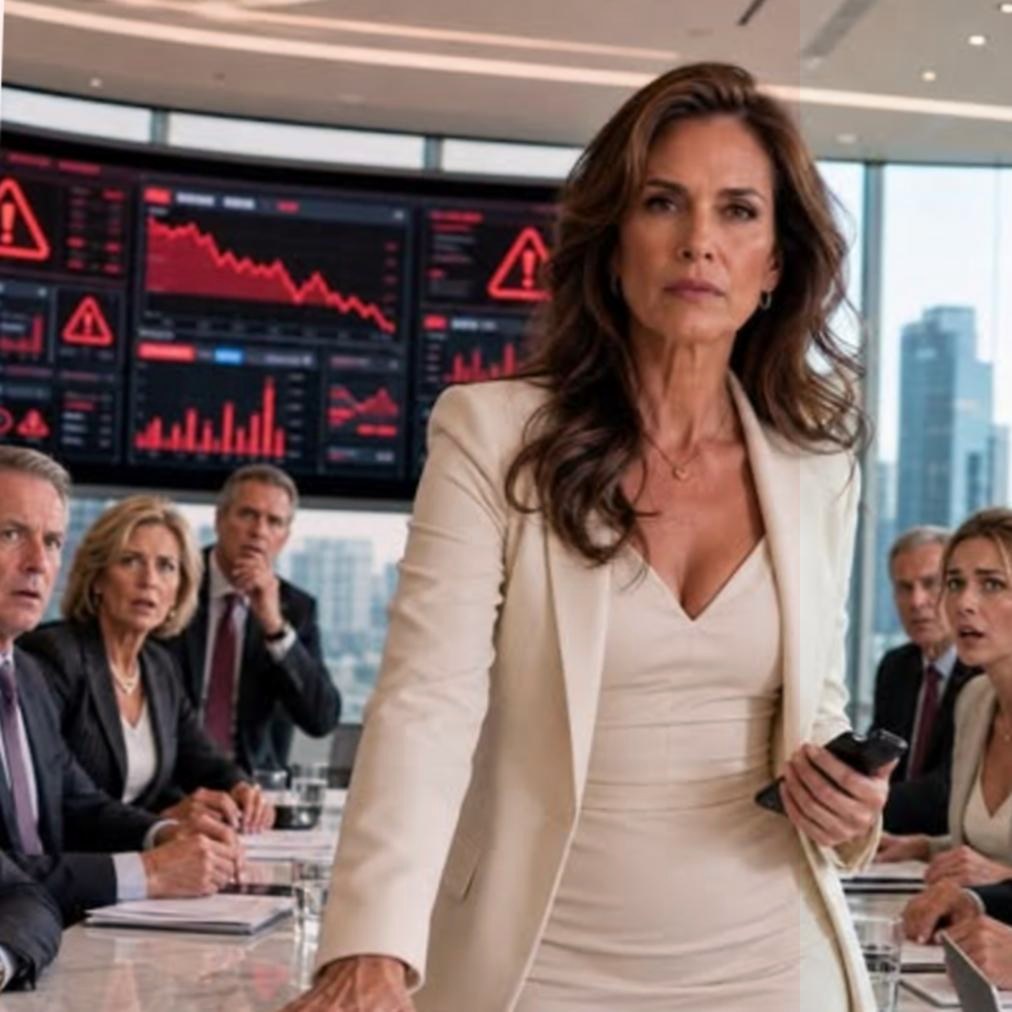
The air on the executive floor felt heavy. Papers continuously came out of the printers, telephones overlapped one another, and red signs were lit on the wall screen. Small plastic cards lay on the tables, as if the entire company were falling apart into papers.
In the main conference room I found Mauricio, Lucia, Renata, the finance director, and three board members.
“You did all this,” Renata told me.
“No. You carried out the dismissal. The system only saw your signatures.”
Mauricio leaned on the table.
“Restore access.”
“There was no official handover.”
“Then let us do it now.”
“Now it is no longer enough.”
Lucia looked at me irritably.
“Carolina, this is a company crisis. Put personal resentment aside.”
“If I had had personal resentment, I would not have pressed the second button last night either. The system would have stopped completely. I only activated what your rules required.”
The finance director removed his thin glasses.
“We must sign the contract this afternoon. The government client demands the complete document chain.”
“Then all documents will be available when the authorized person is officially designated.”
Renata gave a short laugh.
“I can perform this function.”
Several heads turned toward her in the room.
“Have you ever worked in compliance?” I asked.
“I learn quickly.”
“Signing for hundreds of millions for the state is not a training exercise.”
Mauricio struck the table with his fist.
“Enough! You do not run this company.”
“That is exactly why I wrote rules, so that one person could not run it.”
At that moment the door opened and the head of internal audit, Daniel Ortiz, entered. He was holding a small wooden box.
“I found this in my office,” he said. “Carolina left instructions years ago that during a critical change all independent records had to be shown to the board.”
Mauricio looked at the box.
“What record?”
Instead of answering, Daniel looked toward me.
“During the last audit you told me that if your authority was ever not formally transferred, I had to hand this record over to the board.”
Renata jumped up from her seat.
“This is absurd. She was preparing in advance to damage the company.”
“No,” I said. “I was preparing in advance for the day when people would adapt the rules to their own comfort.”
Daniel took a small memory device from the box. Fine scratches were visible on its surface, and on the side was a date written in my hand.
The chairperson of the board asked quietly:
“What is in this?”
“The answer to why my access was canceled on the day when forty-six days remained before the signing of an important contract.”
Mauricio changed color.
“You cannot open this here.”
“Why?”
“Because it is confidential.”
“It may be confidential for the company. For the board—it is not.”
Daniel placed the device in a special reader. A message appeared on the screen: “The record is encrypted. An independent witness and two-step confirmation are required to open it.”
The chairperson looked at the lawyer.
“Is an independent witness here?”
The lawyer lowered his eyes.
“The audit representative should be sufficient.”
Daniel entered the second confirmation. The time, date, and meeting number appeared on the screen. Then the first seconds of an audio recording were heard.
Mauricio raised his hand.
“Turn it off.”
“Why?” I asked.
“You do not yet know what it is.”
“That is exactly why we are listening.”
In the recording, first came the sound of a chair moving. Then Mauricio’s voice, younger and more confident than it was now:
“Carolina will leave before the retirement bonus. Renata will sign, Lucia will prepare the document. And the system…”
Renata suddenly grabbed the chair.
“This is falsified.”
The recording stopped. A second window opened on the screen and showed the file’s confirmation code, the date, and the address of the video of the same meeting.
The chairperson of the board said slowly:
“Does a video exist too?”
Daniel nodded.
“But a second key is required to view it. Only the person who created the recording has it.”
Everyone turned toward me.
I took my phone from my bag, but before I touched the screen, Mauricio’s mobile rang. He answered, listened, and his face emptied completely.
“Who was it?” the chairperson asked.
Mauricio slowly raised his eyes.
“The Federal Audit Service.”
“And what do they want?”
He could not answer. A clear woman’s voice could still be heard from the phone:
“Mr. Landa, please do not let anyone leave the building. We are already on our way…”
“We are already on our way”—those words hung in the room as if the air had suddenly hardened. Mauricio put the phone on the table, but he did not end the call. On the other side, the woman’s voice repeated that all entrances to the building had to be temporarily guarded.
“Are they coming with a warrant?” Lucia asked.
The Federal Audit representative answered directly from the phone:
“With an order to protect documents and investigate possible false certification.”
Renata’s face went pale.
“Carolina reported us.”
“I did not report anyone,” I said. “Your system sent you the signal itself.”
The chairperson of the board gestured to Daniel.
“Open the video.”
“A second confirmation is required,” he told me.
I picked up the phone. My fingers obeyed me calmly, although inside me there was such a noise as if an elevator locked inside my chest were striking the walls. My account was still active because officially my access had been suspended, but not canceled. This turned out to be another procedural error.
My name appeared on the screen. Then the system asked me for a confirmation phrase.
“Do not do it,” Mauricio told me.
“Why?”
“Because after this it will no longer be possible to go back.”
“You lost the way back yesterday, when you used one cup of coffee as the reason.”
I touched the confirmation button.
The video started on the large screen. The camera showed a small meeting room. A date was visible in the corner: six weeks before my dismissal. Mauricio, Lucia, and Renata were sitting at the table.
Mauricio had the contract data open on his screen.
“If Carolina stays, she will receive the bonus and have final control over the project,” he was saying. “And we will not be able to change the document chain without questions arising.”
Lucia asked:
“And if the system stops?”
“Everyone will think it is her fault. Then we will temporarily appoint Renata. We will make the government client lose several days, but the contract will remain with us.”
Renata said quietly:
“I thought we only wanted to reduce her.”
Mauricio smiled.
“Carolina is expensive. Besides, she has rules that interfere with our plans. When the signature chain passes to me, no one will question us.”
A dead silence fell over the room.
The reactions appeared one after another. Lucia brought both hands to her mouth. The finance director put his glasses back on, as if the blurred image were only the fault of the glass. Renata stared at the screen and slowly shook her head.
“It was not like that,” she whispered. “You told me everything was legal.”
Mauricio looked toward her.
“Be quiet.”
“You said Carolina was simply getting in our way.”
“Renata, be quiet!”
A third file appeared in the video: the dismissal order, whose creation date was five weeks earlier. Coffee was not yet written as the reason. The document spoke of “restructuring.” The change of the reason had taken place one hour before the dismissal.
The chairperson of the board looked at the lawyer.
“Did you know this?”
The lawyer shook his head.
“I was given only the final sheet.”
“And still you signed it.”
“The version presented to me was different.”
Mauricio pushed his chair back.
“All of this is a technical misunderstanding. The contract can still be saved.”
“The contract is not the only issue,” I said. “You deliberately canceled critical responsibility, replaced the people in charge, and adapted the chain of government documents to personal benefit.”
Renata suddenly looked at me.
“Why did you not tell me that the system worked this way?”
“Because your lack of knowledge was not the problem. Your willingness to accept someone else’s order as a rule was.”
The Federal Audit voice sounded again on the phone:
“A copy of the video has already been transferred to us. Please leave all computers and phones in place.”
At that moment heavy footsteps were heard in the building corridor. The board members looked at one another. Mauricio put his phone in his pocket, but I saw how he sent someone one short message.
Daniel looked at the screen.
“Carolina, another file exists. It was activated several minutes ago.”
“What file?”
He read the title and his voice died away.
“Redirecting responsibility—personal accounts.”
Mauricio lowered his eyes. For the first time I realized that the video was only the beginning. The main document had not yet been opened, while its copy had already left the building. After several seconds my phone lit up with a notification: the file had been received on a foreign device.
The sender’s name appeared as only one word—Renata.
But Renata was standing in front of me with both hands raised, as if she had touched nothing…
მისი ბოლო შეტყობინება ყველაფერს ისევ ცვლიდა…
ფინალში გაირკვა, რატომ გაჩერდა სისტემა და ვინ ცდილობდა პასუხისმგებლობის ჩემზე გადმოტანას. მაგრამ ყველაზე მძიმე პასუხი დოკუმენტებში კი არა, ერთ პატარა საუბარში დამხვდა.
„ძველებურად დაბრუნება არ მინდა.“
პირველად მშვიდად დავხურე კარი.
👇 ისტორიის ფინალი უკვე გახსნილია
Related posts:
 Part 4 — They Fired Me for Coffee, but a Few Hours Later the Director Could Not Hide His Strange Pallor at the Board Meeting
 My Husband Introduced Me to His Lover at a Restaurant and Asked for a Divorce, but When He Saw My Smile, the Color Drained from His Face
 When Renata Humiliated Me in Front of Everyone, My Father Saw the Folder in My Hands and His Smile Immediately Disappeared
 My Husband Declared Caring for His Mother to Be My Duty, but After One Answer from Me, His Mother Covered Her Face with Her Hand
 My fiancée failed to turn off her phone while humiliating the maid, and the next morning my father’s face turned strangely pale
 On My Birthday, My Mother-in-Law Waved Her Hand at Me, but When the Guest Spread Out the Photos, the Smile Disappeared from Her Face