

Part 1
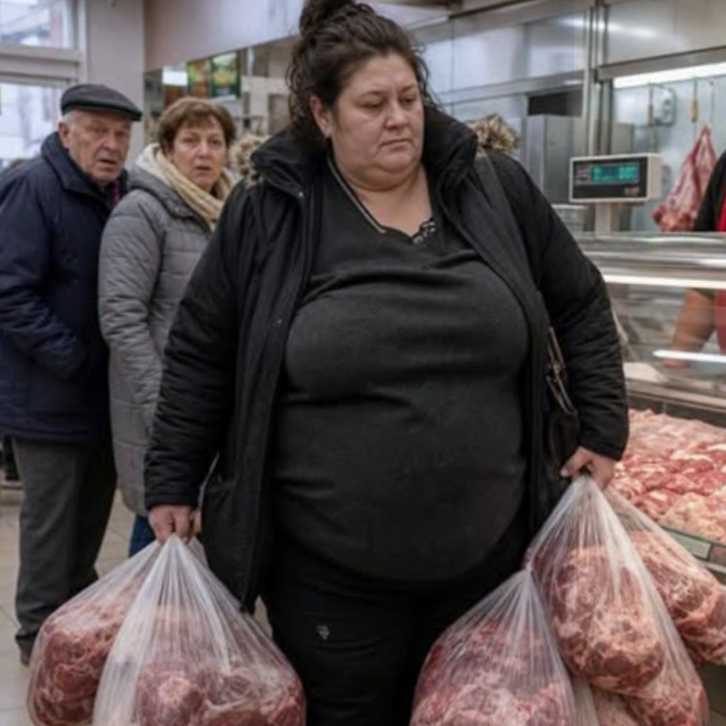
That morning, Lida Stepanovna demanded something at the butcher shop that froze the knife in my hand—sixty kilograms of beef.
It was seven in the morning. The street was still heavy with night dampness, and steam hung over the shop display window like a thin curtain. Lida Stepanovna was always the first customer. Until now, she used to buy about two hundred grams of the cheapest cut and a few bones. But now she stood at the wooden counter, counting old, repeatedly folded banknotes in front of me.
— “Sixty kilos, Ostap,” she told me, as if ordering ordinary bread.
— “Sixty?” I repeated involuntarily.
— “You heard right. Just pack it quickly.”
Her fingers trembled so violently that one of the banknotes fell to the floor. She bent down, but her knee gave out. I reached down first and picked it up.
— “Do you need help?”
— “I don’t need anyone’s help,” she snapped, snatching the money back. “My boy has returned home. We need to set a big table.”
Something in her words didn’t fit, like a key wrongly inserted into a lock. I knew that her son, Maksim, had been buried four years ago. Half the town had attended that funeral.
— “Maksim returned?” I asked carefully.
Lida looked at me. There was such coldness in her eyes, as if my question were an insult.
— “He’s home, Ostap. Don’t ask me anything else.”
I began arranging the meat packages on an old handcart. I wrapped each parcel in thick brown paper and marked the weight with blue chalk. That small mark usually meant nothing, but that day, every chalk line burned unnaturally into my memory.
Lida took hold of the cart handle and stepped out into the street. Remnants of snow crunched underfoot. Meanwhile, I stood by the door for a long time, watching her thin back disappear.
That evening, I dropped by my neighbor Nina’s place to ask casually.
— “Lida Stepanovna’s son…” I began.
Nina set her tea cup on the saucer, her face changing.
— “Maksim? He died four years ago. Why do you ask?”
— “She told me today that he returned home.”
Nina quietly crossed herself.
The next morning, Lida came again. Same time. Same cart. Same sixty kilograms.
— “Ma’am Lida, this is impossible. You live alone.”
— “I don’t live alone.”
— “Then who is in your house?”
She leaned in close and whispered:
— “The ones Maksim left me.”
This time her voice didn’t sound like a threat. It sounded more like a plea. The plea of a person terrified that if she spoke the truth, everything would be stripped away instantly.
Over the following days, the same pattern repeated. Lida bought the meat, loaded it onto the old cart, and headed past the market toward the abandoned factories. Once, I followed her from a distance. The wind carried the scent of rust. At the gate, she looked around several times as if expecting someone, then pushed open the heavy iron door and vanished inside.
An hour later, she emerged. The cart was empty.
That night, I saw her near the trash dumpsters. She was gathering cardboard boxes, sorting plastic bottles, and hiding scrap metal in a small canvas bag. She placed the earned money into the inner pocket of her coat, then checked the pocket repeatedly with her fingers.
The next morning, she requested sixty kilograms of meat once more.
Rumors spread across town. Some said the old woman was hiding something. Others claimed illegal trade was happening at the factory. Eventually, someone called the police.
That same evening, four police cruisers arrived at the rusty gate. Lida stood directly in front of the door.
— “No one goes in here,” she declared.
— “Ma’am, step back,” a young police officer said calmly.
— “If you enter, they will be frightened!”
Something heavy crashed inside. Then came the sound of rapid scratching across the floor.
Lida gripped the lock even tighter, her face draining of color.
— “Ostap, don’t let them…” she said to me.
— “To whom? What are you hiding in there?”
The police officer gently pushed her hand aside. Another shone a flashlight through the narrow gap. An unusual, muffled sound rose from the darkness, and everyone fell silent.
The iron door slowly opened. The officers stepped inside. I followed behind them as the beam of light swept across the floor. At that exact second, the lead officer froze, grabbed his throat, and whispered:
— “This is… impossible…”
His flashlight beam settled directly on something, while Lida moved toward the lock once more…
Part 2
Lida’s hand reached toward the lock, but the young police officer grabbed her wrist.
— “Not anymore, ma’am. Step back.”
— “If you open the door all the way, they will all run away!” she screamed. “You don’t know how frightened they are!”
It was eight in the evening. A damp cold hung inside the factory. Water droplets fell from the ceiling, leaving round, black spots on the floor. In the beam of the flashlights, I saw dozens of wooden crates, old blankets, and empty bowls lined up against the wall.
Then, the first dog emerged from the darkness.
It was a large, emaciated German Shepherd. Its left ear hung limply, and a broad, burned collar mark was visible around its neck. It looked at the police officers, then pressed against Lida, tucking its tail between its legs.
— “There are dogs,” an officer said.
Another appeared behind it. Then two more. Then so many that I lost count.
Some had white spots over their eyes, some were missing a hind leg, and others bore old scars across their bodies. They didn’t bark. They merely breathed, gathering closely around Lida.
I froze in place.
— “Sixty kilograms every day?” I asked, stunned.
Lida lowered her head.
— “Not all of them can eat dry food. Some have damaged jaws. Others’ stomachs no longer work. Maksim knew how to take care of them.”
— “So you gather trash for money to pay for this?”
— “Leaving them behind would have cost me far more.”
The police chief, Irakli Merabishvili, straightened his gloves and surveyed the surroundings.
— “This place isn’t a shelter. There’s no water here, no heat. How many animals are there?”
— “Forty-two,” Lida answered.
— “And who gave you permission to bring them into an abandoned factory?”
— “Maksim.”
— “Maksim died four years ago.”
Lida’s lips tightened.
— “His word hasn’t died for me yet.”
She delivered this response so calmly that even the chief found nothing more to add.
In the factory’s back room stood a small table holding an old scale, a dirty cup, and a red-covered notebook. On every page of the notebook, a name, date, and brief entry were written:
“Buba — left paw, ointment.”
“Nala — stopped shivering.”
“Chito — looked at me for the first time today.”
On the final page, in Maksim’s handwriting, it read: “Mother, if I didn’t make it, they are waiting for you.”
Lida snapped the notebook shut.
— “Take this,” she told me. “Just don’t take the dogs away from me.”
That same night, we called the town veterinarian, Mariam. She examined the animals one by one. She found an old bullet fragment near one dog’s heart. Another had its jaw bound with wire. A third was so terrified it refused to leave the corner.
— “Who did this?” I asked Mariam.
— “Whoever did this lost the right to be called human a long time ago,” she replied.
But the main question remained: why had Lida hidden all of this? Why lied about her son? And why did she stand by the gate every evening as if guarding a living secret from someone?
It was eleven at night when the police discovered a hidden iron box against the back room wall. The moment Lida saw it, all color drained from her face.
— “Don’t open that,” she said.
— “If there’s anything illegal inside, we are definitely opening it,” Irakli countered.
— “My son’s final days are in there.”
Mariam placed a hand on Lida’s shoulder.
— “If you know the truth, tell us now.”
Lida looked at the dogs first, then at me. A small black dog rested its head on her lap and whimpered softly.
— “Maksim wasn’t alone here that night,” she said. “And whoever brought him here still walks this town.”
Silence fell over the room so heavily that even a drop of water falling from the ceiling sounded like a gunshot.
Irakli placed the iron box on the table. The key hung around Lida’s neck alongside a small wooden bead.
— “Open it,” he told her.
Lida unclasped the bead, cupped the key in her palm, and slid it into the lock. But before she could turn it, her phone rang from an unknown number.
She answered.
She listened for a few seconds. Then she slowly lowered the receiver, and for the first time, genuine fear appeared in her eyes.
— “Who was it?” I asked.
Lida murmured:
— “They told me to go to Maksim’s grave in the morning… alone…”
And right then, the lock of the iron box clicked from inside…
Part 3
The lock of the iron box clicked from inside, even though nothing living should have been inside it.
Everyone stepped back. Only Lida didn’t move. She laid both hands on the box and closed her eyes.
— “Mother, open it,” a small, raspy voice sounded.
Mariam looked at me in terror.
Lida turned the key. The lid lifted, revealing a small voice recorder hidden inside. Beside it lay water-damaged documents, several photographs, and a sheet of paper written in Maksim’s handwriting.
Lida pressed the play button on the recorder.
First we heard the sound of wind and creaking metal. Then a young man’s breathing.
— “If you are listening to this, Mother, I probably didn’t make it back home.”
Lida’s knees gave out. I reached out to support her, but she shook her head.
— “No. I need to hear it to the end.”
Maksim’s voice continued in the recording:
— “The factory owner hid these dogs here. He planned to sell them, but the animals were sick and no one would buy them. He told me to kill them all, and after burning the building down, everything would look like an accident. I refused. I switched on the camera and saved the list.”
Irakli slammed his fist onto the table.
— “Who was the owner?”
For a few seconds in the recording, only heavy breathing could be heard.
— “Mother, if the police come, don’t trust everyone on the first day. Call Davit Koberidze. He’s the temporary manager of this factory and knows everything. He has money, connections, and every reason to make this recording disappear.”
Mariam turned pale.
— “Davit Koberidze? But he works at the city council!”
Lida nodded slowly.
The recording played on:
— “I can’t leave the dogs. If I don’t survive, their lives will be in your hands. Don’t sell the house. Don’t beg anyone for mercy. They need sixty kilos of meat every day until you find a shelter. And if anyone asks you why you are doing this, tell them that your boy returned home.”
The recording ended there.
No one spoke. Tears streamed down Lida’s face, but she made no sound. The largest Shepherd—the one with the burn mark on its collar—approached the box slowly and rested its nose against Maksim’s photograph.
For the first time, I understood why Lida kept saying her son was home. Maksim was gone, but his promise was breathing inside this factory.
— “How did he die?” I asked.
Lida ran her finger over the photograph.
— “A truck ran him down on the road. He was trying to rescue two dogs from here that night. The driver didn’t stop.”
Irakli spread out the documents. Inside were illegal land transfers for the factory, animal sale ledgers, and a copy of a video recording. Davit Koberidze’s signature was stamped on the final page.
— “This is sufficient for an investigation,” he said.
Suddenly, Lida’s phone rang again. This time the call came through to Irakli’s number.
He answered and listened for a few seconds.
— “Yes, speaking.”
His expression hardened gradually.
— “No, you won’t close this case. We’ve already found the recording.”
He hung up the phone.
— “Who was it?” I asked.
— “My supervisor. He told us not to open the box and to clear out all the animals by morning.”
— “Why?”
Irakli offered no answer. Right then, a black car pulled up in the factory yard. Davit Koberidze stepped out, dressed in a spotless coat with a calm smile, as if a festive banquet awaited him here instead of dogs and fear.
— “Ma’am Lida,” he said, “you’ve gotten yourself into very serious trouble.”
Lida pressed the recording against her chest.
Davit looked at her first, then at Irakli, and finally at me.
— “The existence of Maksim’s recording means nothing yet,” he said. “Because none of you realize who you are standing against.”
He raised his phone. A single text message was visible on the screen:
“If she doesn’t show up in the morning, we will reopen her son’s death case too.”
Lida saw the message and sat down heavily on a chair.
— “Maksim’s death was no accident,” she said quietly.
For the first time, Davit lost his smile.
Yet he didn’t realize yet that the heaviest piece of evidence was hidden not in the factory box, but inside my coat pocket…
მისი საკუთარი ხმა ყველამ ერთად მოისმინა…
მეგონა, საიდუმლო უკვე გახსნილი იყო, მაგრამ ნამდვილი ბრძოლა სწორედ მაშინ დაიწყო.
ფინალმა ყველაფერი სხვა სინათლეში დამანახა.
„შემიძლია ხვალ დილა სხვანაირი გავხადო.“
მე პირველად ვიგრძენი, რომ სიმართლე მშვიდადაც იმარჯვებს.
👇 ისტორიის ფინალი უკვე გახსნილია
Related posts:
 Part 4 — Every morning, I used to buy sixty kilograms of meat for the old man, but when the gate was opened, the policeman turned pale.
 I was ordered to feed the city’s most feared man, but when he tasted my burnt garlic, his expression suddenly changed
 After the accident on the coastal road, the police officer called my words a lie, but then suddenly turned pale.
 A Decorated SEAL Knocked My Tray Down and Called Me an Office Girl—Then the Admiral Entered, and His Smile Vanished
 I came home early and found a stranger wearing my robe, but the moment he saw my key, his confidence vanished
 My husband pushed me from a frozen cliff, then complained at my funeral that I had taken too long to die—and someone went pale