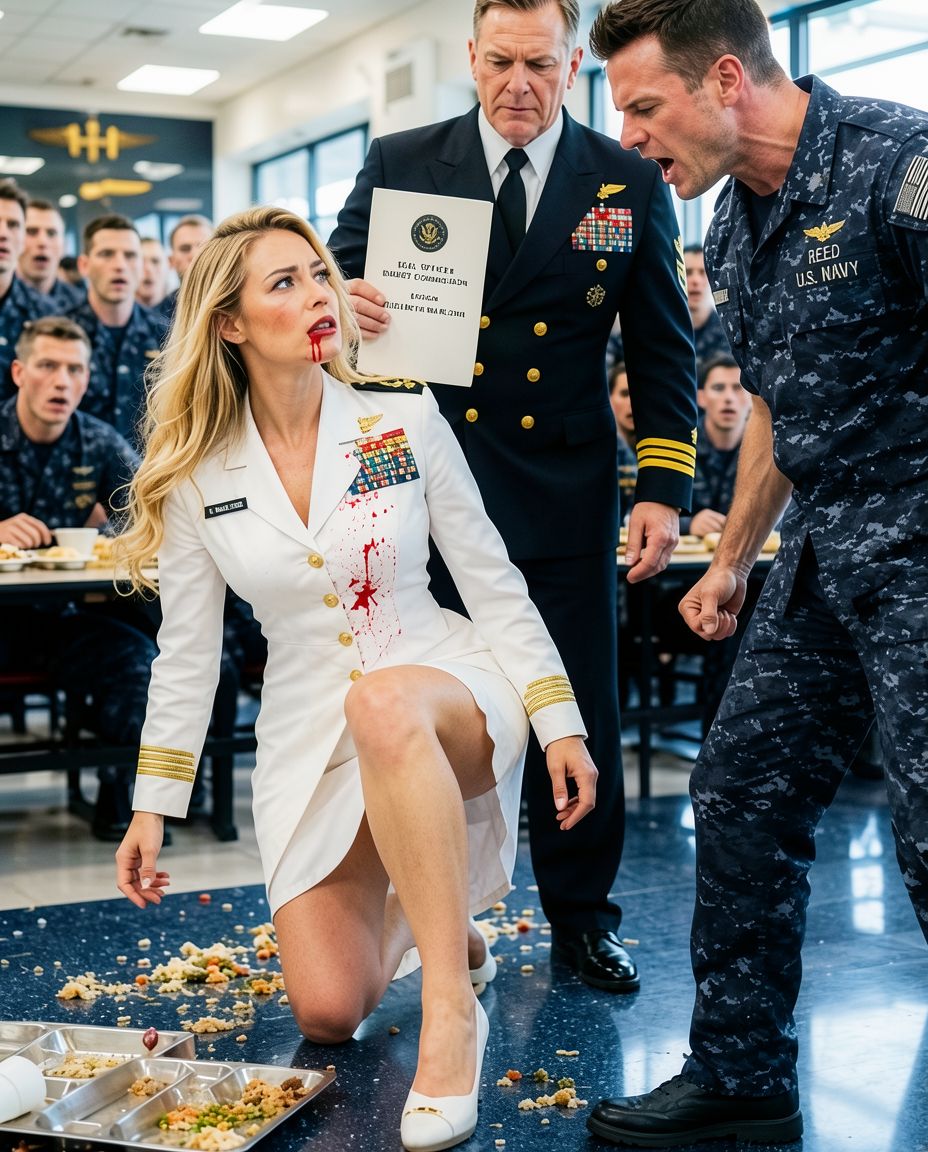
Chief Walker Reed’s fist struck my ribs so hard that my tray flew from my hands and clattered across the naval mess hall floor.
Rice scattered beneath the tables. Mashed potatoes slid beneath a bench. A plastic cup spun in a slow circle until it struck the toe of Reed’s polished boot.
I dropped to one knee, tasting blood where my teeth had cut the inside of my mouth.
Nobody spoke.
There were seventy-eight recruits in the room, nine instructors, one corpsman, and three security cameras mounted high above the serving line. I noticed all of them before I looked at the man standing over me.
Reed was a decorated Navy SEAL. His name was stitched above a row of ribbons on his green uniform, and recruits whispered about him as if he were carved from steel.
He smiled down at me.
“Didn’t know they let office girls eat with warfighters,” he said.
My ribs burned with every breath.
“Pick it up.”
A recruit near the coffee station lowered his eyes. Someone shifted a chair. No one stepped forward.
I pressed my palm against the floor and rose slowly. The small brass compass sewn into the inside hem of my navy cardigan tapped against my hip. My father had given it to me before his last deployment, telling me that panic made people lose direction.
I had carried it through twelve years of military service.
Reed leaned closer.
“You deaf, Hart?”
I wiped the blood from my lip with the back of my hand.
“No.”
“Then move.”
I looked at the food, then at his boots. They stood several inches beyond the red boundary line painted across the tile.
That mattered.
I took one measured breath. Four seconds in. Hold two. Six seconds out.
An old master chief had taught me that rhythm when I was twenty-two and terrified before my first field evaluation.
Don’t fight the room. Read it.
So I read everything.
The camera above the exit had a clean view of Reed’s right shoulder. The corpsman had already reached for his medical bag. Lieutenant Harris, one of the instructors, was staring at Reed’s boots instead of my face.
Interesting.
Reed stepped closer.
“You got something to say, office girl?”
“Yes.”
His smile widened.
I met his eyes.
“You drop your right shoulder before you punch.”
The amusement vanished from his face.
“What did you say?”
“Your left knee compensates for an old ligament injury. You hide it on pavement, but not on tile.”
A murmur passed through the recruits.
Reed’s jaw tightened.
“You think you’re an investigator?”
“No,” I said. “I pay attention.”
His shoulder shifted.
I knew exactly what came next.
Then the mess hall doors flew open, and every head turned as Admiral Richard Bennett entered with three senior officers behind him. Reed snapped to attention, but the admiral walked past without returning the salute.
His eyes locked on me.
Then he looked at the blood on my mouth, the food on the floor, and the sealed black folder in his hand.
He stopped in front of me.
“Ma’am,” he said, loud enough for everyone to hear, “we weren’t expecting you until tomorrow.”
Reed’s face went white.
The admiral finally turned toward him.
“Chief Reed,” he said quietly, “do you have any idea who you just assaulted?”
His hand moved toward the clasp of the sealed folder…
PART 2
His hand moved toward the clasp of the sealed folder, but before he opened it, Lieutenant Harris stepped forward.
“Admiral, there’s been a misunderstanding.”
Bennett did not look at him.
“Is that what you call a closed-fist strike?”
Harris swallowed. The metal whistle hanging from his neck tapped against his belt buckle.
Reed remained rigid, but a muscle jumped in his cheek.
“She was provoking me,” he said.
I almost laughed. My ribs hurt too much.
“By standing in line?” I asked.
His eyes snapped toward me.
Bennett raised one hand.
“Enough.”
The word cut through the room.
A corpsman approached with gauze, but I shook my head.
“I’m fine.”
“You’re bleeding,” the corpsman said.
“I noticed.”
The admiral studied me for half a second, then nodded toward the cameras.
“Secure the footage. No one leaves until statements are taken.”
That was when Reed finally understood this was not going to disappear behind a barracks door.
“Sir,” he said, “I had no idea she was attached to the command.”
Bennett’s expression hardened.
“That would not make the assault acceptable.”
“No, sir.”
“And calling a commissioned officer an office girl?”
The room seemed to shrink around us.
Reed turned toward me so quickly that the corpsman flinched.
“You’re an officer?”
I touched the brass compass beneath my cardigan.
“Lieutenant Commander Evelyn Hart.”
Several recruits gasped. Reed stared at the plain silver bars on my collar as though they had appeared there by magic.
He had seen my civilian-looking cardigan, my tablet, and the temporary access badge clipped to my pocket. He had decided what I was before asking a single question.
Bennett opened the folder.
The paper inside was thick and marked with red classification stamps. He did not hand it to me. He simply held it where Reed could see the seal.
“Lieutenant Commander Hart has been appointed acting director of the Joint Readiness Integrity Task Force,” he said. “Her first assignment is an investigation into missing training funds, falsified qualification records, and retaliation against personnel who reported irregularities.”
No one moved.
My investigation.
For six months, I had followed numbers that refused to line up. Equipment invoices for boats that never arrived. Overtime payments to instructors who were not on base. Medical waivers signed after the dates of supposed injuries.
Every trail led back to this training command.
And every witness who tried to speak had suddenly requested transfer.
Reed’s face changed, but not with shame. With calculation.
“I’ve never seen those documents,” he said.
“You weren’t supposed to,” I replied.
His fingers curled into fists.
Bennett’s gaze dropped to them.
“Chief, keep your hands open.”
Reed obeyed.
The security officer began collecting names. Harris kept insisting that the cameras had malfunctioned earlier that week. The corpsman pressed gauze to my lip while I watched Reed glance toward the side exit.
He was not afraid of the punch being recorded.
He was afraid of something else.
At 8:17 that evening, I sat in a small interview room beneath the administration building. A ceiling fan clicked once every rotation. Across from me, Special Agent Nora Ellis placed a paper cup of cold coffee beside her recorder.
“You knew he would attack you,” she said.
“I knew he was looking for a reason.”
“You walked into the mess hall alone.”
“I needed him to believe I was alone.”
Ellis leaned back.
“What did you put in the folder you carried this morning?”
I looked at the little compass on the table between us.
“Nothing.”
Her eyes narrowed.
“Then why did you keep touching it?”
Before I could answer, the lights flickered. A security officer hurried into the room holding a fresh evidence bag.
Inside was a brass key stamped with the number seventeen.
“It was found inside your locked office,” he said. “The lock was forced from the inside.”
Ellis stood.
“Who has access?”
The officer looked at me.
“Only you, Admiral Bennett, and Chief Reed.”
My stomach tightened.
Then my phone rang. The screen showed my younger brother Daniel’s number, but when I answered, I heard a stranger whisper:
“Stop looking at the ledger, Lieutenant Commander, or your brother won’t make it home tonight…”
PART 3
“Stop looking at the ledger, Lieutenant Commander, or your brother won’t make it home tonight…”
The line went dead.
For one second, I could hear nothing except the ceiling fan clicking above me.
Then I called Daniel back.
Straight to voicemail.
Again.
Nothing.
Nora Ellis took the phone from my hand.
“Tell me everything about your brother.”
“Daniel works at the harbor clinic. He was supposed to call me at eight.”
“Does anyone here know that?”
“Reed does.”
The door opened before she could respond. Admiral Bennett entered with two military police officers and a woman carrying a laptop.
“Daniel is safe,” he said.
My knees nearly gave way.
“What?”
“He left the clinic at 7:52. We found him at a gas station six miles away. Someone had followed him, but he got away.”
Relief struck so sharply that it felt like another blow to my ribs.
Bennett placed the sealed folder on the table.
“The threat was meant to make you open this in fear,” he said. “You’re going to open it now, calmly.”
My fingers broke the seal.
Inside were photographs, bank transfers, medical forms, and a sworn statement from Lieutenant Harris.
I stared at the first page.
The missing funds had been routed through a veterans’ charity controlled by Reed’s former commanding officer. Harris had altered training records to protect the payments. In return, Reed had intimidated recruits, injured whistleblowers, and made every complaint look like a discipline problem.
But the last document was worse.
It was a recording transcript dated three months earlier.
Reed’s voice appeared beneath a time stamp.
“Put the names on the waiver list,” he had said. “If they complain, call them unstable. If they keep talking, make them afraid.”
Harris’s voice answered, “And Hart?”
Reed had laughed.
“She’s an office analyst. One public humiliation and she’ll request reassignment.”
My hands went cold.
The laptop operator played the video.
The image showed Reed and Harris inside the records room. Reed stood beside a locked cabinet while Harris carried folders into a shred bin. On the desk lay the same brass key stamped seventeen.
Reed’s recorded voice filled the interview room.
“Bennett wants Hart here tomorrow,” he said. “She cannot see the audit. Destroy the original forms tonight.”
Harris began to cry before the video ended.
“That isn’t the whole story,” he whispered. “Reed forced me.”
“You signed every page,” Bennett said.
“I was afraid.”
“So were the recruits you helped destroy.”
Reed had been brought into the room by the military police. When the recording finished, he stared at the screen as if hearing another man speak.
Then he looked at me.
“You set me up.”
“No,” I said. “You believed I was harmless.”
His eyes dropped to the compass on the table.
“That thing,” he muttered. “You’ve been recording with it?”
“It is a compass.”
For the first time, his confidence cracked completely.
Bennett signed the order transferring Reed from command custody to investigative detention. Harris surrendered his access card. Nora Ellis began reading the charges in a voice as steady as rain.
I thought the nightmare was finally visible.
Then the woman with the laptop received an alert and went pale.
“Admiral,” she said, “there’s been a data breach.”
Bennett turned.
“What was taken?”
She looked at me.
“Not the financial records. The personnel files.”
A second alert appeared.
Daniel’s name was highlighted in red.
Bennett’s phone rang. He answered, listened, and slowly lowered it.
“Someone just accessed the emergency relocation database,” he said.
My blood turned to ice.
“Where is Daniel now?”
The admiral looked toward the armed officers by the door.
“He’s on his way here.”
Outside, tires screamed against the pavement.
Then every light in the building went out…
He heard his own voice—and finally understood what it had cost…
I thought the evidence would be the end of the nightmare.
I was wrong. The final turn changed what freedom meant to me.
“You knew I was a person.”
For once, he had no answer.
👇 The finale is already open.
Related posts:
 PART 4 — A Decorated SEAL Knocked My Tray Down and Called Me an Office Girl—Then the Admiral Entered, and His Smile Vanished
 The admiral mocked my call sign during graduation, but when one operator stood up, his smile vanished
I brought my daughter to the Cole mansion for one dinner, but when Julian saw her sleeve, his polite smile vanished
I told my former love the child in my arms was his, and when he saw the letter, his fiancée stopped smiling
The admiral mocked my call sign during graduation, but when one operator stood up, his smile vanished
I brought my daughter to the Cole mansion for one dinner, but when Julian saw her sleeve, his polite smile vanished
I told my former love the child in my arms was his, and when he saw the letter, his fiancée stopped smiling
 When my husband’s family broke my leg and my husband told me to submit, the smile vanished from his face three days later.
 I was ordered to feed the city’s most feared man, but when he tasted my burnt garlic, his expression suddenly changed