PART 4
Then every light in the building went out.
For three seconds, the base disappeared into darkness.
Someone shouted near the corridor.
A door slammed.
I heard the sharp metallic click of a weapon being readied, and then emergency lights flooded the room in red.
Nora Ellis grabbed my arm.
“Stay behind me.”
“I’m not hiding.”
“You’re bleeding through your shirt.”
“I can do both.”
Admiral Bennett was already speaking into his radio.
“Lock down every gate. No vehicles leave. Find Daniel’s escort.”
A military police officer ran in.
“His vehicle is at the south entrance, sir. Empty.”
The room seemed to tilt.
“No,” I whispered.
Bennett looked at me.
“Evelyn.”
“He was supposed to be here.”
“He may have taken another route.”
“My brother never takes another route without calling me.”
Nora pointed to the laptop.
“Someone used Daniel’s credentials again.”
The screen showed a new location: the abandoned communications warehouse behind Pier Six.
Reed smiled.
It was the first smile he had worn since the mess hall.
“You people are wasting time,” he said.
I turned toward him.
“What do you know?”
“I know your brother is alive.”
Nora stepped close to him.
“Where is he?”
Reed said nothing.
Bennett leaned over the table.
“Chief, this is your final opportunity to cooperate.”
Reed’s gaze settled on me.
“He should have stayed out of it.”
I felt the old instinct rise in me—the need to force an answer, to attack the fear before it grew teeth.
But the compass pressed against my palm.
Panic made people lose direction.
I took one breath.
Then another.
“Search Pier Six,” I said. “But don’t use the main entrance.”
Nora frowned.
“Why?”
“Because he wants us to rush there. The access breach came from inside this building.”
Bennett’s face changed.
He looked at Lieutenant Harris.
Harris backed away from the door.
“I didn’t do anything.”
“You knew about the warehouse,” I said.
“I only heard Reed mention it.”
“Then tell us what you heard.”
Harris pressed his fingers against his mouth. The red light made his face look bloodless.
“Reed kept duplicate files there,” he said. “He said they were insurance.”
“Against whom?”
“Everyone.”
A burst of static came over the radio.
Then Daniel’s voice broke through.
“Evelyn, don’t come here.”
My heart stopped.
“Daniel? Where are you?”
“Under the warehouse. There’s a service tunnel. I found the files.”
Reed lunged toward the radio, but two officers forced him back.
Daniel continued, breathless.
“He knows I’m here. He said if I touch the blue case, he’ll—”
The transmission cut out.
Bennett pointed at the officers.
“Move.”
We reached Pier Six in four minutes.
Rain hammered the corrugated roof. The warehouse smelled of salt, diesel, and wet rope. A single bulb swung above the loading entrance, throwing shadows across the concrete.
Nora held up a fist.
“Wait.”
From beneath the floor came three knocks.
Then three more.
Daniel’s signal from childhood. When our father was deployed, we used it through apartment walls so we could find each other during storms.
I dropped to my knees and pressed my ear to the concrete.
“Daniel!”
“Here!”
A concealed metal hatch opened near the old winch. He crawled out with a split lip and one hand clamped around a waterproof case.
I pulled him against me.
“I told you not to come.”
“You always say that after I ignore you.”
I laughed once, nearly sobbing.
“What happened?”
“Reed’s partner grabbed me at the clinic. I got free when he stopped to call someone. I followed the access signal here.”
He held up the case.
“This was under the stairs.”
Inside were payment ledgers, photographs, and a small memory card sealed in plastic.
Nora stared at it.
“Where is Reed’s partner?”
A voice answered from the darkness behind us.
“Gone.”
We turned.
A man stepped beneath the swinging bulb. He wore a civilian raincoat, but the tattoo on his wrist matched the symbol on Reed’s old unit photograph.
His pistol was aimed at Daniel.
“Drop the case,” he said.
I moved between them.
“Your name is Marcus Vale.”
His eyes narrowed.
“You’ve seen my file.”
“I read all of them.”
“You read too much.”
“Then you know shooting my brother won’t erase what’s inside that case.”
He glanced at the officers gathering behind me.
“You think paperwork saves people?”
“No,” I said. “People do.”
He fired.
The shot struck the hanging winch above us. Metal screamed. Nora tackled me as the officers returned fire. Vale ran toward the tunnel, but Daniel kicked the loose hatch into his path.
Vale fell hard.
Within seconds, he was disarmed and handcuffed.
The memory card contained everything.
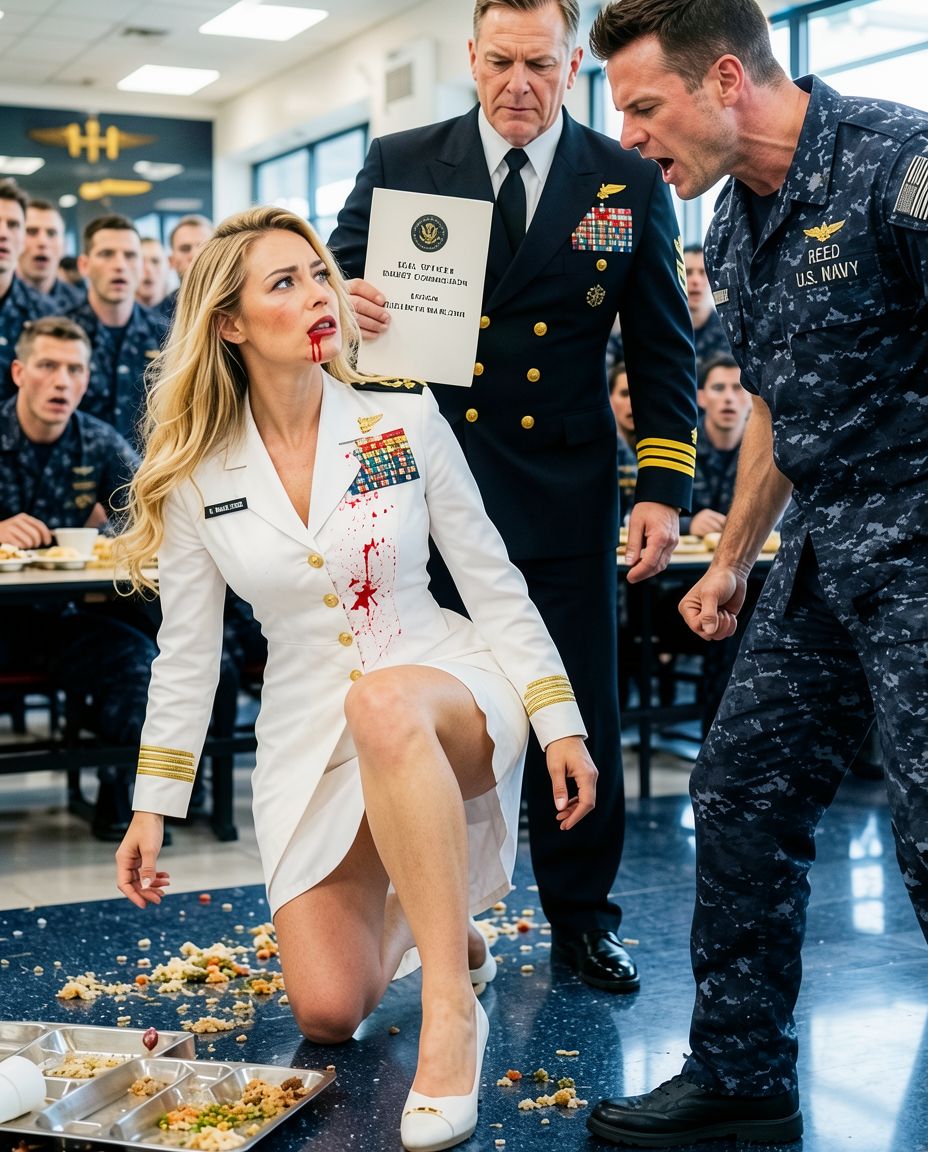
It showed Reed receiving cash, Harris altering records, Vale threatening whistleblowers, and senior contractors approving fraudulent invoices. The final recording showed Reed ordering the attack in the mess hall.
“Make her afraid,” he had said. “After tonight, Hart will leave.”
The next morning, Reed heard those words in a secure interview room.
He sat across from me with his wrists cuffed to the table. His medals had been removed. Without them, he looked smaller, almost ordinary.
The recording played through a speaker.
His own voice filled the room.
“Make her afraid.”
Reed stared at the wall.
“That was taken out of context.”
Nora stopped the recording.
“Which part?”
“I was talking about pressure during an operation.”
“You named her,” I said.
“I didn’t know she was an officer.”
“You knew I was a person.”
His mouth tightened.
For the first time, he looked ashamed.
Not because he had hurt me.
Because the consequences had finally reached him.
His attorney arrived at noon and refused to speak for several minutes after reviewing the evidence.
Then she closed the folder.
“Chief Reed, I cannot advise you to deny the assault. There are three camera angles, six witness statements, and your own recorded admission.”
Reed stared at her.
“You’re my lawyer.”
“I am not a miracle worker.”
By evening, every officer involved had been suspended pending trial. The stolen funds were frozen. The recruits who had been silenced were interviewed privately, without instructors present. Some cried. Some shook with anger. One young sailor simply placed his statement on the table and said, “I thought nobody would believe me.”
I believed him.
That was where the real repair began.
Three days later, I returned to the mess hall alone.
The tile had been cleaned, but one pale scratch remained near the red boundary line. A facilities worker had missed it beneath the serving table.
I stood there with my hand over the brass compass.
The room was empty except for the humming refrigerators.
On the floor lay a single plastic fork, forgotten beneath a chair.
I picked it up and threw it away.
Then I ate lunch at the table where Reed had tried to make me kneel.
A week later, the command emptied his office.
His photographs came down first.
The awards followed.
The last thing left on the wall was a rectangular patch of unfaded paint where his unit flag had hung. A clerk placed his belongings into cardboard boxes, but one photograph remained on the desk: Reed standing beside his father at a graduation ceremony, both of them smiling beneath a bright summer sky.
I did not touch it.
His life was no longer mine to rearrange.
Six months passed.
I moved to Norfolk and accepted the permanent position leading the integrity task force. My office overlooked the harbor, where tugboats groaned awake before sunrise and gulls screamed over the pilings.
Daniel recovered fully. He still complained about my security habits, especially the way I checked every reflection in a window.
“You know,” he said one Saturday morning, “most sisters just ask whether you want pancakes.”
“Most sisters don’t have brothers who follow armed conspirators into warehouses.”
He slid a plate toward me.
“Fair.”
The first snow came in January.
It dusted the harbor railings and turned the sidewalks white. Daniel’s daughter, Lily, visited that weekend and drew a picture at my kitchen table. It showed three stick figures holding hands beneath a yellow sun, even though the real sky outside was silver.
She added a tiny circle near my pocket.
“What’s that?” I asked.
“Your compass,” she said. “So you can always find us.”
I had never told her why I carried it.
Some things traveled through families without needing explanation.
My new routine was quiet. Coffee at six. Reports before breakfast. Walks along the water after work. On Fridays, I bought cinnamon rolls from a bakery near the courthouse and brought one to Daniel.
Peace did not arrive like a parade.
It arrived as ordinary mornings that no longer required armor.
Then, eleven months after the mess hall, a message appeared on my secure phone.
From Reed.
I stared at his name for a long time before opening it.
I am asking for a meeting. I owe you an apology. I want to explain what happened.
A second message followed.
You know I was never a monster.
I set the phone down.
Daniel watched me from across the kitchen.
“Are you going to answer?”
“I already did.”
He glanced at the screen.
“There’s nothing there.”
“Exactly.”
For years, I had mistaken silence for surrender. I had believed that if I explained myself clearly enough, worked hard enough, forgave quickly enough, other people might choose to become better.
That was not my job.
Reed had made his choices in a crowded room, with cameras watching and witnesses standing close enough to hear my tray hit the floor.
I did not need to rescue him from the truth.
I deleted the message.
That evening, I walked beside the harbor while snow gathered on the railing. The brass compass rested beneath my coat, warm from my hand.
The needle trembled once.
Then it settled north.
I kept walking.
Missed the beginning?
Related posts:
 A Decorated SEAL Knocked My Tray Down and Called Me an Office Girl—Then the Admiral Entered, and His Smile Vanished
 When my husband’s family broke my leg and my husband told me to submit, the smile vanished from his face three days later.
 I was ordered to feed the city’s most feared man, but when he tasted my burnt garlic, his expression suddenly changed
I brought my daughter to the Cole mansion for one dinner, but when Julian saw her sleeve, his polite smile vanished
I was ordered to feed the city’s most feared man, but when he tasted my burnt garlic, his expression suddenly changed
I brought my daughter to the Cole mansion for one dinner, but when Julian saw her sleeve, his polite smile vanished
 My Ex Called Me a Liar, Gave My Best Friend’s Baby His Name, and Raised Him as His Son—Until One Terrifying Hospital Night Revealed Whose Child He Had Really Abandoned
I told my former love the child in my arms was his, and when he saw the letter, his fiancée stopped smiling
My Ex Called Me a Liar, Gave My Best Friend’s Baby His Name, and Raised Him as His Son—Until One Terrifying Hospital Night Revealed Whose Child He Had Really Abandoned
I told my former love the child in my arms was his, and when he saw the letter, his fiancée stopped smiling