Part 4
For a few seconds after my mother’s final words, no one in the room moved.
Then everything set into motion all at once.
The police officer spoke into his radio. The lawyer pulled out his phone. Claire held the boys even tighter against her chest, and from behind her shoulder, I saw their tiny hands tightly laced together.
— “What is in that room?” I asked my mother.
— “Nothing like what you think.”
— “Then why are you afraid?”
She didn’t answer me.
The lawyer pulled me to the side.
— “Mr. Nikoloz, it would be best right now if you moved your mother to a private residence. A public confrontation will only hurt everyone involved.”
— “You hid the truth from me for six years.”
— “I was merely following Mrs. Tamar’s instructions.”
— “And now?”
The man stared at me for a long time.
— “Now I am an attorney, not someone who will defend a lie. I will no longer represent her in this case.”
He placed his leather folder on the table and stepped back.
My mother’s phone rang again. This time it was a call from Marina. Tamar didn’t answer. A few seconds later, a voicemail arrived.
The police officer received permission and played it over the speaker.
I heard my mother’s own voice, older and sharper than on the previous recording.
“Do not contact Claire. Nikoloz is in Lisbon, and once he returns, I will resolve everything myself. If necessary, I will claim that the children are ill and that coming near them poses a danger.”
My mother lowered her eyes.
For the first time, she heard her own words the way the rest of us did.
An expression washed over her face—the kind that takes hold of a person when they realize they can no longer run from what they have said.
— “I was simply protecting the family,” she whispered.
— “You weren’t protecting the family. You were protecting your own power,” I answered.
The officers escorted her to the side. No one was shouting. Nor did I take any joy in her fear.
I simply felt that for six years, I had relied on my mother for protection, but now, for the first time, I was no longer obligated to cushion the consequences for her.
That evening, we went to Claire’s old apartment.
The building sat on the edge of the city. The scent of damp stone filled the hallway, and the paint was peeling off the staircase railing in patches. Claire unlocked the door carefully.
The boys stood right behind her.
— “You lived here?” I asked.
— “Until your mother’s people showed up.”
The living room was virtually empty. Two mattresses rested against the wall, and the curtain drawn across the window had a large tear down the middle.
A small wooden shelf stood in one corner. Only a single photograph remained on it.
In the photo was a young Claire—pregnant, exhausted, yet smiling. She was holding the very wooden toy airplane whose broken wing I had seen at the airport.
— “Why did you leave this behind?” I asked.
— “Because I thought that if you ever came back, you would see it.”
On the back of the photo, a small inscription read: “For Nikoloz, so he never thinks we never existed.”
The words struck deep into my chest.
That night, I sat in the same room with the boys for the first time.
The older one was named Luka, and the younger one was Niko. They were five years old, but they finished each other’s sentences. Luka used his right hand, while Niko used his left. As bedtime approached, both of them asked the exact same question.
— “Will you come back tomorrow?”
— “Yes,” I told them.
— “And the day after?”
— “The day after, too.”
Claire looked at me from the doorway.
— “You need to handle promises carefully.”
— “I know.”
— “You didn’t know much back then.”
— “I’m starting to learn now.”
The next morning, the police received the keys from the landlord and opened the room my mother had mentioned at the airport.
The room was small, its window sealed off with bricks. Wooden boxes sat stacked beneath layers of dust inside.
In the first box, we recovered Claire’s medical records. In the second box lay my old letters and printed message logs. Every envelope had been opened, yet the letters remained untouched.
In the third box, they found a formal declaration bearing my signature, purporting that I surrendered all parental rights over the children.
— “That isn’t my signature,” I said.
Claire looked down at the document.
— “Your mother had copies from your old contracts.”
The forensic evaluation took two weeks.
It proved that the signature had been forged. Furthermore, the letters had been intercepted and sent from the very same private post box my mother used for hotel business transactions.
The DNA test results arrived that same day.
Luka and Niko were my sons.
Both of them.
I already knew it in my heart, but seeing the truth written down on paper felt heavy nonetheless. Claire held the paper in her hand and lowered her eyes.
— “You can leave now if you want,” she told me.
— “Go where?”
— “Back to your former life.”
— “It doesn’t exist anymore.”
— “You might still miss it.”
— “I missed you for six years. Now, all I want is what was lost.”
The investigation reached the courtroom.
My mother denied everything at first, then claimed she was trying to protect Claire, and finally admitted to concealing the letters out of fear that my career and our family name would be ruined.
She sat two seats away from me in the courtroom.
The judge reviewed the documents and asked:
— “Mr. Nikoloz, do you wish for the prosecution to seek a harsher penalty?”
Tension tightened across my mother’s face.
I looked at Claire. She held Luka’s hand, while Niko stood pressed against her knee.
— “I want the law to be enforced,” I said. “But I am not asking for revenge.”
My mother did not receive probation. She was handed an eighteen-month prison sentence, a heavy fine, and a strict restraining order barring any direct contact with us. A portion of her assets was transferred into an educational trust fund for the children, as the court established that those funds had previously been deployed to intimidate Claire.
I didn’t look at her with a triumphant expression.
As I walked out of the courthouse, she addressed me only once.
— “Nikoloz, I wanted to protect you.”
— “It isn’t protection when you strip a person of their right to choose.”
— “I am your mother.”
— “I know. That’s why it hurts.”
Then I walked away.
Three months later, we moved to a new city.
We rented an apartment in a small coastal town where fishermen’s boats were visible in the morning and the scent of salt hung in the streets by evening. I continued managing the hotel remotely, but two days a week, I worked alongside the boys in a small workshop.
Luka painted wooden toys.
Niko attached strange, spinning wings onto them.
One morning, when the first snow fell, the boys pulled me over to the window.
— “Dad, we have to draw our family at school today,” Luka told me.
— “And what are you going to draw?”
— “Four people.”
— “Four?”
— “Me, Niko, Mom, and you.”
Niko added a fifth, tiny figure onto the paper.
— “Who is that?” I asked.
— “The woman who doesn’t scare us anymore,” he said.
Claire stood in the kitchen pouring tea. Her eyes welled with tears, but she didn’t cry.
It was then I realized that a new life doesn’t start with loud declarations.
It starts when a child asks you in the morning if you will stay, and for the very first time, you can answer without a second thought—yes.
A few weeks later, I received a letter from my mother sent from prison. It contained a short message: “I’m not asking you to forget me. Just come and listen to me once.”
Claire set the letter on the table.
— “Do you want to go?”
I stared at the envelope for a long time.
— “No.”
— “Are you sure?”
— “For the first time in my life, I am.”
I didn’t burn the letter, nor did I write back. I simply placed it in a drawer alongside the boys’ birth certificates and the court verdict.
I didn’t want to erase the past.
I just didn’t want to live for it anymore.
That evening, Luka brought over the wooden toy airplane—the same one I had found at Claire’s feet in the airport. He had already repaired the broken wing and repainted it yellow.
— “Will it fly now?” he asked me.
— “If you launch it well, it will fly.”
Niko opened the window. Outside, the first snow fell gently across the yard.
I took the airplane in my hand and looked at the boys. For six years, I believed that I had to reclaim a lost life.
But life doesn’t turn back.
It waits for you up ahead.
I launched the wooden airplane into the falling snow.
And this time, no one tore us apart.
Missed the beginning?
Related posts:
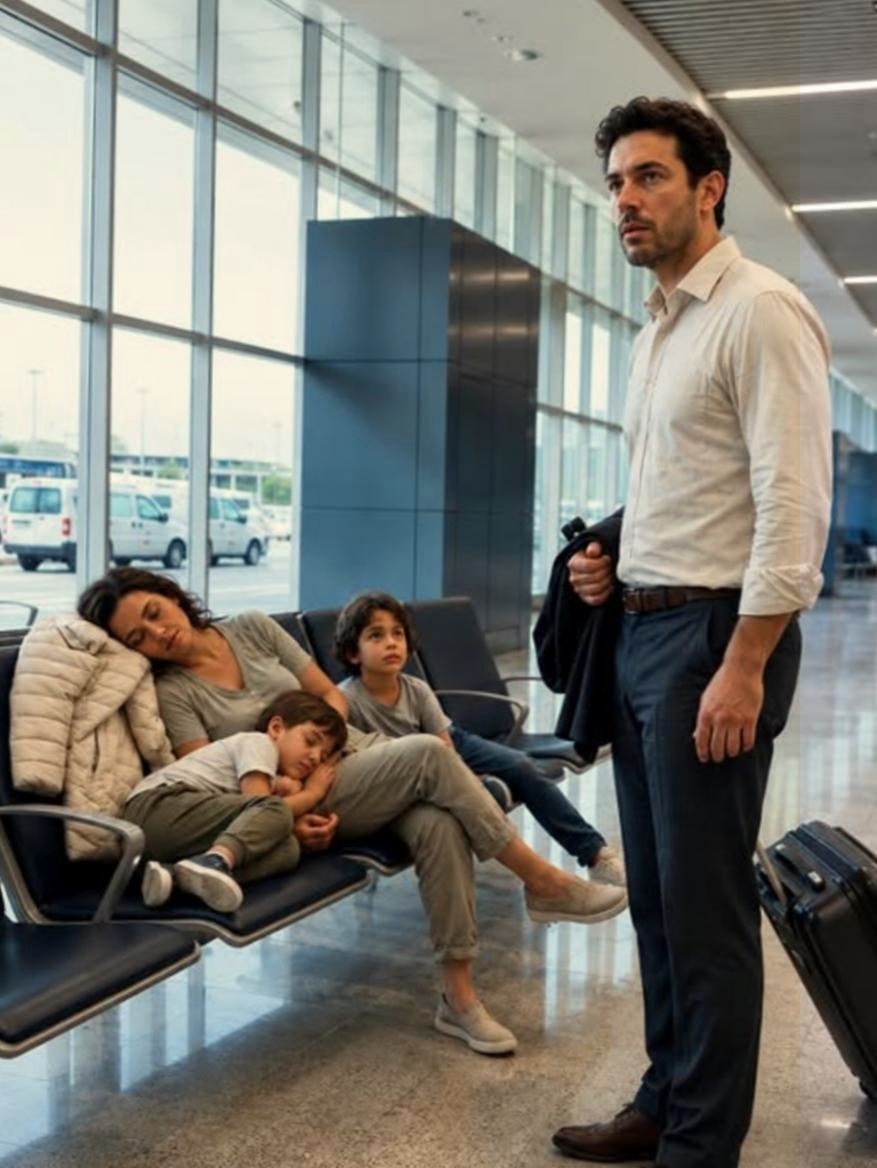
 My ex-girlfriend was sleeping on the floor at the airport with two children lying beside her—and when she saw me, the color drained from her face.
 When the dangerous mobster’s son reached out towards me, his father looked at the photo and went pale.
 Mi exmarido me vio cenando con mis hijos después de años de silencio, y su esposa dejó de sonreír
 My parents wanted to throw my belongings out into the yard and keep my child, but the smile vanished from my father’s face the moment I gave my answer.
 No one could stop the mafia boss’s son until I approached him—and the color instantly drained from Rico’s face.
 My ex-husband sat beside me to mock my ruined life, but at the airport three children ran toward me and his smile vanished