
When I read “another page,” I was not afraid for the first time.
Fear walked around my apartment all night, as if checking with careful steps where it could hide. But now something heavier had appeared in its place.
Decision.
Tako called me ten minutes later.
“We are going to the notary in the morning,” she told me. “We must take all the originals with us.”
“Father is still outside.”
“Call the police.”
“Not yet.”
“Elene, this is no longer an ordinary family dispute.”
“I know. But I want to hear everything together at least once.”
In the morning Father made eleven calls. Mother sent me nine messages. Natalie wrote only one: “Because of you, you will ruin us all.”
I answered none of them.
The notary’s office was on the third floor in an old neighborhood. The varnish was peeling from the stair railing, and the corridor smelled of dried lavender. Grandmother’s old lawyer, Otar Melikidze, was waiting there; he was over seventy and checked his pocket watch every few minutes.
“Your grandmother told me to open this page only when someone touched the trust,” he said.
“She knew this would happen?”
Otar nodded.
“She was not afraid of your family. She was afraid that they would call love a debt.”
He took a thin folder from the safe. The paper was yellowish, but the handwriting was clearly visible.
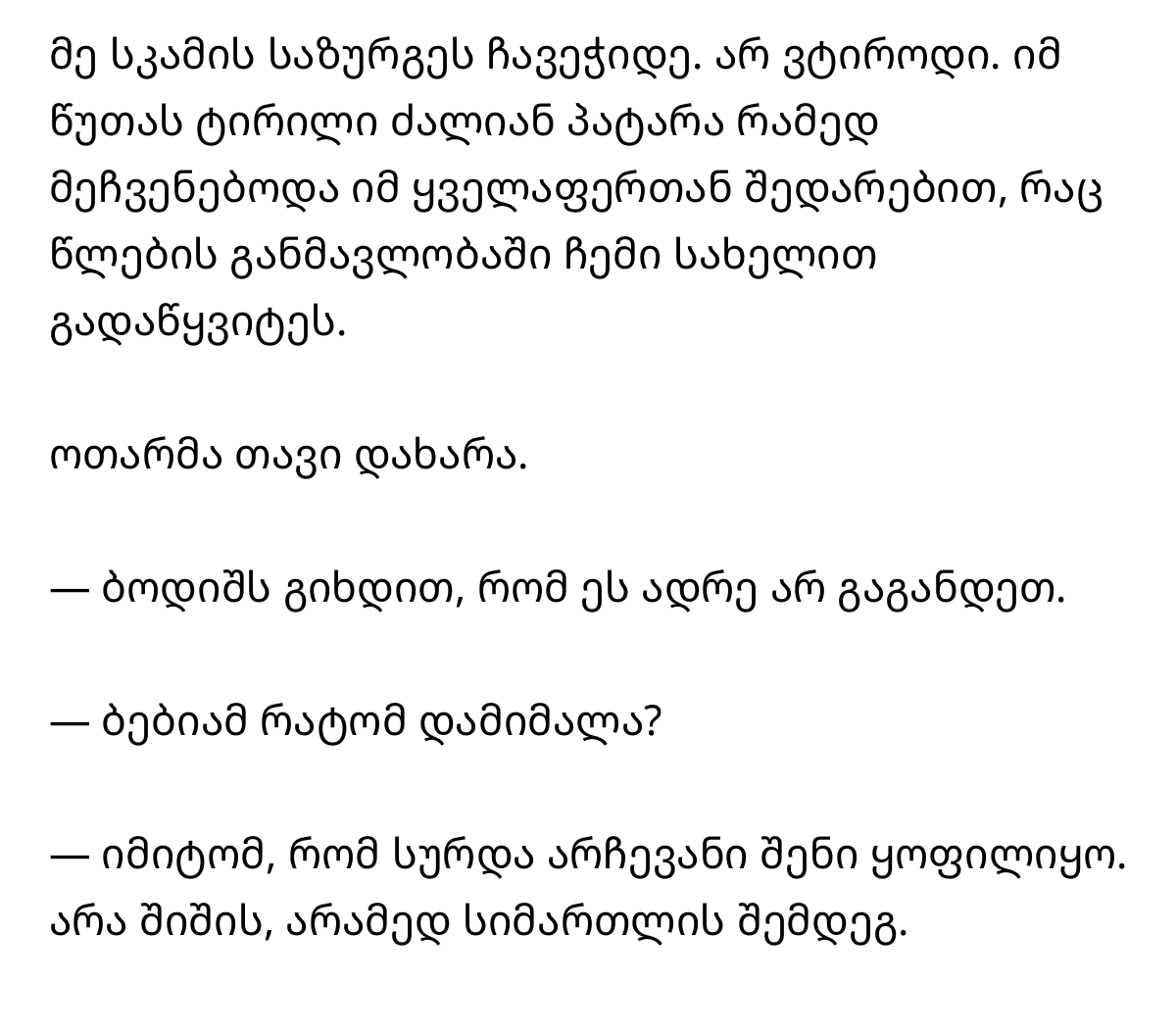

“If my granddaughter is left alone to protect this money, she must be given a recording describing the family’s demands.”
“A recording?” I asked.
Otar placed a small wooden box on the table. Inside was an old voice recorder.
“Grandmother recorded this during her last month.”
Tako pressed the button.
For several seconds only static could be heard. Then Grandmother’s voice sounded—weak, but firm.
“Giorgi says that Elene cannot manage money. Marina says that Natalie needs a house. I told them that the money is for Elene. They answered that Elene belongs to the family.”
Silence fell in the room.
Then my father’s voice sounded.
“When the girl turns twenty, we will take care of the trust. You only need to make her sign.”
Mother asked quietly:
“What if she refuses?”
Father laughed.
“Then we will remind her at whose expense she lives.”
The recording ended.
I gripped the back of the chair. I was not crying. At that moment crying seemed too small a thing compared with everything they had decided in my name over the years.
Otar lowered his head.
“I apologize for not telling you this earlier.”
“Why did Grandmother hide it from me?”
“Because she wanted the choice to be yours. Not after fear, but after the truth.”
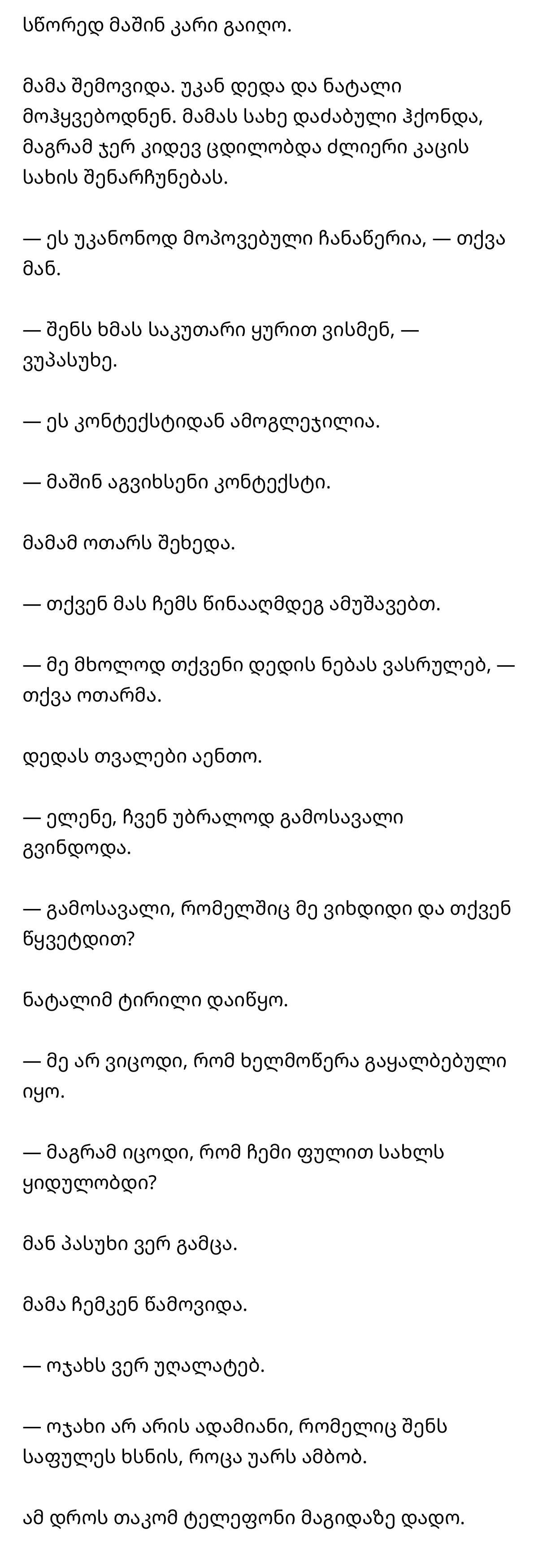

Just then the door opened.
Father entered. Mother and Natalie followed behind him. Father’s face was tense, but he was still trying to maintain the face of a strong man.
“This is an illegally obtained recording,” he said.
“I am hearing your voice with my own ears,” I answered.
“It was taken out of context.”
“Then explain the context to us.”
Father looked at Otar.
“You are turning her against me.”
“I am only carrying out your mother’s will,” Otar said.
Mother’s eyes lit up.
“Elene, we simply wanted a solution.”
“A solution in which I paid and you decided?”
Natalie began to cry.
“I did not know the signature was forged.”
“But you knew you were buying a house with my money?”
She could not answer.
Father came toward me.
“You cannot betray the family.”
“Family is not a person who opens your wallet when you refuse.”
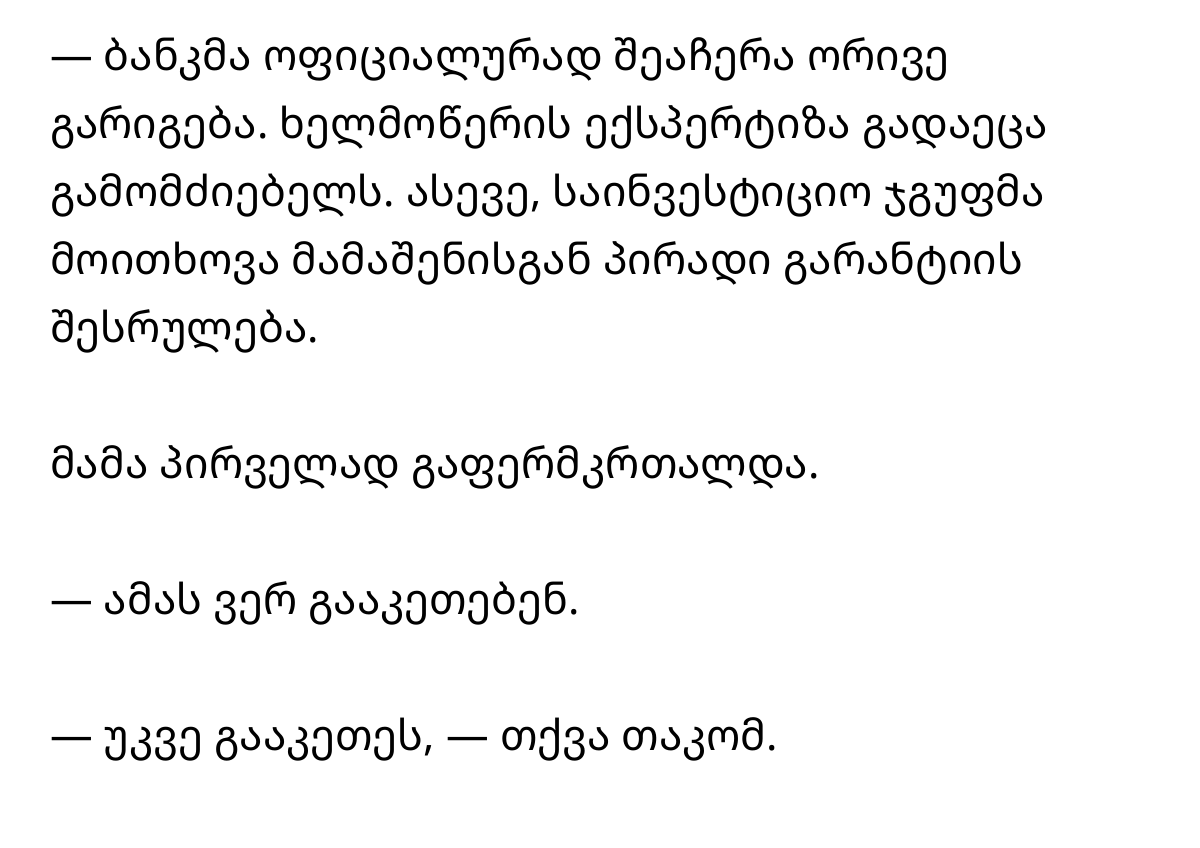
At that moment Tako put her phone on the table.
“The bank has officially suspended both deals. The signature examination has been transferred to the investigator. Also, the investment group has demanded that your father fulfill his personal guarantee.”
For the first time Father went pale.
“They cannot do that.”
“They already did,” Tako said.
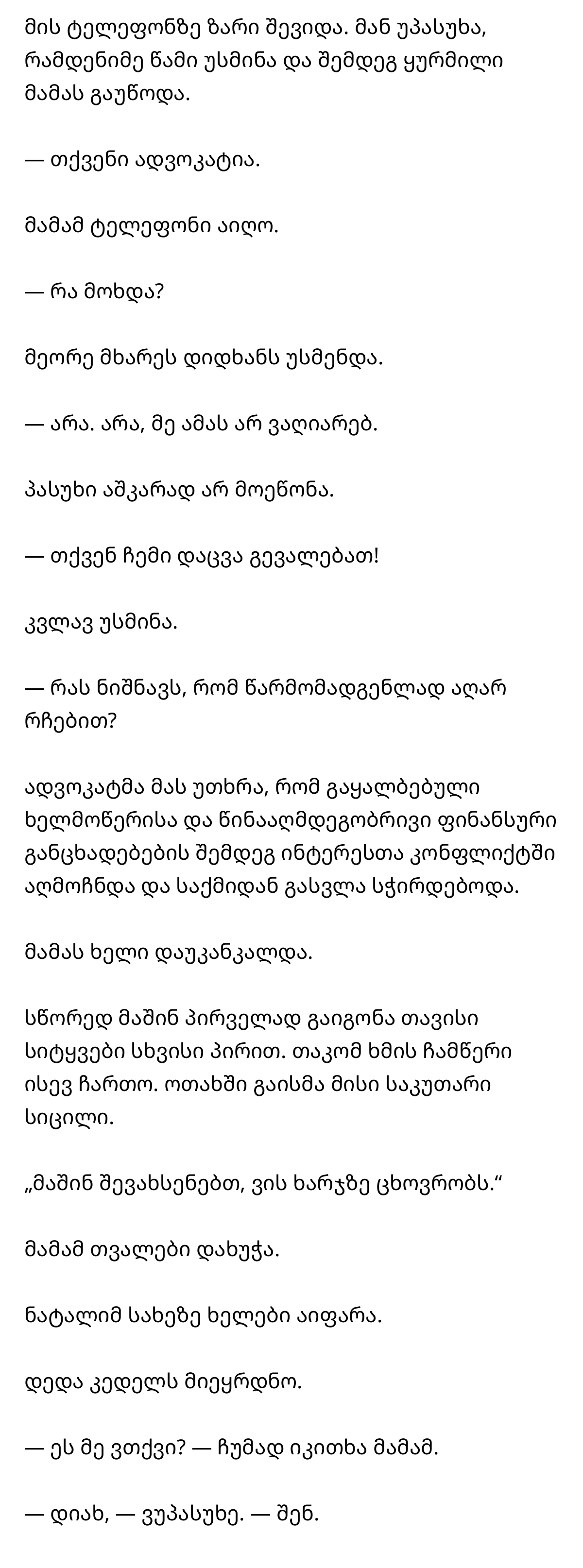

A call came to her phone. She answered, listened for several seconds, and then held the phone out to Father.
“It is your lawyer.”
Father took the phone.
“What happened?”
He listened for a long time on the other end.
“No. No, I will not admit this.”
He clearly did not like the answer.
“You are responsible for defending me!”
He listened again.
“What do you mean you are no longer remaining as my representative?”
The lawyer told him that after the forged signature and contradictory financial statements, he had found himself in a conflict of interest and needed to withdraw from the case.
Father’s hand trembled.
At that very moment he heard his own words through someone else’s mouth for the first time. Tako played the recorder again. His own laughter sounded in the room.
“Then we will remind her at whose expense she lives.”
Father closed his eyes.
Natalie covered her face with her hands.
Mother leaned against the wall.
“Did I say this?” Father asked quietly.
“Yes,” I answered. “You.”
That same week the bank canceled the loan application. The investment group filed a lawsuit against my father and his company. The investigation established that Father had ordered the practical forging of the signature, while Mother had provided the necessary old documents. No charges were brought against Natalie, because her participation was limited to knowing about the family conversation, although she too was forced to apologize to the house’s owner and withdraw from the deal.

Father appeared in court.
I did not attend every hearing. My life no longer had to become a permanent continuation of his crime. The lawyers settled the case so that the company’s assets were sold to cover the debts. Mother moved into a small apartment. Natalie found a permanent job for the first time and paid the bills herself every month.
One evening, when I was alone at home, I looked around Father’s old study. The large map on which he marked “our future property” no longer hung on the wall. Only an empty frame remained on the desk.
I took my childhood photograph from it.
The room was empty.
But for the first time this emptiness no longer resembled abandonment. It was a place where air came in.
Three months later I moved to a seaside town. I kept the trust money untouched and used only a small part to open an educational studio. There I taught children financial literacy—how to read a contract, how to protect their own signature, and how to say “no” without guilt.
In the first days, the rooms smelled of paint. Children’s colored pencils lay on the windowsills. One little girl drew a house with a huge door and wrote on the door: “My rules.”
I hung the picture on the wall.
Every week I went to Grandmother’s grave. Once a little boy who came to my studio asked me:
“Can your family really love you and still not give them everything?”
I smiled at him.
“It can. Love and entitlement are not the same thing.”
That winter the first snow came. The city quietly turned white. The kettle tinkled in the kitchen, and Grandmother’s voice recorder lay on the table. I no longer played it, but I knew it was there.

At the end of December Father sent me a letter. It was short.
“Come, let us talk. Everything can still be fixed. Family is family after all.”
I looked at the letter for a long time.
Then I forwarded it to Tako.
“Will you answer?” she asked me.
“Yes.”
“What will you tell him?”
I wrote only one sentence.
“I am no longer going to open the door behind which I was losing myself.”
No answer came.
That evening I fastened the small copper dandelion brooch to my chest. The children were making noise in the room, and snowflakes struck the window glass.
One girl pointed at the brooch.
“It looks like wind.”
“No,” I told her. “It reminds me of roots.”
It was snowing outside.
I locked the door and, for the first time, apologized to no one for it.
Missed the beginning?
Related posts:
 My father promised my house and car to my sister as an inheritance, but the morning call immediately erased his smile
 My Ex Asked Me to Kiss Her in Front of Everyone, but After My Answer, the Smile Suddenly Disappeared from Her Face
 They were taking Grandma to a restaurant, but three hours later, they left her at a nursing home—when I asked about it, my father stopped smiling for the first time.
 My parents wanted to throw my belongings out into the yard and keep my child, but the smile vanished from my father’s face the moment I gave my answer.
 Father Left Houses to My Brothers, but Burdened Me with Mother’s Life — Yet My Brother’s Smile Suddenly Disappeared
 Me raparon antes de la boda de mi hijo y me llamaron anciana ridícula, pero cuando alcé la copa, alguien dejó de sonreír