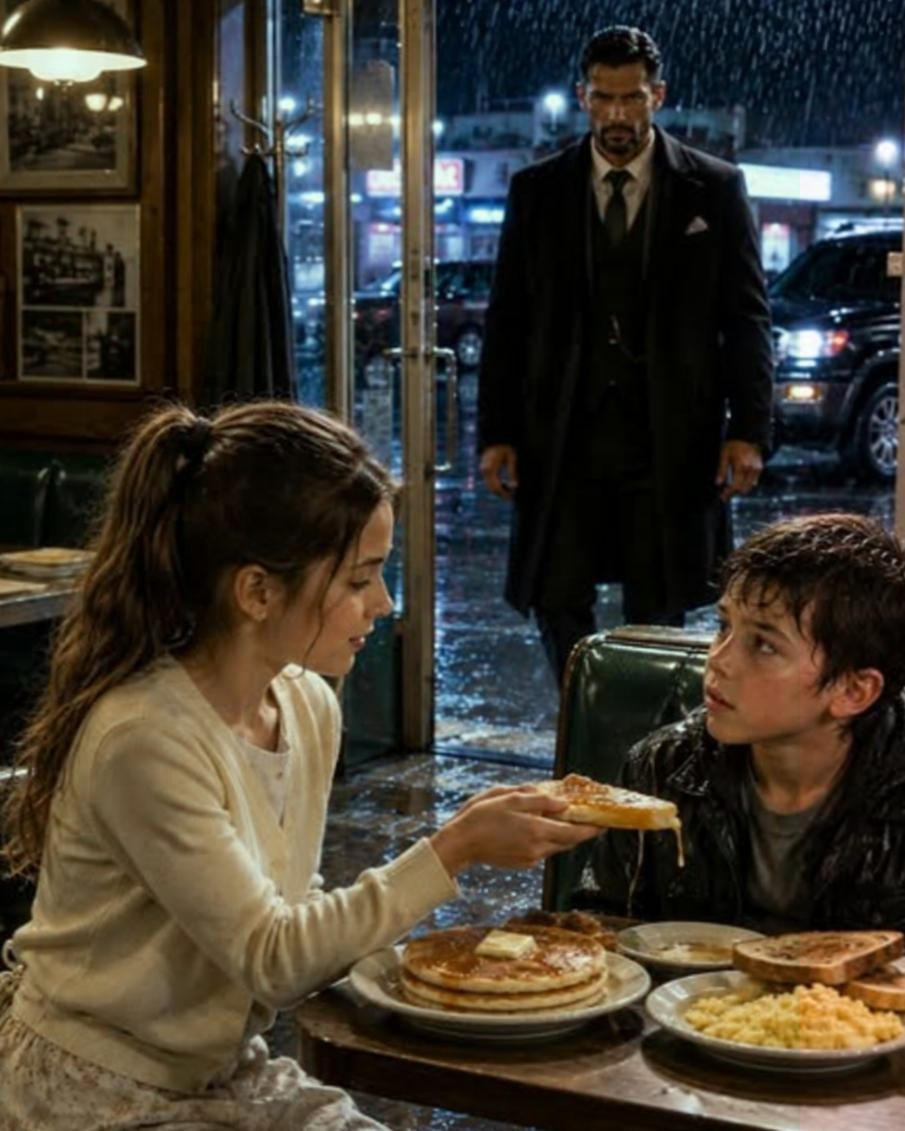

That night, when the storm turned Chicago’s streets into rivers, my grandmother told me that we should never let a lost boy stay in the diner—but the door was already opening.
I was twelve years old and doing my homework behind the cash register. Outside, rain struck the windows as if someone were trying with all his strength to shatter them. Only two tables were occupied in the diner, while the old heating radiator gave a hoarse sigh every few minutes.
When the bell rang, I raised my head.
A small boy was standing in the doorway.
He could not have been eight. His expensive coat was completely soaked, water poured from his shoes onto the floor, and in his hands he held a torn paper bag as if his whole life were hidden inside it.
The boy was trembling.
“Are you all right?” I went over and took a small towel from my grandmother’s cloth apron.
He nodded, but his eyes were fixed on the door.
“What is your name?”
“Misha.”

“Where are your parents?”
His lips moved, but he made no sound. Then his stomach answered. The sound was so loud that the man sitting nearby lowered his newspaper.
“Sit down first,” I told him. “We’ll think about the rest later.”
I seated Misha in the warmest corner, wrapped the towel around his shoulders, and went into the kitchen. I prepared our only remaining dinner: two eggs, three pancakes, the last pieces of bread, hot soup, and the final slice of apple pie.
My grandmother, Marina, closed the pot lid noisily.
“Anna, the rent is due tomorrow.”
“I know.”
“And we have nothing left for ourselves either.”
I looked at Misha. The boy was clutching his hands on his knees, as if he were afraid I would take the food back.
“He needs it more,” I answered.

Grandmother looked at me for a long time, then quietly ladled the soup into a bowl.
Misha began to eat. Not greedily. Hungrily. His fingers gradually stopped trembling, but his gaze still darted toward the door.
“Whom are you looking for?” I asked.
“The nanny.”
“Do you have a phone?”
He shook his head.
“Do you know your father’s name?”
Misha suddenly froze.
“Mikhail Volkov.”
I heard that name for the first time then, but Grandmother’s face changed at once. The glass she was holding slipped from her hand, and shards scattered across the floor.

“Grandma?”
She lowered her voice.
“Anna, this boy should not have been here.”
“Why?”
Grandmother did not answer me. Three black cars stopped outside. Their headlights burst through the windows and drew long, moving shadows on the walls.
The doors opened. First men dressed in black entered, and then a tall man in a black coat, with such calm on his face covered in raindrops that it was more frightening than shouting.
Misha immediately jumped up.
“Father!”
The man looked at his son. Fear appeared in his eyes for a moment, but immediately disappeared. Then he looked at the empty plates, and then at me.
The diner fell silent.

He stopped in front of me, as if he were looking not at a twelve-year-old girl, but at a decision that was supposed to change his whole life.
Mikhail Volkov opened his lips and said…
Mikhail Volkov opened his lips and said:
“You gave my son life, girl.”
His voice was low, but every word sounded in the diner like a spoon falling. I stepped back. Grandmother clutched her apron, as if these six words could make the walls collapse.
“I only fed him,” I said.
“Today that was not simple.”
Misha ran toward him and wrapped his arms around his father’s waist. Mikhail’s hands immediately fell onto his son’s back, but his eyes remained on me.
“Where did you find him?” he asked.
“He came by himself. He lost his nanny near the shopping center.”

The man’s face hardened.
“The nanny was no longer there when he disappeared. Neither was the security guard. Nor the man who was driving the car.”
One of the men dressed in black noticed Misha’s torn bag and reached toward him. The boy immediately crawled under the table.
“Don’t touch him,” I said.
The man stopped.
Mikhail slowly looked over.
“Step back, Ilya.”
Ilya obeyed silently.
I handed the bag to Misha. The boy pressed it to his chest. On its edge I noticed a small dark mark, as if something had been written in ink and then washed away by the rain.
“Did someone write something on this?” I asked.

Misha lowered his head.
“I don’t know.”
Mikhail took a card from his pocket and handed it to Grandmother.
“All expenses will be reimbursed to you.”
Grandmother did not look at the card.
“I don’t want money. I want you to leave here peacefully.”
Something flashed in Mikhail’s eyes, almost respect.
“Tonight this place will no longer be peaceful, Mrs. Marina.”
Five minutes later the cars left, but I stood by the window for a long time. The lights disappeared in the rain, while Misha’s bag remained in my hands. Grandmother took a small, wet sheet of paper from its pocket. Only one name, written in childish letters, could be read on it: “Boris.”
That same night our neighbor, Mr. Sergo, came in through the back door. He quietly told us that the owner of our building was doubling the rent and intended to evict the diner in the morning.

“If you want to fight Volkov’s people, I cannot help you,” he said.
“We are not fighting anyone,” Grandmother replied.
“They themselves come with a fight.”
At 7:20 in the morning, heavy blows on the door woke me. Two men stood there, holding eviction papers. One of them wore a black watch on his left wrist and smelled of wet matches.
“You have three hours,” he said.
“The document is dated yesterday,” I noted.
The man smiled mockingly at me.
“Children do not check documents.”
I stood behind Grandmother, although my knees were trembling. Just then the sharp sound of tires came from outside. It was Mikhail’s car. He got out alone and snatched the eviction paper from the man’s hand.
“This is no longer your business,” he told him.

“Mr. Volkov, we are only carrying out an order.”
“Then you are carrying out a bad order.”
Mikhail tore the document in half. For the first time the man lost his smile.
“You do not know whom you are helping,” he muttered.
“That is exactly why I will ask,” Mikhail said. “From whom did you get this order?”
The man fell silent.
That evening Misha returned to our diner, this time together with his father. He stopped at the door, holding a small pencil.
“Anna, I have to tell you something,” he said. “Boris told me I would never see Father again if I did not do what he told me.”
Mikhail’s face turned pale.
“What did he tell you?”

Misha looked toward me. Then he took a folded sheet from the bag and put it on the table.
“But before I tell you, you have to see what I drew…”
Misha unfolded the sheet on the table. It was a childish drawing: a large black car, the back exit of the shopping center, and four figures. One of them held a phone. In place of the car’s license plate, Misha had written exactly six digits.
Mikhail looked at the drawing and slid his chair backward.
“Where did you see this car?”
“Where the nanny left me,” Misha said. “Boris told me Father was busy and that I had to go with him.”
“Why didn’t you go?”
“The driver talked about you. He said that if the girl saw him, everything would be ruined.”
My breath caught.
“About me?”

Misha nodded.
“He said there was a camera in the diner.”
Grandmother immediately opened the old cash register. Behind it, by the wall, stood a small flickering screen. We used the camera only when someone stole money, but recordings were kept for several days.
“There is nothing here,” Grandmother said.
“There is,” I answered and looked at the screen’s cable. “The power was not turned off.”
Mikhail signaled to Ilya. He turned on the recording. The previous night appeared on the screen: Misha entered through the door, then a black car stopped outside, and ten minutes later another car with the same license plate appeared by the diner’s back exit.
Boris was visible in the frame.
He got out of the car, approached our door, touched the handle, and looked at the device mounted above the camera. Then he called someone on the phone.
The voice was clearly audible in the recording.
“The boy has not returned yet. If Volkov does not sign, we will take the boy out of the city. The girl is accidental, but her camera must disappear.”

Silence descended over the diner.
Mikhail’s face became like stone.
“Boris is my head of security,” he said.
“He was going to take your son,” I said.
“And kill you too, if you saw the recording.”
This time I was afraid. Not for myself. For Grandmother.
Mikhail immediately called the police, but before the call ended, another call came in. It was an unknown number.
“Volkov,” a man’s voice said, “your son is alive only because that girl shared her food with him. Now you have a choice: sign the port documents, or your family will disappear together with this diner.”
Mikhail put the phone on the table.
“Boris was already here,” he said.

Grandmother asked fearfully:
“Are we waiting for the police?”
“No,” Mikhail answered. “The police are on the way, but Boris has people there too.”
He took a small key from his pocket and placed it in front of me.
“With this you will open the back room. Inside are my old documents. If I do not return, give them to a journalist.”
“Where are you going?”
Mikhail kissed Misha on the forehead.
“To the man who turned my son’s hunger into a weapon.”
That same night Misha was taken to a clinic because he had a fever for several hours. Grandmother and I were sitting beside his bed when the doctor found a small object tucked into the blanket.
It was the other side of the sheet taken from Misha’s bag. On it, not a childish drawing but numbers written in Boris’s handwriting could now be read—bank accounts, dates, and one short sentence: “The diner must be emptied.”

Mikhail took the sheet. His hands were trembling for the first time.
But at that very moment his phone rang in the clinic corridor.
“Mr. Volkov,” said an unfamiliar voice, “Boris was not working alone. Your wife is alive and we know where she is hiding…”
მიხაილის წერილმა კარი გააღო, მაგრამ პასუხი სხვანაირი აღმოჩნდა…
მეგონა, სიმართლის გამხელა ყველაფერს დაასრულებდა. მაგრამ ყველაზე რთული არჩევანი ამის შემდეგ დამრჩა.
„მე აღარ დაგიცდი.“
ამჯერად მან პასუხის მოთხოვნა ვეღარ გაბედა.
👇 ისტორიის ფინალი უკვე გახსნილია
Related posts:
 Part 4 — I shared my only dinner with a boy lost at twelve, but at the appearance of his father, the glass slipped from Grandma’s hand
 My mother demanded the apartment I had paid for, and when I refused at my brother’s birthday, his smile suddenly vanished
 I lived with my child in a shed for two years, but when I came to the gate of my own house, Andrei lost color
PART 4 — My mother demanded the apartment I had paid for, and when I refused at my brother’s birthday, his smile suddenly vanished
I lived with my child in a shed for two years, but when I came to the gate of my own house, Andrei lost color
PART 4 — My mother demanded the apartment I had paid for, and when I refused at my brother’s birthday, his smile suddenly vanished
 At the Christmas Table, My Mother Started Humiliating My Sister, but After My Answer the Glass Froze in Vanessa’s Hand
 Part 4 — I lived with my child in a shed for two years, but when I came to the gate of my own house, Andrei lost color





