
“The one where the original documents are. And your child is there…”
The first thing I did after the phone fell from my hand was grab Daniel’s arm.
“My child is not there. I do not have a child.”
Daniel did not answer me.
His silence frightened me more than his words.
He called a second time. This time he received an answer immediately.
“Yes, I am listening.”
He listened for several seconds.
“How old is she?”
He looked toward me.
“Eight years old? A girl? Her name?”
The muscle in his face contracted.
“Lea.”
I ran toward the door.
“Who is Lea?”
“Preston’s daughter from his first marriage,” Daniel told me. “The child whom Richard took from her mother and who has lived with the Hales for years. She is at the warehouse now. They probably used her to move the evidence.”
Somewhere far away, the sound of a siren was heard.
We ran down the stairs. Stopping in the elevator was impossible. My heels sounded on the marble, while only one thought spun in my head: they had used yet another person who could not defend herself.


Fire trucks were already standing by the warehouse. The smell of burned rubber and paper filled the air. Black smoke rose from the roof.
“You cannot go in there!” a firefighter shouted at me.
“There is a child inside.”
“She is trapped on the second floor; a team is going in.”
I rushed toward the door, but Daniel grabbed me by the shoulders.
“Amelia, no.”
“Let me go!”
“If you go in now, you will lose both of you.”
I heard these words, but I did not believe them. Then a child’s voice came from the upper floor.
“Amelia!”
Lea was shouting my name.
How did she know my name?
The firefighters brought her out several minutes later. The little girl was holding a blue plastic box. Her face was covered with soot, and her hair was burned on one side.
I went down on my knees.
“Lea, I am here.”
She held out the box to me.
“Grandfather told me not to give this to anyone. Then he locked the door.”
Inside the box were documents, several memory cards, and a small recorder.
The complete conversation was on that very recorder. Not only Richard’s, but Preston’s as well.

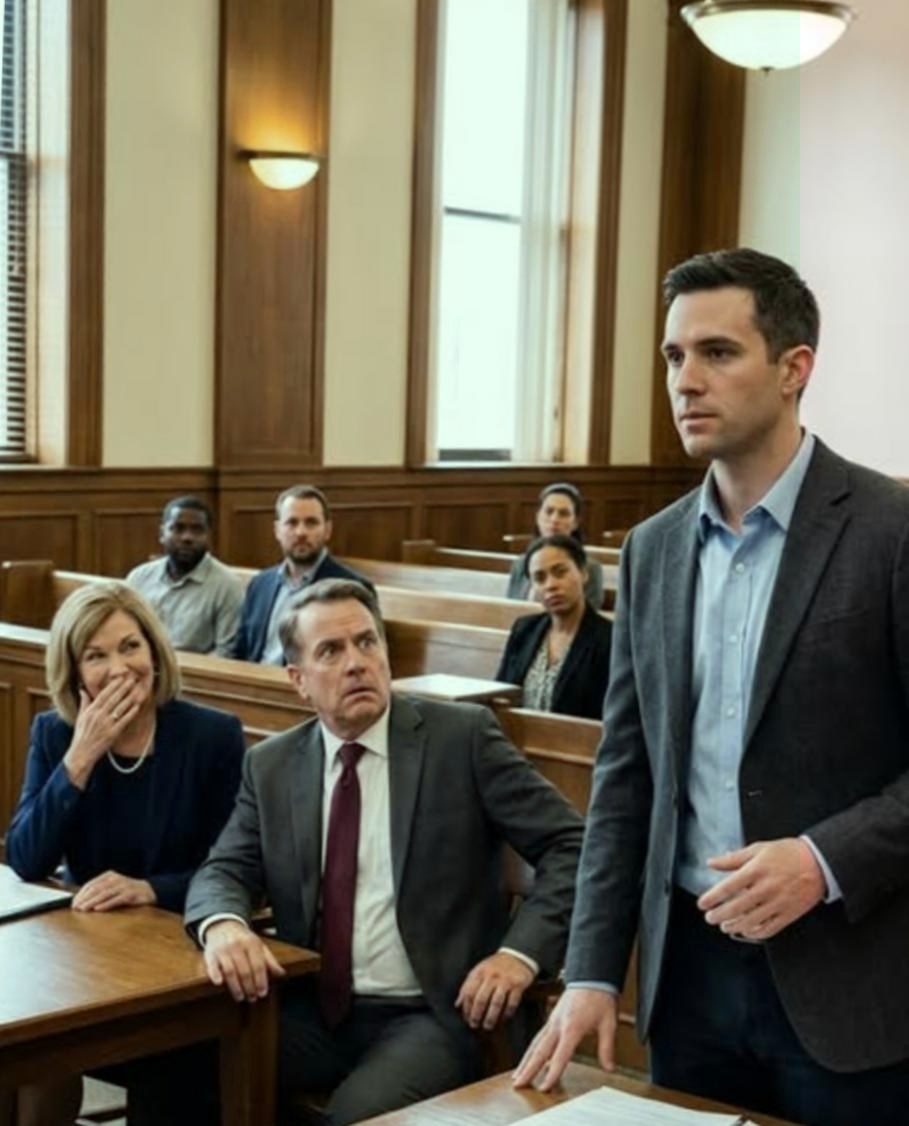
Three hours later, we were all sitting together again in the court’s temporary courtroom. This time Preston’s table was less orderly. One of the lawyers had already left. The second was speaking quietly on the phone. Voss was clasping his hands together.
Judge Morrison ordered the recording to be played.
First Preston’s voice was heard.
“Amelia only sits at home. She will never understand what is happening in the contracts.”
Then Vivian’s voice:
“If she finds out, they will drag her into it too. Everything is signed in her name.”
Richard said:
“That is why we must convince her that she is insignificant. Such people have difficulty defending their own opinion.”
In the courtroom, Vivian raised her head.
“That is not my voice.”
I did not look toward her.
Then Preston’s final phrase played:
“After the divorce, Amelia will lose everything. By the time she realizes that we registered the accounts in her name, it will already be too late.”
The recording ended.
Silence completely filled the courtroom.
The judge slowly looked at Preston.
“Mr. Hale, would you like to add anything?”
Preston opened his mouth, but could not say a word.
Voss leaned toward him.
“Do not say anything.”
“But it was not like that,” Preston muttered.
“That is exactly how it was,” I told him.
It was my first complete sentence that day, and the entire courtroom fell silent.


The court temporarily stopped the seizure of all my assets, imposed a restriction on Preston’s accounts, and handed the recordings over to federal investigators. Richard was arrested that same evening. Vivian was taken in for questioning. Preston still sat there, as if he had become a guest in his own life.
But this was only the beginning.
His personal phone, lying on the table, suddenly lit up. A message appeared on the screen. Preston read it, and all the blood drained from his face.
“What happened?” I asked.
For the first time he looked at me not with contempt, not with confidence, but with fear.
“Colonel Ward…” he said. “You said he was dead.”
“I did not say it. You did.”
The judge signaled to the investigators. One of them took Preston’s phone.
The message said that the owner of the secret account had agreed to testify. This person turned out to be the family’s internal bookkeeper, a loyal financier of twenty years. The complete chain of transfers was kept in his safe.
Preston finally lost control.
In the evening Voss caught up with me in the corridor.
“I refuse to remain my client’s representative,” he told me. “I will become a witness in this case.”
Preston heard this.
“Martin, you cannot do this.”
“I already have.”
The folder fell from his hand. The papers scattered across the floor.
That night the investigators came to me at the hotel. Several recorders lay on the table in the small room. Among them was the one I had hidden years earlier in the copper clock.
“When did you make this recording?” the investigator asked.
“Three years ago.”
“Then why did you not submit it?”
I looked at the city lights through the window.
“Because I still believed that Preston would confess the truth himself.”


The investigator turned on the recorder.
I heard my own voice, tired and quiet:
“If we ever need it in court, we must bring all this out.”
Then Preston’s voice was heard:
“You think too much. You are simply my wife.”
His words remained in the room.
For the first time I heard my own marriage through someone else’s ears.
I realized that for years I had not been waiting for protection from him, but for permission to be myself.
At four in the morning I entered our former house to take my things. The house was empty. Only traces of dust remained in the hall.
The copper clock still hung on the wall in the breakfast room.
Its hand had stopped at six forty-two, as if it too was waiting for the morning when I would finally leave.
I took the clock down.
The recorder was no longer inside. Only a small scratch remained on the metal edge.
It was the only thing I took from that house.
Four weeks later, the court ordered Preston held in pretrial detention. Richard was charged with state fraud and destruction of evidence. Vivian maintained silence for several weeks, then told the investigators everything she knew.
I was not happy about their downfall.
I simply no longer tried to save them at the cost of my own life.
Six months later I moved to a small town near the coast. I began working at a military legal center. I rose at six in the morning, brewed black tea, and sat by the window from which the harbor cranes could be seen.
Lea came to me twice a week. Officially, I had temporary guardianship of her, but in everyday life that no longer mattered.
One evening she drew me a picture at the kitchen table. In the picture, two women stood before the sea. One of them held a small clock.
“Is this you?” I asked.
“No,” Lea told me. “This is the woman who got her time back.”
I laughed at the words, and my eyes immediately filled with tears.

The first winter there was peaceful. In December, snow came. White silence covered the town. Lea stood by the window and drew stars on the glass with her finger.
That same evening I received a letter from Preston.
“Amelia, I know that I hurt you badly. Everything changed in court, but we can still talk. Meet me just once. I still love you.”
I read the letter to the end.
Then I folded it.
Lea asked me:
“Will you answer?”
“Yes.”
On the back of the paper I wrote only one sentence:
“You are asking me to return as the woman who no longer exists in order to talk to you.”
Then I put the letter in the trash bin.
At the final court hearing, Preston was sentenced to twelve years of imprisonment. Richard received seven years. Vivian made a deal and lost all the property.
I did not smile at them at a single hearing.
When the judge announced the decision, I simply lowered my eyes and took Lea’s hand.
As I was leaving the courtroom, Preston called to me.
“Amelia!”
I stopped, but did not look back.
“Did you really never love me?” he asked.
Somewhere far away, a heavy door lock closed.
“I loved you,” I told him. “But love does not mean that you should give a person permission to lose themselves.”
Then I left.

Years passed. Lea’s drawing hangs on the wall of my office. The old copper clock stands on the corner of the desk. It no longer works, but I still check it every morning.
Not because I want to turn time back.
Because now its stopping no longer frightens me.
One morning I picked up the clock, put it into Lea’s bag, and we left the house. The first snow was falling outside.
She took my hand.
And for the first time in my life, I expected nothing from anyone.
The copper clock lay calmly in my hand.
Time was no longer waiting for me.
Missed the beginning?
Related posts:
 My Spouse’s Family Mocked Me in Court When I Stood Without a Lawyer, but After My First Words My Father-in-Law Turned Pale
 My husband’s fiancée used my surname on her wedding invitation, but when I mentioned one stolen bracelet, his face went white
 Llevó a su amante a la gala más exclusiva, pero al verme bajar la escalera su sonrisa desapareció por completo
 Mi futuro cuñado me humilló delante de doscientos invitados y exigió que peleara, pero al verme descalza dejó de sonreír
 Meu noivo se casou escondido e exigiu que eu salvasse o pai dele — então o advogado parou de sorrir
Manžel mě nechal těhotnou na letištní ploše, ale když jsem vyslovila jedinou větu, jeho právník přestal dýchat
Meu noivo se casou escondido e exigiu que eu salvasse o pai dele — então o advogado parou de sorrir
Manžel mě nechal těhotnou na letištní ploše, ale když jsem vyslovila jedinou větu, jeho právník přestal dýchat