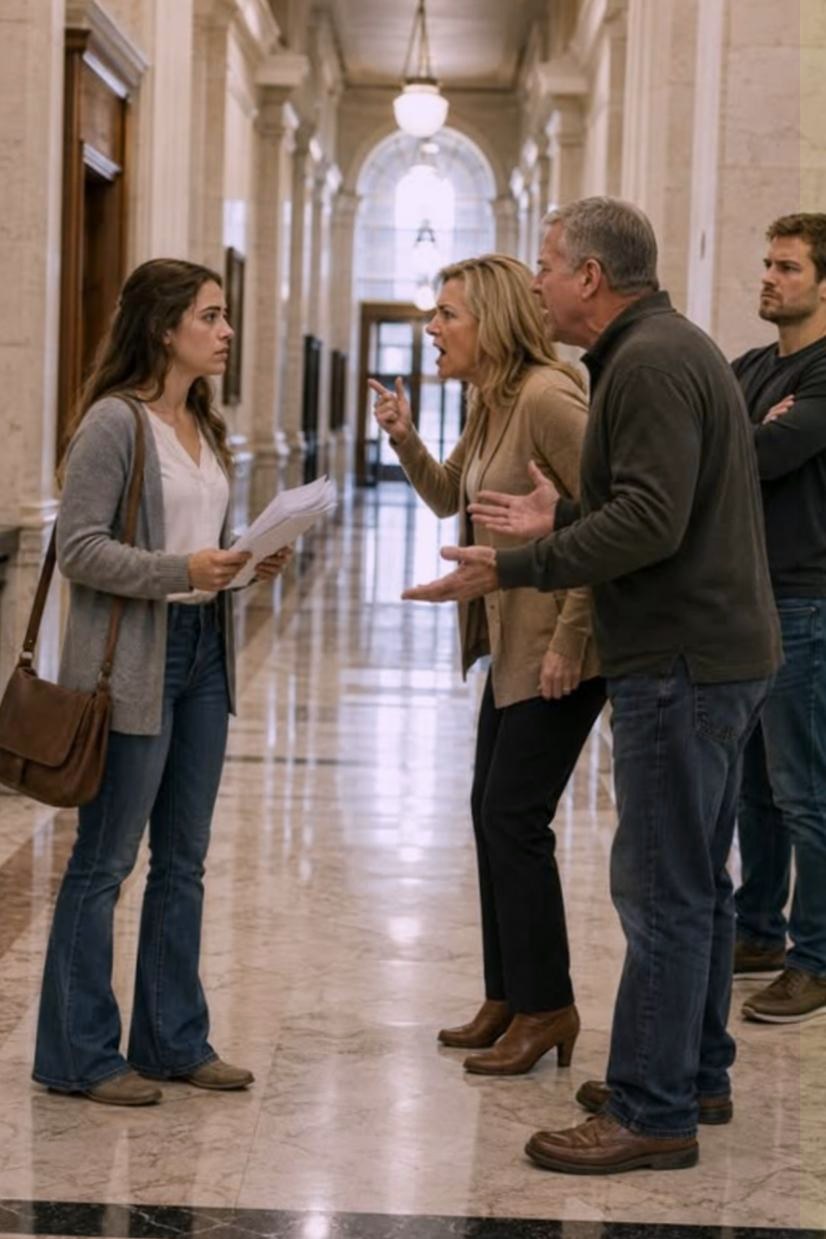


…for the first time my father could not answer anything.
His hand searched for support in the air several times, but found nothing there.
My mother looked toward me.
“Evelyn, tell him this is a misunderstanding.”
I stood by the corridor wall and watched as the police officer fastened handcuffs around my father’s wrists. The sound was very quiet. One metal ring struck another.
“This is not a criminal case!” my father shouted.
“You will explain that to the investigator,” the police officer replied.
Mason moved toward the door.
“I should not be here.”
Daniel blocked his way.
“If you intend to leave, wait for a lawyer first.”
“You are her lawyer, not mine.”
“Now I am no longer your lawyer either.”
Surprise appeared on Mason’s face.
“What do you mean, you are no longer?”
Their attorney stood several steps behind them, holding a closed bag.
“I did not know that the documents had been hidden,” he said. “Under these circumstances I can no longer represent you.”
My mother let out a noisy breath in the corridor.
“Everyone is leaving us.”
No one answered.

The bank representative, Helen, looked over at me.
“Mrs. Carter, your house will not go to auction. It was never legally pledged by your parents as security. We will officially correct this.”
At that moment I felt no relief. I felt only exhaustion, as if eight years had pressed down on my shoulders all at once.
The judge postponed the hearing until the next day. That same evening the investigator scheduled my father for questioning at the office. My mother went home, while Mason remained alone on the steps in front of the courthouse.
I walked past him.
“Evelyn, wait.”
I stopped.
“You do not understand what was happening in our home.”
“I know that you were using my house to cover your debt.”
“We did everything for you.”
“No, Mason. You did everything to take everything away from me.”
He angrily pulled out his phone.
“Listen to this.”
And he turned on a recording.
I heard my own voice, which he had recorded several months earlier during a conversation at his house. I was saying there: “If I ask my parents, maybe they will reconsider selling the house.” My voice was low and frightened.
Mason brought the phone close to my face.
“There, you yourself say that you were thinking about returning home. You also knew that it was family property.”
Daniel snatched the phone from his hand.

“Play the second part of the recording.”
Mason fell silent.
Daniel rewound the file. After several seconds my voice was heard again:
“I meant returning home to clean it, not giving up ownership. Dad, please do not sign anything at the bank in my name.”
Then my father’s voice came:
“If you refuse, you will lose everything.”
The color changed in Mason’s face.
For the first time he heard his own lie through someone else’s ears.
“It… it was not like that,” he said.
“It was,” I answered.
“You are still my sister.”
“And that is exactly why it hurts that you wanted me to do this to myself.”

The next day everything ended quickly in court.
The judge completely rejected the lawsuit and ordered my parents to reimburse my expenses. He found their claim to the house groundless. Because of the audio recording and the bank documents, the case was turned over for investigation.
He did not speak about revenge.
Neither did I.
He only said:
“A family relationship cannot create a property right and cannot justify appropriating another person’s labor.”
When my father was led out of the courtroom, his head was bowed. My mother remained on the chair, holding a small cloth bag containing old keys. She no longer had the key to my house.
Mason waited for me on the courthouse steps.
“Where do I go now?” he asked.
This was a question his parents should have asked me for years. For the first time, he heard it from me.
“I don’t know, Mason.”
“You can help me.”
“I can help if you begin working. But I can no longer take responsibility for your life.”
He looked at me for a long time.
“You really will not give me money?”
“No.”
“You still will not share the house with me?”
“No.”
I said this word calmly. That was exactly why it was final.

That same week the bank sent me an official letter stating that my property was free of all claims. Daniel placed the document on my kitchen table.
And at that time I was painting the wall.
The smell of paint still filled the room. Warm Nashville air came through the window. On the table lay the old red ceramic tile that I had removed from the front steps when the crack grew wider.
On the back of the tile I had written a date in pencil: age twenty-two, first house.
That evening there was only one empty chair in the living room. I bought that chair for my parents when I thought that someday they might want to come to me and see my work.
Now the room was empty.
I moved the chair over to the window.
Three months later I started a small job at a local technical training center. I taught young people to repair computers and basic programming. The salary was not huge, but for the first time I was working somewhere my knowledge was not considered the common property of the family.
In the mornings I made coffee at home and placed the cup on the same cracked ceramic tile, which now sat on the shelf.

Naomi came often.
“You still have not replaced these old cabinets?” she asked once.
“Not yet.”
“Why?”
“Because now I decide when I will replace them.”
In December the first snow came. It rarely snowed in Nashville, so I watched the white flakes by the window for a long time.
My seven-year-old neighbor girl, Lily, opened the door and gave me a drawing. A house was drawn on the paper, and in front of it were four red tiles.
“Is this you?” I asked.
“No, this is a house that no one can take away anymore.”
The child’s words cut through me so sharply that for several seconds I could not say anything.
“Then where am I?”
Lily drew a small figure in the corner of the paper.
“At the door. You are holding the key.”

Several weeks later my father sent me a letter. I recognized the handwriting, but I did not open the envelope immediately.
“We made mistakes. Your mother is very ill. Family should help one another. Come, let us start over.”
I showed it to Daniel.
“Do you want an answer?” he asked.
“Yes.”
On the paper I wrote only one sentence:
“I wish you peace, but my house and my life are no longer a place for you to fix.”
I did not write anger.
Nor reproach.
Then I folded the letter and put it on the windowsill. Several minutes later I changed my mind and put it in the trash.

That night I went out onto the front steps. I had not yet laid the new tile. I held the old red ceramic tile in my hand, the one with the date written on it.
It was cold.
But it was mine.
I set the tile beside the steps and opened the door. The light was on inside, the walls were still slightly uneven, and the old cabinets creaked in the kitchen.
Everything was not perfect.
But everything was mine.
This time the house opened the door for me.
Missed the beginning?
Related posts:
 They Demanded That I Be Evicted from My Own House Because of My Brother, but My Father’s Smile Suddenly Disappeared at the Judge’s Question
 Mi esposo se burló de nuestro matrimonio ante sus socios, pero cuando me vio entrar al salón, dejó de sonreír
 The Morning After the Wedding, My Husband Humiliated Me in Front of Everyone, but His Mother Turned Pale When She Saw My Calm Smile
 When Margaret was suffocating an unconscious patient lying in a hospital with a pillow, someone suddenly shouted beyond the door
 My Nanny Saved My Children During an Armed Attack, but When She Took the Music Box, My Guard’s Smile Disappeared
 After my warning at the billionaire’s negotiation, the lawyer ordered the guards to remove me, but his smile suddenly disappeared