
“Giorgi, I know you are inside.”
This voice did not sound like Revaz’s.
Emily looked toward the door, while I watched the bell swinging. The little copper bell still hung beside the handle. Twenty years ago, it had contained only a child’s laughter and the fear of a snowy road. Now every jingle told me that the past had returned home.
I was already calling the police.
“Do not open the door,” I told Emily.
“Who is it?”
A woman was breathing quietly behind the door.
“My name is Nino. I was on the road that night. And the girl did not survive alone.”
Emily switched her phone to recorder mode.
“How do you know my name?”
“Because I stood beside you at the hospital.”
My knees grew heavy. That night at the hospital so many doctors, policemen, and relatives were moving around that I no longer remembered a single face. I remembered only Emily’s little hand, which was squeezing my fingers.
“Open the door,” Nino told me. “I have a document for you.”
The sound of a police car entered the yard. Only then did we open the door.
Nino turned out to be a woman close to fifty. She held a box wrapped in cloth. There was an old scar on her forehead and a patch of burned skin on her left hand.
“That night I stopped by the roadside,” she said. “My husband was driving. We saw Revaz’s car approach your son.”
“Why did you not come to the police?” Emily asked.
Nino lowered her eyes.
“My husband died there. I was taken to the hospital, and Revaz paid the doctor and told me that if I said anything, he would take my son away.”
She opened the box.
Inside lay a small memory card from a video camera, with burned edges.
“We had a camera in the car. It recorded everything several minutes before the accident. I thought the card had been destroyed. A few days ago I found it among old belongings.”
The policeman carefully took the card.
We sat at the kitchen table when the recording began. A snow-covered road appeared on the screen. Our car was driving ahead. Behind it was a black automobile.
Revaz was sitting at the wheel.
And beside him was another man.
My father.
No. This was impossible. My father had died twelve years before the accident.
Emily stared at the screen.
“Who is that?”
The sound from the video came on.
“The girl is already in the car,” an unknown man said.
Revaz answered:
“The child is a problem for us. If she survives, she may tell everything.”
The third man bent down, and his face was illuminated.
I knew him.
It was Lasha, our family’s former driver. The man whom everyone thought had lost his job and left the city after the accident.
But Lasha had been alive then. And he was with Revaz.
At the end of the recording Lasha got out of the car, approached Nika’s car, and bent down near the rear tire. Then he returned and said:
“The child is there. If something happens, she will be the only one left.”

Emily rose from her chair.
“That is why I remember Mother’s voice. But I also remember another man’s hand.”
Her voice broke.
I went over and hugged her.
“You are not guilty of anything.”
“Neither are you, Grandpa. But you knew that Father was afraid of Revaz.”
“I knew. And still I told him to return home. I thought everything would be resolved.”
That was my heaviest confession.
That night the police surrounded Revaz’s house. He did not try to escape. He called a lawyer, but the lawyer said only this on the phone:
“I cannot get involved in this case. I heard the recordings.”
“You are my lawyer!”
“No longer.”
That was when Revaz lost control for the first time.
The next day the investigator seated us in a small room. On the table lay the cassette, the memory card, and the old report.
Revaz was there too. He was not yet wearing handcuffs, but two policemen stood in front of him.
“Let us listen once more,” the investigator said.
Revaz shook his head.
“It is not necessary.”
“It is necessary,” I said.
The recording began.
His own voice sounded: “Now it is already too late.”
Revaz closed his eyes.
“I do not remember this.”
“But you said it,” the investigator replied.
“Twenty years have passed.”
“That is exactly why we are listening.”
Revaz placed his hands on the chair. For the first time I saw him looking at his own words as at the crime of a stranger. His face became gray.
“I did not want the children to die,” he said quietly.
“But you knew there were children in the car,” I told him.
He looked toward me.
“You knew too that something was happening.”
“I had suspicions. You knew.”
That difference had been waiting twenty years.
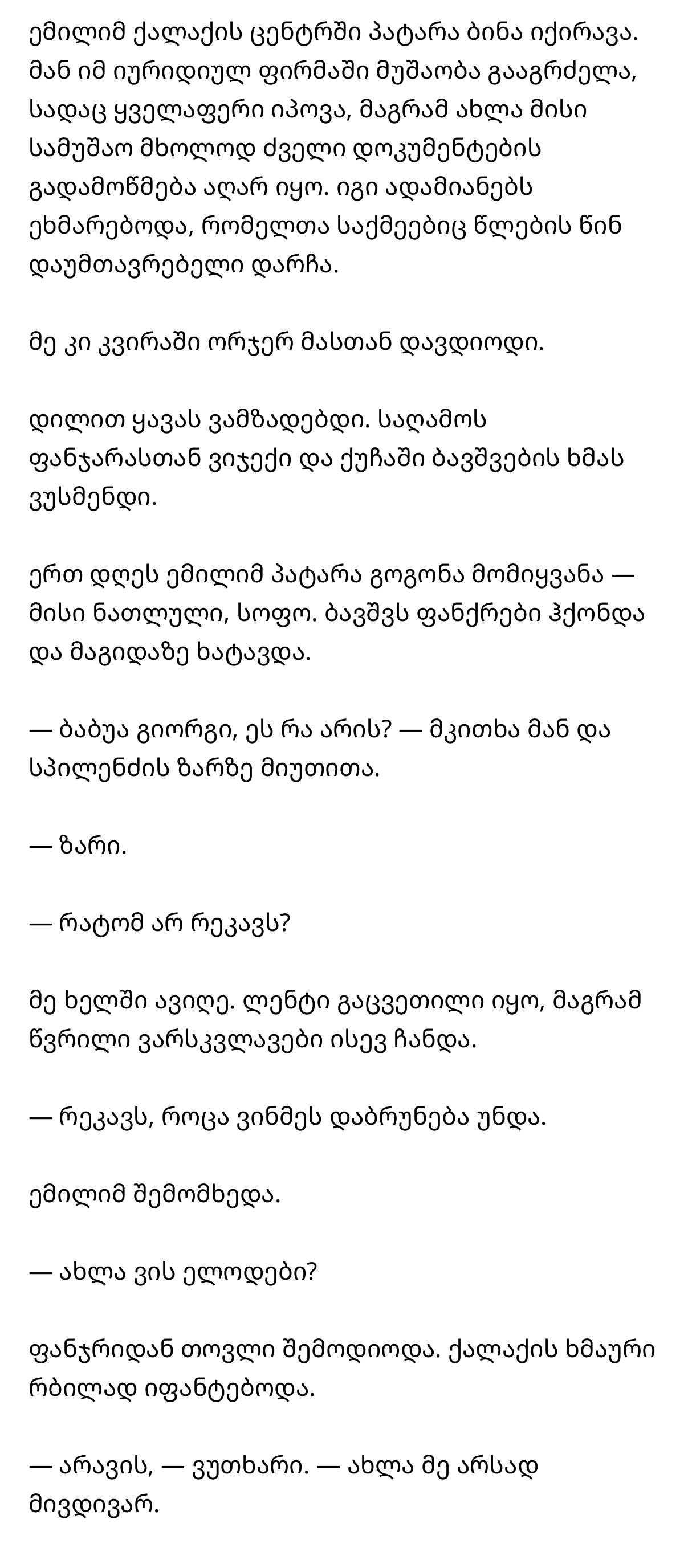

Revaz and Lasha were arrested. The case reached court. I did not attend every hearing. Sometimes Emily went, sometimes she only listened to the recordings. We did not need to return to that night every day for the truth to be real.
Several weeks later a parcel from Revaz arrived at our old house.
Inside was Nika’s wallet.
I had found it in the wreckage of the car twenty years earlier, but I thought the police had taken it from me. Inside the wallet was a small photograph of Nika, in which Emily was three years old and was holding that very copper bell.
Revaz had written a letter.
“I may never deserve forgiveness. But I want you to know that your son tried to protect the child until the last moment.”
I read the letter twice.
Then I put it in a drawer.
I did not tear it up.
Nor did I send a reply.
For me, forgiveness and returning to the past had never been the same thing.
Three months later the first snow came.
Emily rented a small apartment in the city center. She continued working at the law firm where she had found everything, but now her work was no longer only checking old documents. She helped people whose cases had remained unfinished years earlier.
And I went to see her twice a week.
In the morning I made coffee. In the evening I sat by the window and listened to the sounds of children in the street.
One day Emily brought me a little girl — her goddaughter, Sopho. The child had pencils and was drawing on the table.
“Grandpa Giorgi, what is this?” she asked, pointing at the copper bell.
“A bell.”
“Why does it not ring?”
I took it in my hand. The ribbon was worn, but the tiny stars could still be seen.
“It rings when someone needs to return.”
Emily looked at me.
“Who are you waiting for now?”
Snow was coming through the window. The city noise scattered softly.
“No one,” I told her. “Now I am not going anywhere.”
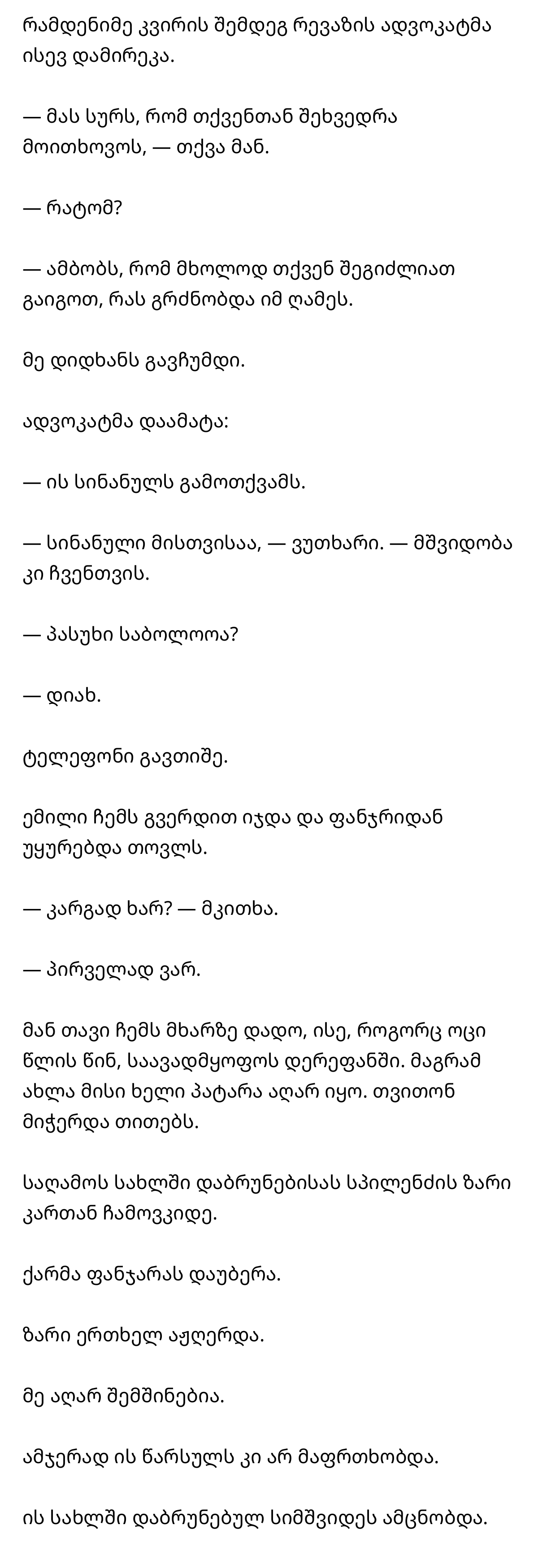

Several weeks later Revaz’s lawyer called me again.
“He wants to ask to meet with you,” he said.
“Why?”
“He says that only you can understand what he felt that night.”
I was silent for a long time.
The lawyer added:
“He expresses remorse.”
“Remorse is for him,” I said. “Peace is for us.”
“Is the answer final?”
“Yes.”
I ended the call.
Emily sat beside me and watched the snow through the window.
“Are you all right?” she asked.
“For the first time.”
She rested her head on my shoulder, just as she had twenty years earlier in the hospital corridor. But now her hand was no longer small. She herself was squeezing my fingers.
When I returned home in the evening, I hung the copper bell by the door.
The wind blew against the window.
The bell jingled once.
I was no longer afraid.
This time it was not frightening me with the past.
It was announcing the peace that had returned home.
Missed the beginning?
Related posts:
 On the anniversary of the accident, my granddaughter handed me a sheet of paper and asked me one calm question — the glass stopped in my hand
 A ten-year-old girl arrived at the hospital with a sick infant, but a single call made the doctors’ blood run cold.
 When My Wife Announced She Was Going on a Date with Another Man, Her Smile Disappeared After My Calm Response
 Part 4 — A ten-year-old girl arrived at the hospital with a sick infant, but a single call made the doctors’ blood run cold.
 When the dangerous mobster’s son reached out towards me, his father looked at the photo and went pale.
 The Mafia Boss’s Car Fell into the Abyss, and I Tried to Save Him—but His Guards Pulled Out Their Guns