
Dato’s words were still hanging in the air when the crying was repeated from behind the barn.
This time more clearly.
It was a child’s voice.
I ran toward the door, but Dato grabbed my arm.
“Do not go out.”
“There is a child there!”
“It may be a trap.”
“Do not use children as traps!”
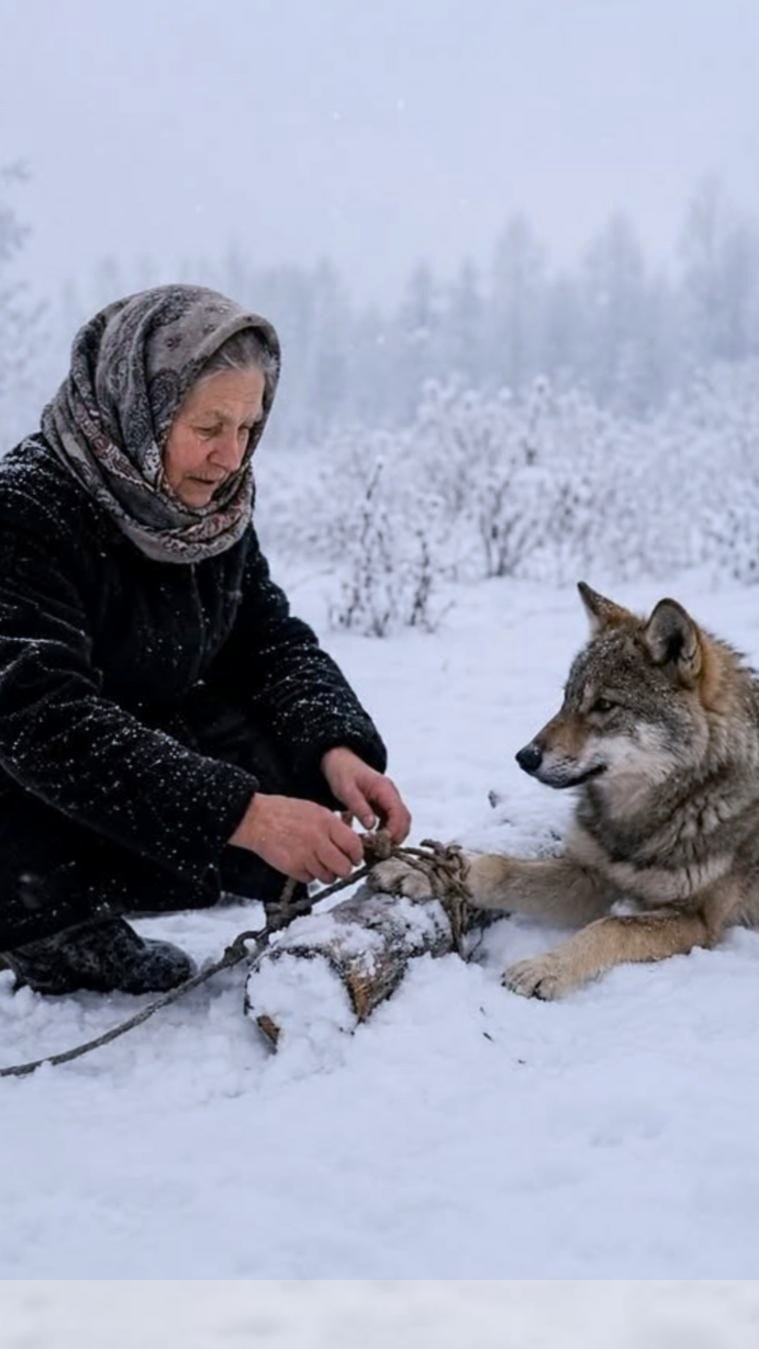
I pulled his hand away and went around the back of the barn. The snow reached my waist. The wolf immediately led me forward; it was limping, but did not stop. It went around an old pile of firewood and pressed its nose to a wooden door stuck into the ground.
Small fingers appeared from under the door.
“Do not be afraid,” I whispered. “I am here.”
“Lady, please do not leave,” came from inside.
I pulled the nails out with my hands. One cut my finger and blood fell onto the snow, but I did not feel the pain. When I opened the door, a seven-year-old boy was sitting inside. His face was covered with dirt, and his lips were blue from the cold.
“I am Sandro,” he told me. “I came with Nino, but the men hid me here.”
The wolf sniffed the boy’s face. Sandro held out his hand and touched the fur.
“This wolf protected Nino.”
“Where is Nino?”
“In the river tunnel. She followed the path, and they left me here.”
I brought Sandro into the house and laid him down by the stove. Dato stood at the door, as if his body no longer obeyed him.
“Who hid you here?” I asked the boy.
Sandro looked toward him.
“That man. He called Dato.”

Dato closed his eyes.
At that moment the sound of a siren was heard outside. The police car stopped by the gate, and village people came behind it. Eka jumped out of the first car. Her face was wet with tears.
“Where is Nino?”
“By the old tunnel of the river,” I answered. “The police found her, but there was someone else there too.”
The second policeman spoke on the radio. Several minutes later a message came: Nino was alive, her leg was bruised, but she was conscious. No other child had been found with her. As it turned out later, the “second child” was Sandro himself, whose voice they had heard from the tunnel before Dato hid him in the barn.
Dato tried to escape.
The wolves blocked his way.
They did not touch him. They simply stood in a circle in front of him, exactly as they had stood around my house in the morning. Dato put the rifle in the snow and raised his hands.
“I did not want to,” he said. “Lasha interfered himself. The others planned everything.”
“Who are the others?” the policeman asked.
Dato could not answer.
I gave Lasha’s notebook, the photograph, the trap sign, and the copper plate to the policeman. Then they found Dato’s old telephone. Several recordings were stored in it, including his conversation with the unknown man.
“The child has appeared. The wolf found her. If the old woman remains alive, everything will come out.”
It was Dato’s voice.
He heard his own words for the first time when the investigator played the recording aloud in the small village administration room. Dato sat on a chair, his hands clasped in front of him, and seemed to be trying to attribute the voice to someone else.
“I did not say this,” he whispered.
The investigator placed the telephone on the table.
“It is your voice.”

“No.”
“You yourself said that the old woman had to keep silent.”
Dato raised his head and looked at me for the first time.
“Marta, I just wanted everything to end.”
“Did my son say that twelve years ago too?”
He fell silent.
The investigation established that Lasha had not died accidentally. He discovered a network of traps, took a photograph, and asked Dato for help. But Dato informed the people to whom he sold the meat. Lasha was attacked in the forest. His notes remained hidden because Dato convinced everyone that an accident had happened.
Nino and Sandro were taken to the hospital. Dato and the armed man were arrested. The police found the other participants several days later. Twenty-one traps were removed from the forest, and each one had that sign carved on it.
The wolves left that same evening.
The surviving wolf came to me at the end. I carefully touched its paw. The wound would heal. It no longer had the copper plate around its neck. The police told me that the photograph hidden there and the small note had become the most important evidence.
“You are free now,” I told it.
It looked at me for a long time, then turned toward the forest and disappeared into the snow.

Several weeks later the village became noisy again. Eka came every day. Nino was already running, although she often woke up at night. Sandro’s grandmother lived in a distant city, and while they waited for her arrival, the boy stayed with me.
One evening Sandro asked me:
“Marta, why did the wolves help people?”
I put firewood into the stove and looked at the flame.
“Perhaps they knew that we too were once creatures who needed protection.”
“Were you afraid of them too?”
“Very much.”
“And still you saved it.”
“Sometimes fear tells you to run away. But your heart tells you first to look at someone else.”
Three months later a small memorial plaque was attached beside my house. Lasha’s name and new forest-protection rules were written on it. People said that after that winter they had not found a single trap in the village.
And I slowly learned life again from the beginning.
In the mornings I helped at Eka’s school. At noon I knitted warm socks for Sandro. In the evening I sat by the window and watched the forest. I was no longer afraid of every sound.
One morning the first snow came.
Sandro drew a picture for me on a sheet of paper: a small house, a large moon, and a wolf standing in front of it. He drew a copper-colored circle around the wolf’s neck.
“This is your friend,” he told me.

“Wolves do not become friends.”
“Then why did it come back yesterday?”
I went to the window. There really were fresh tracks in the snow. In the yard, beyond the fence, stood that gray wolf. Its leg barely hurt anymore. It looked at me for several seconds and went toward the forest.
That same evening I received a letter from Dato. He sent it from prison. He wrote that he missed my house, the stove, and our old life. At the end he asked me to speak in his favor at the trial, because “everyone makes mistakes.”
I read the letter to the end.
Then I folded it and put it in Lasha’s notebook, on the page where his last entry was written.
I did not answer.
I was no longer obliged to save anyone from their own crime.
That night the wind rose outside. Snow struck the window, while the fire quietly burned in the stove. My husband’s old blanket still hung by the door, the one with which I had first wrapped the frozen wolf. The surname embroidered with red thread had almost disappeared, but one letter remaining on the fabric could still be seen.
I touched it with my hand.
A distant howl came from the forest.
I opened the door.
This time I was not afraid.
Only one pair of tracks led through the snow toward the forest.
And I knew that some thanks come without words.
Missed the beginning?
Related posts:
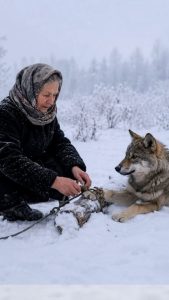 Marta brought a frozen wolf into the house, and in the morning dozens of beasts stood around the house and the village dogs began howling all at once
 Three Days After the Divorce, My Ex Mocked Me When He Saw an Old Man with Me — Then the Color Drained from His Face
 My Husband Declared Caring for His Mother to Be My Duty, but After One Answer from Me, His Mother Covered Her Face with Her Hand
 An Unknown Man Humiliated Me in Front of Everyone, but the Restaurant Owner Looked at Me Only Once — and His Smile Immediately Disappeared
 Rowan seated a secretary in my place and told me, “Remember your place” — but he turned pale at the sight of my calm smile
 On Christmas Eve, my ex-husband broke into the house to catch another man, but the color suddenly drained from his gaze