


The person who entered the rear entrance of the clinic was not Daniel.
It turned out to be Victor’s brother, Richard — the man who had handled family affairs for years and presented himself to the police as his lawyer.
The call was still at my ear.
“Lock all the doors,” I told the clinic employee. “Take the children to the police car and do not let anyone go with them.”
“It’s already too late,” the woman replied. “He is in the intensive-care corridor.”
The first police officer shouted into the radio and tightened the handcuffs on Victor.
“Put down the phone,” he told me.
“Mother is at the clinic.”
Emily heard this and ran toward me.
“Is Mother alive?”
“She is alive. We are going to her now.”
Daniel leaned against the wall.
“Grant, listen to me. None of this is the way it looks.”
“Then you will explain it to the police.”
“Victor forced me.”
Victor quickly turned his head toward him.
“Be quiet.”
That one word was enough for the last hope to disappear from Daniel’s face.
Richard was arrested by the police at the clinic five minutes later. He did not manage to reach Anna’s ward. The cameras showed how he tried to deceive the reception employee and said that Anna was mentally unstable and that he needed to protect the children from her.
But on those same cameras, his voice could be heard clearly.
“If Anna starts talking, no one from this family will survive.”




The next day, the court investigator played this recording before me in a small police room. Only Marcy, a child-protection representative, Daniel, and I were sitting in the room.
Richard’s voice came from the device attached to the wall.
“Daniel, sign it. If you do not sign, they will take the children away from you.”
Then Daniel’s voice sounded.
“Anna will not find out about this.”
“Anna will soon be unable to find out anything.”
The recording stopped.
Daniel covered his face with both hands. For the first time I saw how he heard his own voice from someone else. It was as if the cruelty of a strange man was sounding in the room, until he slowly realized that the man was himself.
“I did not want to,” he whispered.
“But you said it,” Marcy replied. “You said it yourself.”
Daniel raised his head.
“I wanted to protect Emily.”
“It is not protection when you take food away from a child and tell her not to speak to anyone,” I said.
That evening, Victor and Richard were charged with fraud, coercion, and creating a danger to the children’s lives. Daniel gave evidence to the investigation. He still faced punishment, but his cooperation became important in the matter of guardianship of Emily and the twins.
I did not feel victory in the courtroom.
Only exhaustion.
We saw Anna three days later. She was lying on the second floor of St. Luke’s Clinic, with a broken rib and a stitch visible to the left of her forehead. When Emily entered the room, Anna extended her hand.
“Mother, I won’t give them water anymore. I really won’t. Mr. Grant bought milk.”
Anna began to cry and embraced her child.
“You saved me, my little one.”
“No,” Emily said. “He saved us.”
I stood at the door, holding the small yellow plastic bottle that one of the twins had held that evening. It had a picture of a rabbit on it, and one ear was half broken.
Anna spent several weeks in rehabilitation. Child protective services found temporary housing, and then provided her with a small apartment on the outskirts of the city. Daniel lived separately and could meet the children only under supervision.




Victor’s house was sealed.
Emily’s room remained empty.
One day I entered it again because Anna needed my help taking things away. Only one old photograph lay on the floor. In the photograph, Emily sat in her mother’s lap, while Daniel stood behind the camera. The same wooden clock hung on the wall, the glass of which had shattered that evening.
But the twelve dates were gone.
I put them in the folder and gave them to Anna.
“This is your truth,” I told her.
“No,” she replied. “Now this is my past.”
Six weeks later, I was already living in another city. I changed jobs and began working on technical matters at a children’s aid center. Every morning I got up at six, brewed coffee, and repaired the little bicycles left in the center’s back yard.
Emily called me every Saturday.
Once she asked me:
“Mr. Grant, are bad people always punished?”
I was standing by the window. The first snow was falling.
“Not always,” I told her. “But the truth gives a person the ability to live far from them.”
“We live far away, don’t we?”
“Now we do.”
“Then we are already all right.”
Her voice was so calm that for the first time since that October evening, I breathed out freely.
Anna gradually returned to work. She opened a small sewing workshop and sewed clothes for children there. She kept Emily’s blue dress, even the one with the coarse stitching at the knee.
“I will not throw this away,” she told me once. “This dress helped us endure that day.”
Months later, I received a letter from Daniel. My address was on the envelope, and inside there were only a few sentences.
“I want you to bring me back to the children. I know they trust your word. I admitted everything. Maybe you could help me once again.”
I looked at the letter for a long time.
Then I called Anna.
“What would you do?” I asked.
“Whatever your conscience tells you,” she replied. “Only remember that you must not lose yourself again in order to save him.”
I wrote a reply to the letter.
“The right to meet the children belongs to the court. I can no longer decide in your place or protect you. You have already told the truth. Now you must learn to live with its consequences.”
I added nothing else.
That same evening I received a drawing from Emily. On the sheet, four people stood in front of a house: Anna, Emily, the two babies, and beside them a small man holding a yellow bottle. A large sun was drawn above, and below it was written: “No one is afraid here.”


I attached the drawing to the refrigerator.
And on my desk I placed the little yellow bottle. The rabbit still had one broken ear. Sometimes, when I had a difficult day, I put my hand on the bottle and remembered that that evening Emily still did not know how to save herself.
But she knew how to ask for help.
And that was already a beginning.
The first snow was falling silently in the yard. The phone rang. It was Emily.
“Mr. Grant,” she said to me, “could you come again tomorrow?”
“Of course.”
“Why?”
I went to the window and looked at the yellow bottle.
“Because sometimes family is also the people you meet by chance and who no longer let you leave.”
The next morning I poured warm milk into the bottle.
This time nobody asked for money.
Not even on Friday.
Missed the beginning?
Related posts:
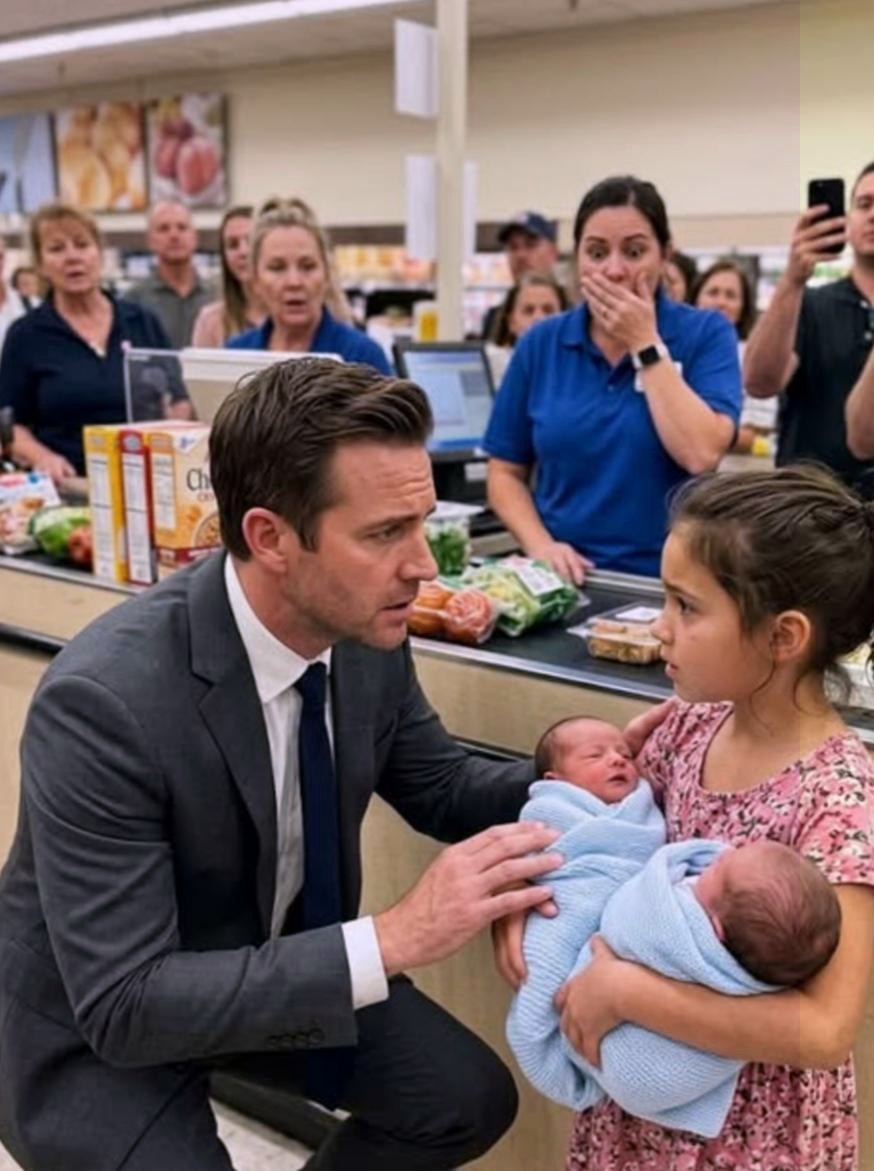
 An eight-year-old girl asked for milk at the checkout, saying she would pay on Friday — and when we opened the door of her house, I froze
 When My Wife Announced She Was Going on a Date with Another Man, Her Smile Disappeared After My Calm Response
 On a Rainy Night Emily Asked Me to Take Her Home, but One Question of Mine Suddenly Changed Her Face
 On Our Wedding Night My Wife Undressed, and I Froze — When My Mother Saw Her Face, She Stopped Smiling for the First Time
 I sheltered an unknown girl in a rented room, but when black cars stopped at my door, my heart clenched
 Three Hungry Girls Were Eating Grass on My Lawn, But When One Looked Me in the Eyes, My Fiancée’s Smile Disappeared





