
At that moment, the sound of a car engine came from downstairs.
Father rushed to the window.
“That blue car belongs to Lucas’s friend.”
“My friend?” Lucas shouted. “I did not call anyone.”
Alexander had already picked up the phone.
“The security team is on the way. No one is to go to the house.”
Mother ran toward the door.
“My documents are there.”
“That is exactly why you are not going,” I said.
My voice was calm. So calm that I did not recognize it myself.
Mother stopped.
“Emily, please. You do not understand what is happening.”
“You have told me my whole life that I did not understand. Today I will listen to you for the first time.”

Alexander looked at me and nodded. Ten minutes later the security officers entered the yard. They brought out a young man from the small storage room behind the house. He was holding the old keys to my grandmother’s house.
Lucas stepped backward as soon as he saw him.
“That is Daniel. He works at my company.”
Daniel lowered his eyes.
“Lucas told me to bring only one folder.”
“Where is the folder?” I asked.
He fell silent.
Alexander’s security officer opened his bag. Inside they found photographs of my grandmother’s house, copies of the notarial documents, and a small iron tool.
Father found a chair and sat down.
Mother stared at Lucas.
“You told me the safe was empty.”
Lucas hid his face in his hands.
“Because I had a debt. I only needed time.”
“You did everything in my name.”
“You taught me that everything is permitted for family.”
These words struck Mother as if Lucas had hit her.

The police came in the morning. Before that, Alexander’s lawyer, Ms. Nino Kakabadze, was already sitting in the living room. She neither raised her voice nor threatened anyone. She simply opened the folders and touched each document with her finger.
“A forged signature, an illegal transfer of funds, an attempted unlawful entry onto property, and threats,” she said. “These are four independent matters.”
Mother looked at her.
“You were our family lawyer.”
“I was, until I learned that you were deceiving my client.”
“You will defend us.”
“No. I no longer represent you in this matter.”
This was the first moment when Mother understood that the old rules had ended.
At the police station, that same morning, they played the recording to Lucas. There were only four of us in the room: me, Alexander, the investigator, and Lucas.
My mother’s voice sounded again from the speaker.
“If she refuses, we will tell everyone that she is psychologically unstable.”

Lucas lowered his eyes.
Then he heard his own voice.
“Lucas needs the house. The business debt must be paid.”
He raised his head.
“Did I say that?”
No one answered him.
“Did I really say that?”
The investigator turned off the recording.
“You admitted it yourself.”
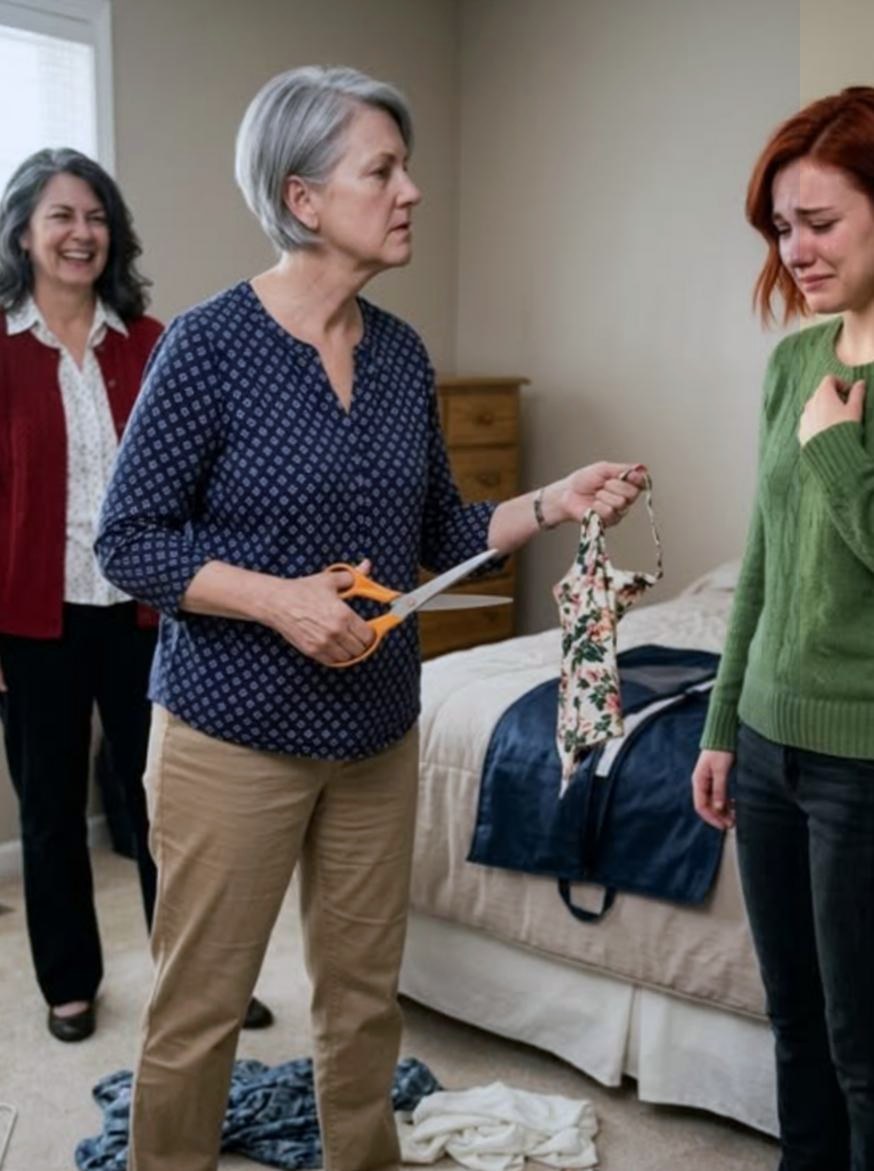
Lucas placed his hands on the chair. His fingers trembled just as my hands had trembled that day when I touched the cut-up clothes.
“Emily, please, tell him that it was not like that.”
“I cannot tell him that you did not say your words.”
“We are brothers and sisters.”
“That is exactly why it hurts.”

The case went to court. Lucas confessed to the crime in order to receive an agreement instead of imprisonment. He was ordered to sell the company, return the money, and perform community service. Mother received a suspended sentence and a financial penalty in the case of the forged documents. Father became a witness because in the end he confessed everything.
I did not feel victorious after a single hearing.
Only the weight was lifted from me.
I saw Grandma’s house one week later. The door was open. The smell of dust stood in the rooms, while the curtains were carried by the wind.
Her bedroom was empty. Only one photograph remained on the wall—Grandmother and me in the kitchen, both of us holding flour-stained aprons.
I opened the drawer of the sewing table. Inside was a small wooden space exactly the size for Grandma’s copper-colored scissors.
But the scissors were with me.
Mother had left them in the room that night. The police kept the item as evidence, but later the investigator returned it to me.
I brought it home.

Three months later I opened a small workshop in the coastal town. I sewed clothes and taught women how to sew a new dress for one another from old fabric. A photograph of Grandma hung on the wall. My worktable stood by the window.
Alexander often came in the evening.
One day a little girl named Sophie brought me a drawing. In the drawing a woman stood in front of a large house. The woman held small moon-shaped scissors in her hand.
“This is you,” Sophie told me. “Because you turn cut-up things whole again.”
I bent down and hugged her.
“Sometimes we cannot return things to their former state.”
“Then we make something new,” she told me.
That evening the first snow came. The roofs of the town were covered in white, and the steam on the workshop windows drew small circles.
A message from my mother appeared on the phone.
“I want to talk to you. Can we start over?”
I stared at the screen for several minutes.

Then I wrote:
“You can start, but without me.”
It was not revenge.
It was a boundary.
For the first time in years, I was not trying to give up my own peace for someone.
I put the phone aside and placed Grandma’s scissors on the table. The white light entering through the window was reflected on the copper surface. The small engraved moon was still the same as I remembered it from childhood.
Outside, the snow began to fall more heavily.
I was sewing the edge of a new dress.
And this time I chose the fabric myself.
The scissors gleamed in the moonlight.
Missed the beginning?
Related posts:
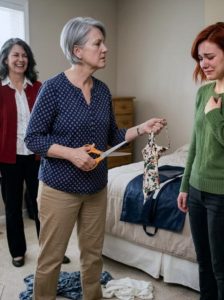 My Mother Cut Up My Clothes and Made Me Appear Alone at the Wedding, but as Soon as the Door Opened, the Smile Disappeared from My Mother’s Face
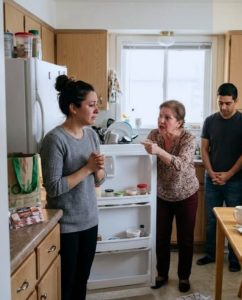 The Meat My Mother Sent Was Being Saved by My Husband for His Mother-in-Law, but When He Opened the Refrigerator, His Face Suddenly Turned Pale
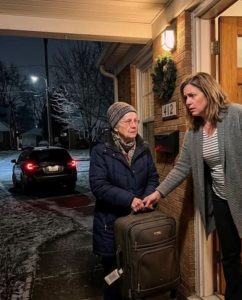 Father Left Houses to My Brothers, but Burdened Me with Mother’s Life — Yet My Brother’s Smile Suddenly Disappeared
 Mother Left Me Alone for a Month, and I Left Something Waiting for Her in the Kitchen — Her Smile Disappeared Immediately
 Mein Mann versteckte mich nach der Geburt unserer Zwillinge vor seinen Gästen – dann hörte sein Chef auf zu lächeln
 My Family Tried to Break into My House with a Fake Lease, but My Father Lost His Color When the Door Opened