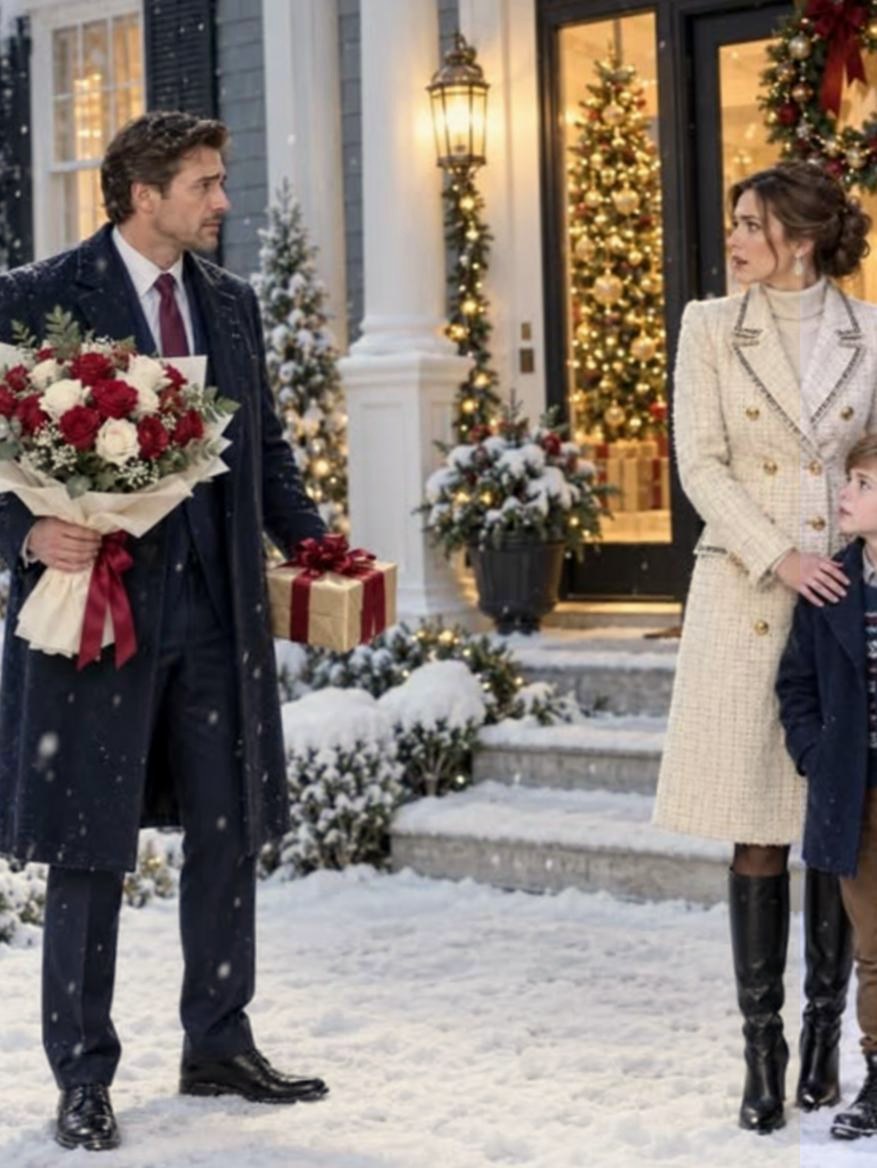

When the lawyer’s call ended, such silence fell over the house that it seemed as if the snow outside had buried the whole city.
Wendy stood by the window.
The umbrella in her hand slowly folded.
“I put this money aside for you,” she said.
“No. You used this money so that my life would remain in your hands.”
“I wanted to protect you.”
“From whom?”
“From Jessie. From her family. From the child whom I did not know then was truly yours or not.”
Jessie smiled bitterly.
“I offered you a DNA test. You refused.”
Wendy turned her head toward her.
“Because Ivan was already lost.”
“No,” I said. “Because you wanted me to be lost.”
Wendy’s face crumbled.
The phone came alive again. This time the lawyer was on a video call. Bank statements appeared on the screen. Dates, amounts, transfers. The first payment had been made two weeks before Leo’s birth. The last—a few days after his third birthday.
“To whom were these amounts transferred?” I asked.
“To a private agency that interfered with finding Jessie’s address and contact information,” the lawyer answered. “Then the transfers continued to her lawyer.”
Jessie grabbed the chair.
“I thought I simply could not find you.”
“I owe you an apology,” I told her. “But my mother’s crime does not cancel my responsibility. I myself left you when I did not listen to your explanation.”

Jessie nodded.
“I will not tell you that everything suddenly got fixed either. Seven years do not disappear in one night.”
Leo stood at the door. He was holding my old photograph.
“Dad, were you really a soldier?”
“I was.”
“Then why couldn’t you find me?”
This question was even heavier.
“Because I was too proud and too angry. I thought refusing to hear the truth was easier. I was wrong.”
Leo turned the photograph toward me.
“Can you write your name on this?”
I took a pencil. My hands were trembling. On the back of the photograph I wrote: “For Leo, from the day I first saw you.”
Wendy picked up her bag.
“I will not go to court. I will sign everything.”
“The court is no longer your choice,” Jessie said.
Wendy looked toward her, as if seeing her for the first time not as an obstacle, but as a person.
“Will you ever forgive me?”
Jessie did not answer for a long time.
“Forgiveness is possible. Forgetting is not.”
Wendy left.
As she went out through the door, the tip of her umbrella scraped the floor and left a small black mark. In childhood I always cleaned such marks from my mother’s things. This time I did not move.

The next morning my former military friend called me. He told me that the former manager could testify against Wendy. Then my lawyer contacted me and said that temporary control over the inheritance fund had already been suspended.
I did not call any of the calls a victory.
Because I was in Leo’s room.
Paper snowflakes hung on the walls of his room. A small model rocket stood beside the bed. And on the table lay a wooden box in which Jessie had kept his first hospital bracelet.
There was also an empty room.
That room should have been mine for seven years, but now there were only an unfinished shelf, dust, and two nails left in the wall. Jessie opened the door for me and let me inside.
“When Leo was born, I thought I would prepare it for you one day,” she told me. “Then I realized I had to turn it into a child’s room.”
One object had still remained in the corner: a small wooden horse that I had made in the first year of our marriage.
Jessie picked it up.
“You always painted this badly.”
“I could not do it better now either.”
She smiled for the first time.
But it was not the old smile. It was more careful. More real.
Over the following weeks everything changed slowly.
I rented a small apartment in the city, ten minutes from Jessie’s house. In the mornings I went to work in the warehouse security department, and in the evenings I picked Leo up from school. At first he sat far away from me in the back seat of the car.
On the first day he asked me:
“If you go away again, will you come back again?”
“I will go only if I tell you beforehand. And I will always come back.”
“Promise?”
“Promise.”
He held out his hand.
He wrapped his little finger around my finger.
That touch proved to me more that I was his father than any document.

Six weeks later Jessie brought me the preparatory court documents. We sat at the same table, while Leo arranged colored pencils in the living room.
“Wendy has not contacted us again,” Jessie said.
“That is good.”
“You are still waiting for her call.”
“Sometimes a person also wants to say the truth at least once.”
“She already said the truth. You just did not understand it then.”
Three months later the first snow came.
Leo brought me a school drawing. Three people stood in front of a house on the sheet. Jessie’s hair was colored yellow, Leo held a large red star in his hand, and I stood beside them in a military coat and with strangely long legs.
“This is our family,” he told me.
“Why am I so tall?”
“Because you have to be visible in the picture for the first time.”
We stuck the drawing on the refrigerator.
That same evening I received a message from Wendy.
“Can we meet at least once? I will explain everything to you. You are my son.”
I looked at the screen for a long time.
Earlier I would have run immediately after such a message. I would have done anything to prove her love, even surrender my own truth.
Now I handed the phone to Jessie.
“Do you want me to answer?” she asked.
“No. This time I will do it myself.”
I wrote:
“You are my mother, but that does not mean you can decide again whom I should be with. You no longer have a place in Leo’s life until you take responsibility for yourself. I will no longer protect you from your guilt.”
For a long time I did not dare to send it.
Then I sent it.
No answer came.

That night Leo asked me to teach him how to blow the military whistle. My old metal whistle lay on the table, the one I had always carried with me after the mission.
“It makes a very loud sound,” he said and covered his ears.
“Then we will use it only in emergencies.”
“Is it an emergency now?”
Snow was falling outside the window. Jessie was arranging glasses in the kitchen. For the first time no one in the house was waiting for the door to open in fear.
“No,” I told Leo. “Now we are simply at home.”
He took the whistle in his hand and smiled cautiously.
And I put the old wooden horse back on the shelf, placed Leo’s drawing beside it, and realized that the lost years could not return.
But the life that remained still belonged to us.
The whistle lay silently on the table.
This time I was waiting for no one.
Missed the beginning?
Related posts:
 Seven years later I went to apologize to my ex-wife, but when the door opened, a boy looked at me and his mother turned pale
 I Found My Mother Bloody on the Kitchen Floor, While My Wife Was Drinking Wine — At My Words, Her Smile Began to Disappear
 My mother-in-law took me to the hospital, but my husband demanded that I apologize — he turned pale for the first time at my answer
 They left me in the rain with my newborn child, and when one call came, Luka’s smile suddenly disappeared
 No one could stop the mafia boss’s son until I approached him—and the color instantly drained from Rico’s face.
 I Entered the Mafia Boss’s House While He Was Wounded, but When He Heard My First “No,” the Doctor Turned Pale