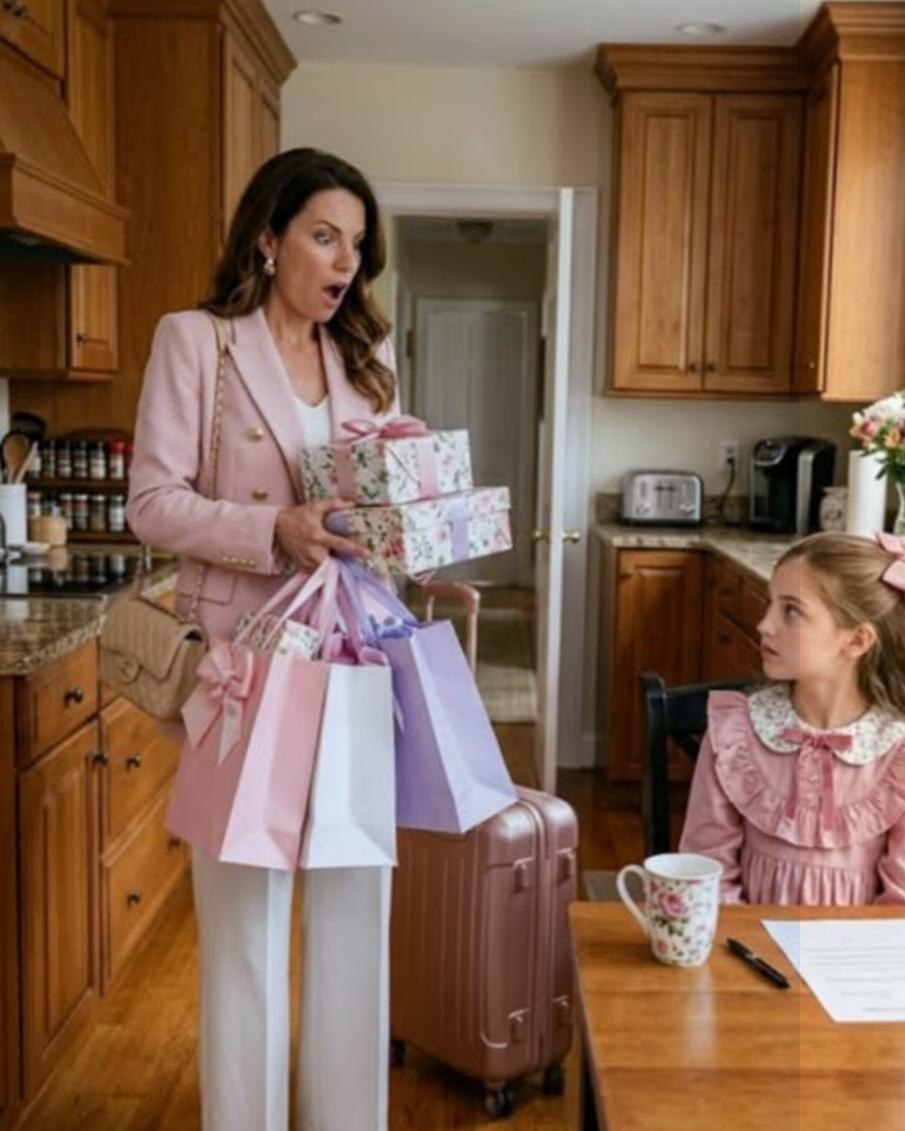

Rebecca ended the call and put the phone on the table. Mother was still looking at the letter, as if that one sheet could destroy all the walls of the room.
“What accounts are you talking about?” she asked.
“The accounts into which the money Daniel sent for Sydney was deposited,” Rebecca said. “The money was supposed to be kept in the child’s name. But you withdrew it for five years.”
Mother’s lips froze.
“That money was for the family.”
“No. That money was for Sydney.”
Ellen took statements from the folder. Dates and amounts were visible on every page. Some transfers had been made exactly on the days when Mother told me that we had no money left at home.
Coldness poured into my stomach.
“Is that why you did not want me to meet Father?”
Mother could not find an answer.
Her phone rang. A lawyer’s name appeared on the screen. Mother answered quickly.
“Irakli, you have to come immediately.”
She listened for several seconds, then her face changed.
“No, you cannot do this. You are my lawyer.”
Ellen raised her head.
Mother went to the window and placed her hand against the glass.
“What do you mean, you no longer want to continue the case?”
As she listened to the answer, her shoulders sank.
“Because you knew everything?” she shouted. “Then why were you defending me?”
The call ended.
“The lawyer refused,” she said soundlessly. “He said he could not agree to repeat lies in court.”
No one in the room was glad. Neither was I. I did not feel Mother’s defeat. I felt only tiredness, as if I had lived for a whole month not on twenty dollars, but on her secrets.

That same night a police officer asked Mother to go with them. They did not put handcuffs on her. They simply told her that she would have to answer questions.
Mother tried to stop at the door.
“Sydney, I did everything for you.”
I held the wooden box against my chest.
“You decided for me who I needed.”
“I am your mother.”
“I know. But that no longer means that all your decisions were right.”
She left.
Her heels came quietly down the stairs. Earlier that sound meant returning home. That night, for the first time, I understood that some departures are final, even if the door does not close completely.
The next morning the recording was played in the small courtroom. Mother sat there with her hands clasped together. When she heard her own voice, the voice saying, “Tell Sydney that her father died,” she raised her head.
The recording continued.
“If she knows that I am taking the money, I will lose everything. The child must stay with me, otherwise Daniel will take my life away.”
Mother closed her eyes.
Hearing your own words turned out to be something different. You could not blame a stranger. You could not say that someone had misunderstood you. Your voice stood against you.
The judge did not speak for long.
“Sydney will temporarily live with her father and Mrs. Alvarez until the final custody decision is prepared. Mother will have the right to supervised visits. The investigation into the financial matters will continue.”
Mother looked toward me.
I neither nodded nor turned away.
Justice does not always come with noise. Sometimes it is simply written on paper and everyone in the room falls silent.

In the evening I entered my old room. The dark blue shirt that I had worn four days in a row during the last week was still lying on the bed. On the windowsill I found the crumpled twenty-dollar bill.
I had one dollar left.
I had not spent it. On the last day I sewed it into the inner seam of my pocket, as if I wanted to prove to myself that I had made it to the end.
There was no longer a suitcase in Mother’s room. Half-empty hangers remained in the closet, and her old photograph with me hung on the wall. In the photograph she was smiling, while I was holding her hand.
I did not take the picture down.
That night Daniel cooked pasta for me. He added too much salt, and we both asked for water.
“I am a bad cook,” he said.
“But there is food anyway.”
He fell silent.
And for the first time I smiled at him.
Weeks passed slowly. The court decided that Mother needed treatment and financial supervision. She did not go to prison, but she could no longer pass the consequences of her decisions on to someone else. Daniel did not ask me to call him Father. Nor did he say that I had to forget everything immediately.

He simply woke me every morning and asked:
“Are you ready to go to school today?”
At the end of autumn we moved to a new city. The house had a small yard, and from the kitchen window I could see a maple tree instead of the street. Daniel worked at an auto repair shop at six in the morning, and I started going to school.
During the first days I always had two sandwiches in my bag. One for me. The second—in case someone needed it.
Mrs. Alvarez called me once a week. Rebecca wrote me letters and asked how I was. Ellen explained every court update to me in simple words, so that I would never feel as if my life had disappeared into someone else’s folder.
Daniel hung a small board on the wall. Every evening we wrote on it what we needed to buy.
Milk.
Bread.
Apples.
And sometimes cake, if we had money left.
One day, returning from school, I saw Daniel standing in the kitchen and cleaning the wooden box he had brought with him.
“Are the letters still there?” I asked.
“All of them.”
“Could we read some of them together?”
His hand stopped.
“Whenever you want.”


We read three letters. One was about my fifth birthday. The second was about the day when I first went to school. In the third Daniel wrote that he came to my house every week, but the door was never opened.
I did not cry because of the letters.
I cried because all those years someone had really been waiting for me.
Three months later the first snow came. A white layer fell in the yard, the roofs became silent, and every sound in the street grew soft.
That evening I received a message from Mother.
“I want us to start over. You are still my child. Call me.”
A second message came a few minutes later.
“I loved you then too. I simply made a mistake.”
I looked at the screen for a long time. The old Sydney would have answered immediately. She probably would even have apologized for forcing Mother to make such a choice.
But I already knew that love can have a place and still not be allowed to hurt you again.
I wrote:
“I cannot see you yet. When I am ready, I will contact you. Please respect this decision.”
Then I put the phone down.

Daniel stood by the window and watched the snow.
“Did you answer her?” he asked.
“Yes.”
“Was it a good answer?”
“It was my answer.”
He nodded. He said nothing else.
That night I returned to my room and opened the box of old things. Inside there was still the crumpled one dollar that I had hidden in my pocket months before. Beside it I put the silver star-shaped hair clip that Father had kept for me.
Two small things.
One of them reminded me of the day when I was left alone. The other—of the day when I realized that I was no longer alone.
I straightened the crumpled dollar, put it in the wooden box, and closed the lid.
Then I opened the window. Cold air entered, but this time it did not bring the smell of hunger and fear. There was only the clean silence of snow.
I was no longer afraid of independence.
Now it was my choice.
Missed the beginning?
Related posts:
 Mother Left Me Alone for a Month, and I Left Something Waiting for Her in the Kitchen — Her Smile Disappeared Immediately
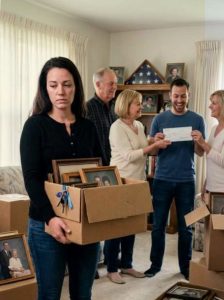 Mother gave my brother my grandmother’s money and held out a paper for me to sign — but her smile disappeared when the lawyer arrived
 Father Left Houses to My Brothers, but Burdened Me with Mother’s Life — Yet My Brother’s Smile Suddenly Disappeared
 My husband gave flowers to his former lover, and I left the hall — behind the cameras, his smile disappeared
 I Found My Mother Bloody on the Kitchen Floor, While My Wife Was Drinking Wine — At My Words, Her Smile Began to Disappear
 The Meat My Mother Sent Was Being Saved by My Husband for His Mother-in-Law, but When He Opened the Refrigerator, His Face Suddenly Turned Pale