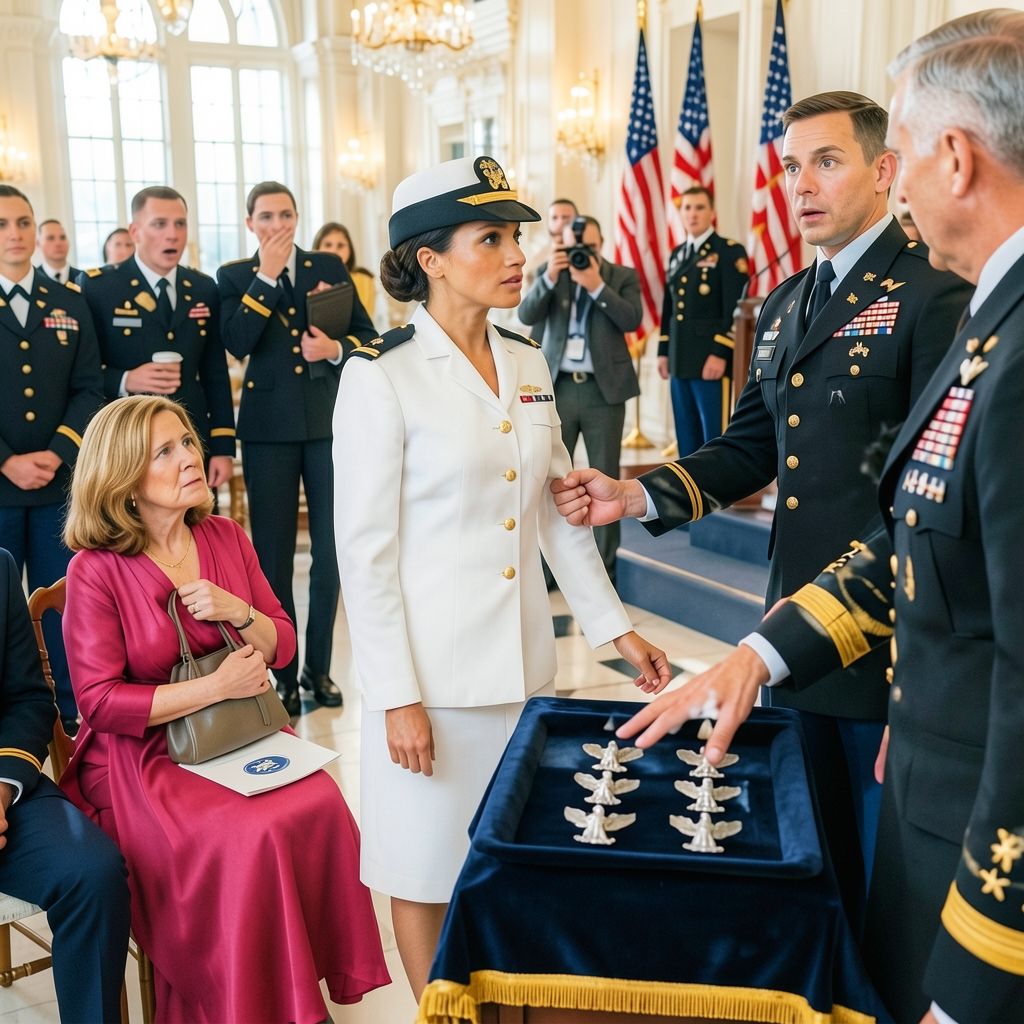
The captain grabbed my arm at the entrance to the military hall and hissed that the promotion ceremony was for real service members, not random women wandering in from the parking lot.
His fingers crushed the fabric of my dress. One of the blue buttons tore loose, and a single thread dangled between us like a tiny flag of surrender. Beside me, my mother tightened her grip on an old, worn handbag she had bought twenty years earlier. She always said expensive things were not automatically good things.
“Take your hand off me,” I said.
The captain did not blink. “Ma’am, the front rows are reserved for officers’ families. You are not permitted to sit there.”
“I was invited.”
“Everyone says that.”
My mother tugged gently at my elbow. “Madison, don’t make trouble. We can sit in the back.”
That old fear had entered her voice—the fear I remembered from childhood, when she came home from cleaning other people’s apartments and told me not to make noise because the owners might decide they no longer needed her.
I looked at the brass nameplate beside the nearest chair.
Evelyn Hayes.
My mother’s name.
“That is her seat,” I said.
The captain’s mouth twisted. “Of course it is. And who exactly are you?”
He meant the question to be quiet, but several guests turned toward us. At the far end of the hall, a young reporter stopped writing. Onstage, General Mitchell continued sorting through the ceremony folder, unaware of the scene unfolding near the doors.
“I already explained,” the captain said. “Military personnel will be called by name. Do not create a disturbance.”
“You did not explain anything. You grabbed me and insulted my mother.”
His expression hardened. “Say one more word, and I will have security escort you both outside.”
My mother went pale. I felt anger rise through me, hot and immediate, but seven years in uniform had taught me that the person who loses control first usually hands the other side the weapon.
“All right, Captain,” I said quietly. “Then call the general.”
He leaned closer, lowering his voice. “Do you really believe anyone here knows you?”
Before I could answer, General Mitchell finally looked up. His eyes moved from my face to my mother, then to the captain’s hand and the torn blue thread hanging from my sleeve.
He opened the folder in front of him, found a marked page, and rose halfway from his chair.
“Madison Hayes,” he began…
PART 2
“Colonel Madison Hayes.”
The general’s voice was calm, but Captain Harrington pulled his hand away as if he had touched a live wire. The color drained from his face. He did not look at me. He looked at General Mitchell.
“Sir, I didn’t know—”
“That is precisely the problem,” the general said. “You did not know, yet you decided you had the right to put your hands on someone and determine who deserved a seat in this room.”
Silence spread through the hall. Even the faint hum of the heating system seemed to disappear.
My mother still held the strap of her handbag so tightly that her knuckles had turned white. I placed my hand over hers.
“Mom, you’re all right.”
She flinched anyway.
That small movement hurt more than Harrington’s grip. My mother had spent fifty-three years apologizing for taking up space. She apologized when a waiter brought the wrong order. She apologized when strangers stepped on her shoes. She apologized for needing anything at all.
General Mitchell turned back to the captain. “You are relieved of ceremonial duties. Report to my office at three o’clock with your personnel file and identification.”
“Sir, I was only following protocol.”
“No. You followed your assumption. That was your choice.”
Harrington saluted stiffly and disappeared through the side door. The lock clicked behind him. Somehow, that tiny sound felt louder than the applause that followed.
The ceremony continued. I walked onto the stage while my mother took her place in the front row. When an usher offered to move her farther back, she did not apologize. She simply straightened her shoulders and placed the old handbag across her lap.
“Madison,” she whispered, “did I embarrass you?”
I turned toward her. “You raised me in a one-room apartment on a cleaner’s wages. You taught me how to polish army boots before I understood what the army was. If anyone should feel ashamed today, it is not you.”
General Mitchell removed the old silver leaves from my uniform and replaced them with the eagle insignia of a colonel. The metal was cold against my collar, but for the first time that morning, I felt warm.
The applause lasted several minutes. My mother cried and smiled at the same time.
By evening, however, the victory had begun to feel strangely fragile. My phone rang from an unknown number.
“Colonel Hayes?” a woman asked. “This is Captain Reyes, Captain Harrington’s aide. You need to know that he was not acting alone. Someone pointed you out to him before the ceremony.”
I sat up. “Who?”
There was a pause.
“Sergeant First Class Mark Tillman,” she said. “But that is not the worst part. Someone has already prepared an official complaint against you, and it is being filed tomorrow morning…”
PART 3
The next morning, a message from the inspector general’s office appeared on my phone. Retired Colonel Richard Weston had filed a formal complaint accusing me of deliberately hiding my rank so I could provoke Captain Harrington into a public confrontation.
I read the message three times. Then I went to the bottom drawer of my desk and pulled out the folder I had brought home from the ceremony. Inside were the seating chart, the printed program, my promotion orders, and a photograph of the blue button my mother had picked up from the floor.
At seven in the morning, I was sitting across from Major Paulson.
“I reviewed the security footage,” he said. “You entered calmly. Harrington blocked your path, grabbed your arm, and refused to check the guest list.”
“And Weston’s complaint?”
“It is based on his statement. But he was not the only witness.”
The major placed several signed accounts on the desk. The young reporter had seen everything. So had two officers and the attendant at the entrance. They had heard Harrington call us intruders. They had seen his hand close around my sleeve.
Then the other piece surfaced.
Sergeant Tillman had pointed at my mother and me before the ceremony and told Harrington that the front row belonged to Colonel Weston’s family. He had never checked the invitation list. He had never looked at the seating chart.
When I confronted him, he denied it for less than a minute. Then his eyes dropped to the floor.
“I never told him to grab you,” he muttered.
“No,” I said. “You only gave him the excuse to humiliate my mother.”
I did not demand that Tillman lose his career. Eighteen years of service should not be erased by one terrible choice, even when the choice is deliberate. But he was removed from ceremonial duties and required to complete training on equal treatment and professional conduct.
Harrington received a formal disciplinary reprimand, lost eligibility for promotion, and was transferred to an administrative post where he could no longer decide who was worthy of being heard. Weston’s complaint was dismissed for lack of evidence. Investigators also discovered why he had filed it: he could not accept that the woman he had once called “too soft to command” had become his successor.
That evening, I called my mother.
“You can stop apologizing for taking a seat,” I told her.
She laughed, then sent me a photograph. Beside her battered handbag sat a new dark-blue leather one.
“The old one still works,” she wrote. “But this one matches my dress.”
I placed my phone beside the eagle insignia on my desk. The metal no longer felt heavy.
The torn blue thread stayed in my pocket—not as proof that someone had tried to push us out, but as a reminder that sometimes the door they guard so fiercely is the very door that opens widest for you.
Related posts:
 My Mother Swore in Court That I Had Never Served in the Army, but When the Doors Opened, the General Who Pulled Me From a Burning Aircraft Walked In
 My Family Sold My Grandfather’s House After Leaving Him to Die Alone in a Hospital, but a General Saw His Old Ring and Asked Me Where I Had Gotten It
 My husband pushed me from a frozen cliff, then complained at my funeral that I had taken too long to die—and someone went pale
 I was ordered to feed the city’s most feared man, but when he tasted my burnt garlic, his expression suddenly changed
 My future mother-in-law handed me a bucket before dinner, but when I reached for my coat, her smile disappeared
 My husband let his mistress steal my speech and wear my mother’s pearls, but the hospital screen made him stop smiling