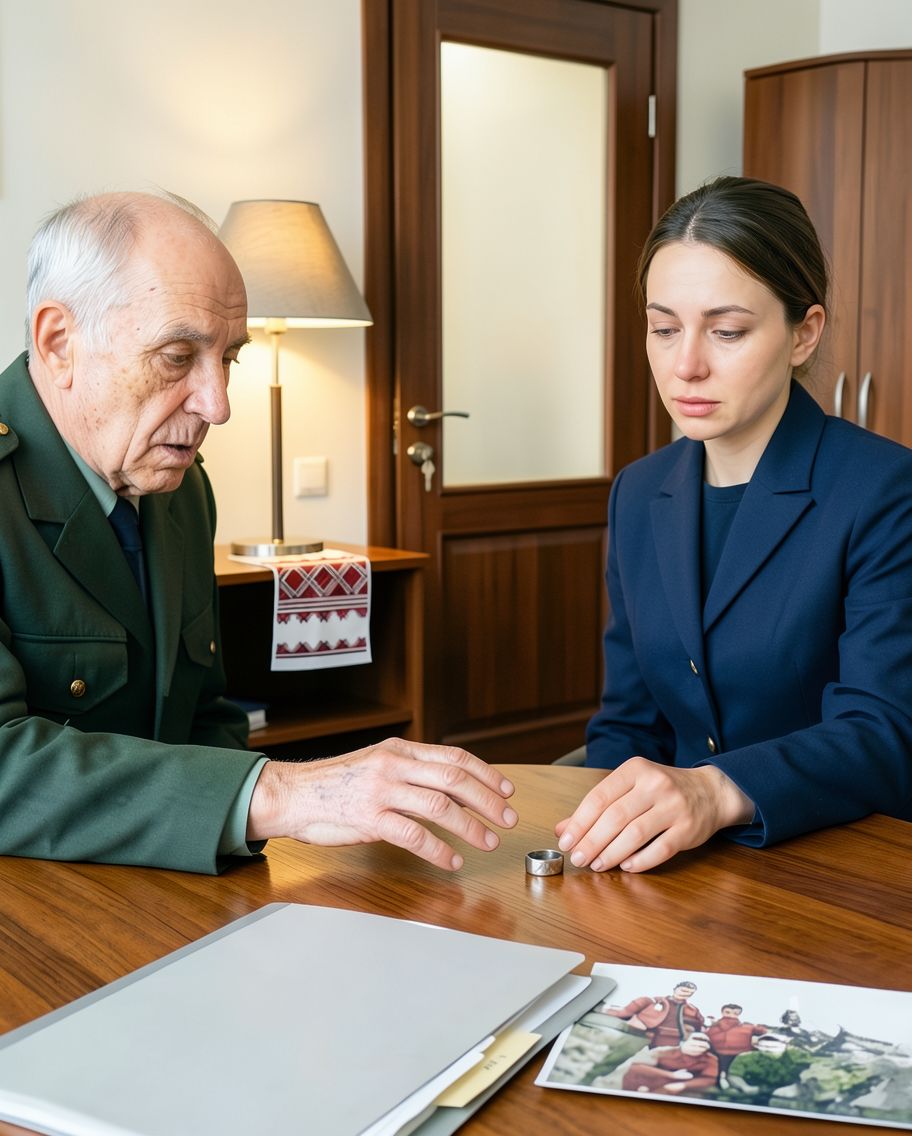
The moment my mother learned that my grandfather had died, she did not ask how he had spent his final hours—she only asked whether anyone had already offered money for his house.
I was standing in the hospital hallway, still holding Nicolas Grytsenko’s cold hand, when her voice came through the phone.
“Is the property paperwork in order?” she asked. “That is what matters now.”
For two nights, I had slept in a plastic chair beside his bed. I changed the water in a paper cup, adjusted his blanket, and listened to his breathing grow thinner. My mother said the roads were dangerous. My father claimed he had an important appointment. My brother Andre sent one message: “Let us know when the inheritance is available.”
Nicolas opened his eyes just after dawn. His face looked small against the white pillow.
“So you are the only one who did not forget me,” he whispered.
I tried to smile. I could not tell him that he was right.
He died three hours later without seeing any of them.
At the funeral, there were six people: a priest, two neighbors, a nurse, a shopkeeper, and me. My mother sent a message instead. Too busy this week.
That evening, I returned alone to his little house outside Lviv. The kitchen smelled of tea, camphor, and damp wood. His old jacket hung behind the door, carrying the faint scent of smoke and winter. On a chair lay a torn button fastened to a loose blue thread.
I was not searching for money. I wanted one photograph, one letter, anything that belonged to the man my family had treated like an unwanted piece of furniture.
In the bottom drawer of his dresser, beneath a neatly folded handkerchief, I found a heavy silver ring. Scratches covered its surface. Inside was a strange symbol: a lantern above three sharp mountain peaks.
I had seen it on his finger when I was a child.
“What does it mean?” I once asked him.
He closed his hand around it.
“It reminds me who I am.”
Three weeks later, my parents sold the house. My mother took the clock. My father took the old truck. Andre kept asking when the money would arrive.
I kept the ring.
A month later, while wearing my uniform at a regional military ceremony, I felt someone seize my wrist. General Taras Savtchouk was staring at the silver ring as if he had just seen a ghost. He pulled me toward a locked room, placed a sealed gray folder beneath a lamp, and reached for the red seal…
PART 2
His fingers hovered over the red seal, trembling so badly that the lamp cast their shadow across my face.
“Before you read this,” General Savtchouk said, “you must understand that your grandfather was never an ordinary man.”
I almost laughed. My entire family had spent years insisting he was exactly that. To my mother, Nicolas had been a difficult old man. To my father, he had been an expense waiting to disappear. To Andre, he had been a joke at the end of the table.
The general broke the seal.
Inside was a photograph of thirteen young soldiers standing beside a shattered helicopter. Their uniforms were torn, and wind pushed snow across the mountains behind them. Some were smiling. Others looked toward the horizon with the uneasy stillness of men who already knew they might not return.
I recognized Nicolas instantly, though his hair was black and his face was smooth. Beside him stood Savtchouk, decades younger, with one arm pressed against his ribs.
“Where was this taken?” I asked.
“In a place that officially never existed.”
He placed a page before me. It was covered with dates, military stamps, and thick black lines hiding entire paragraphs.
“Our aircraft was hit,” he continued. “The command ordered the position abandoned. I was injured. The others were told to retreat without me.”
“And my grandfather?”
Savtchouk looked at the photograph.
“He refused to leave.”
The room seemed to shrink. I thought of Nicolas’s hands slicing bread, repairing a fence, and tying my scarf when I was little. Those same hands had carried a wounded man through snow and gunfire.
Twelve names in the report were followed by a black cross. Beside Nicolas’s name, someone had written: Returned. Refused all honors.
“Why did he never tell us?”
The general touched the ring.
“Because speaking about himself would have forced the authorities to speak about the twelve who died. He believed no medal should shine brighter than their graves.”
I wanted that to be the whole truth. But a newer sheet was sticking out from the final envelope. At the top, I saw my name.
“What is that?” I asked.
Savtchouk did not answer. He unfolded a letter written in Nicolas’s shaky hand. On the back, my grandfather had drawn the lantern and the three mountains.
“He ordered me to give you this only if you were the person who wore the ring without ever asking what it was worth,” the general said.
I unfolded the paper. The first line stole the air from my lungs.
“Kateryna, if you are reading this, my family has finally discovered what it never took the time to see.”
Then the general’s telephone rang. He listened, and the color drained from his face.
“Your mother has contacted the military archives,” he said. “She is demanding that your grandfather’s name be removed from the file.”
“Why would she do that?”
Savtchouk turned the last page toward me. At the bottom was a signature I knew by heart, written years before, beside a sentence that could destroy everything my family had told me…
PART 3
The signature at the bottom was not Nicolas’s.
It belonged to my father.
I recognized the sharp, slanted letters from the notes he left beside unpaid bills. The document showed that he had learned the truth about my grandfather years earlier and had personally requested that the military record remain hidden.
“He knew?” I whispered.
“Your father received a copy when he first tried to sell the house,” General Savtchouk said. “He feared the story would bring reporters, questions, and an investigation into your grandfather’s former property.”
Suddenly, my father’s old words sounded different. Old stories are worth nothing. I had thought he meant memories. He meant the truth.
Nicolas’s letter shook between my fingers. He wrote that he wanted neither revenge nor money. He wanted the ring to belong to the person who had stayed beside him until the end without expecting an inheritance. He had written my name.
Then came the sentence that broke me completely: Those who do not come when a man is suffering do not need to be punished. Their absence is already their answer.
I covered my mouth, but the sob escaped anyway.
The general called the archives in front of me. His voice was calm, yet no one dared interrupt him. He verified every document, ordered the letter preserved, and demanded that Nicolas Grytsenko’s name be restored to the public record of the operation.
The next morning, he called my mother.
She answered impatiently. “I am busy. Does this concern the house?”
“No,” Savtchouk replied. “It concerns the man you left to die alone in a hospital.”
He told her that Nicolas had saved his life, carried two wounded soldiers through a frozen mountain pass, and refused every reward so the twelve dead men would not be forgotten.
My mother did not apologize. She asked whether the revelation would change the property’s value.
I took the telephone from the general.
“Grandfather knew who came to see him,” I said. “He also knew who never came.”
Then I ended the call.
A week later, Nicolas’s name was read at an official ceremony. The photograph of the thirteen soldiers filled a large screen. No one applauded at first. The silence in that room finally sounded like respect.
Afterward, the nurse who had cared for him handed me a small hospital identification tag.
“He kept his hand closed all the time,” she said. “As if something important was missing.”
I slipped the ring onto my finger.
That evening, my father called. First he claimed he had known nothing. Then he said Nicolas should have spoken up.
“He did not have to earn your presence by hiding his courage,” I answered.
For once, my father had no reply.
In spring, I stood alone beside Nicolas’s grave and placed a copy of the photograph beneath the old stone. Morning light touched the silver ring, and the tiny lantern seemed to glow above the three mountains.
“I remember you,” I whispered.
And for the first time, my grandfather’s name was not buried with him—it was the light that led me home.
Related posts:
 My Mother Swore in Court That I Had Never Served in the Army, but When the Doors Opened, the General Who Pulled Me From a Burning Aircraft Walked In
 My husband pushed me from a frozen cliff, then complained at my funeral that I had taken too long to die—and someone went pale
 I signed my former father-in-law into emergency surgery while his own son called him too old to save—and then my ex stopped smiling
 The Captain Grabbed My Arm at My Mother’s Promotion Ceremony and Told Us the Front Row Was for Real Military Families—Then the General Opened His Folder and Said My Name
 My Mother Slapped Me in a Hospital Bed When I Refused to Give My Brother $250,000 for His “Business”—Then a Stranger in a Dark Suit Opened the Gray Envelope They Were Desperate to Hide
 My Mother Swore Under Oath That I Had Never Served in the Army, While My Brother Tried to Steal Our Father’s Defense Company—Then a Federal Marshal Walked Into Court With a Sealed Gray Case