
At the moment when the judge signed the order to send the children to four different cities, the smallest girl lost her shoe and clung to her brother as if the floor were sinking.
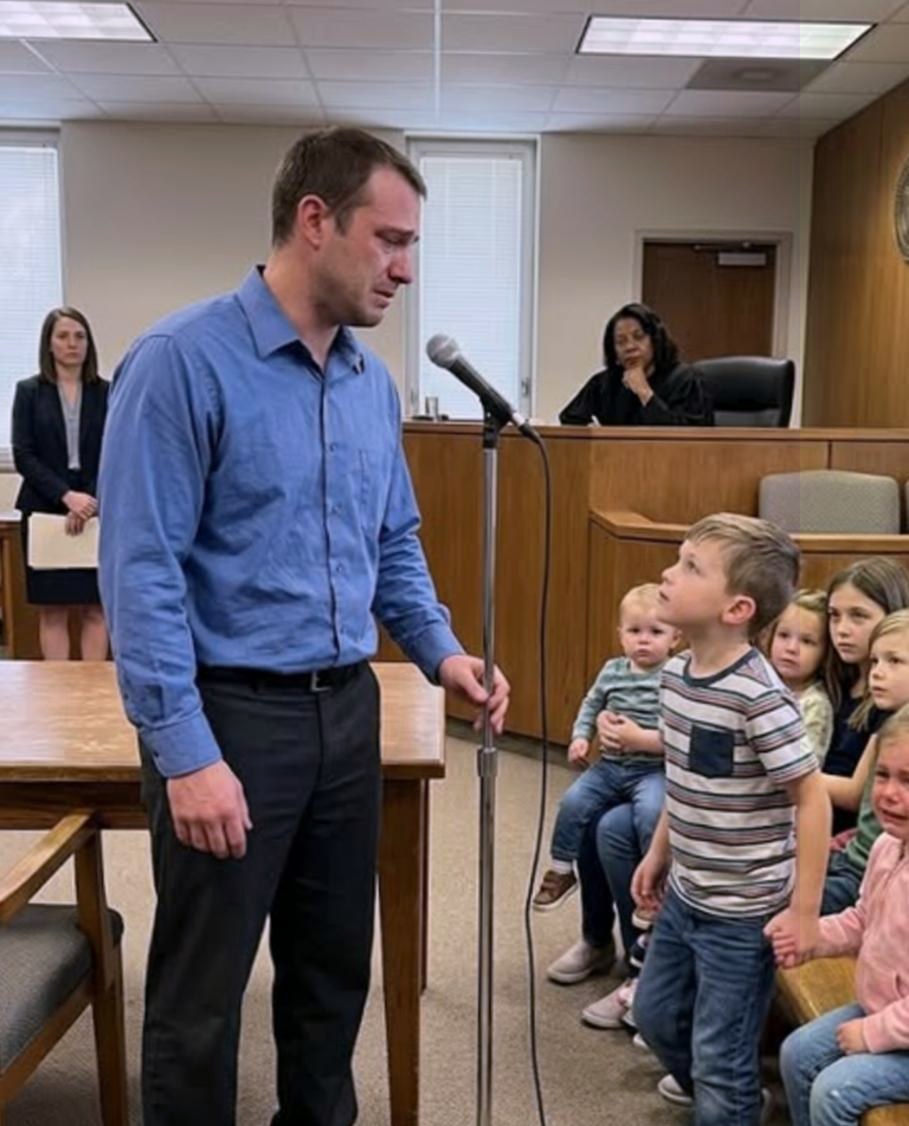
All this was happening in the cold corridor of the family court, at ten forty in the morning. Five children sat pressed against one another on a hard wooden bench. The oldest, a six-year-old boy, Niko, held his one-year-old sister, Lile, with his left hand, while with his right hand he held the arm of his other sister. On his wrist was a small plastic bracelet shaped like an elephant. One ear was broken.
I had been looking at that bracelet all morning.
Three weeks earlier, the mother of these children had died, and their father had been arrested. I accidentally saw the social services notice while I was making a wooden shelf in my workshop. In the photograph, Niko was standing and protecting the smallest child. On his face was written a kind of fear that a six-year-old child should not have known.
That same day I called.
“Mr. Carter, you are a twenty-nine-year-old single man,” social worker Mrs. Harris told me. “Taking in five children at the same time is practically impossible.”
“Practically impossible is separating them,” I answered.
“Four families are already ready.”
“Probably four cars too.”
Silence fell in the telephone for several seconds.
That night I could not sleep. I imagined how they would put five children into different cars, how they would promise them that it would be only temporary. I knew that word. I had heard it myself in childhood.
The next morning I withdrew all my savings. I bought five seats, removed the workshop wall, and put two bunk beds in the common room. I carved a small wooden moon on each of the five beds, because I wanted every child to know at night that there was a place in the room for them too.

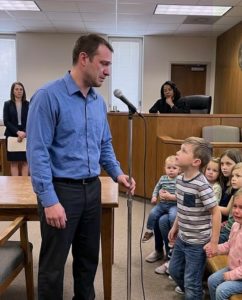
Now I was standing before Judge Miller, while the state prosecutor was questioning me against my interests.
“This man is impulsive, inexperienced, and has no idea what raising children under five means,” he said. “Besides, he himself admits that he has neither a wife nor a large income.”
My lawyer, Mrs. Rivera, stood up.
“He has stable work, his own house, and the safety check has already begun.”
“Begun does not mean completed,” the prosecutor answered sternly.
Judge Miller took off his glasses and looked directly at me.
“Mr. Carter, people do not make such a great sacrifice without a reason. Why do you want to take in five children whom you have never seen before?”
The courtroom fell silent. Only the low hum of the elevator motor could be heard.
I looked at Niko. Lile began to cry, and he placed the hand with his broken-eared elephant bracelet on her shoulder.
I knew that hand.
I was six years old when I last clung to my four siblings in a courthouse corridor. I was the oldest then too. Then too, they told me that the separation was temporary.
“I do not promise them that everything will be easy,” I said into the microphone. “I promise only that, as long as I can, I will protect them together.”

The judge looked toward the social worker.
“Is the transportation ready?”
“The cars are waiting downstairs, Your Honor.”
Miller put his hand on the document lying on the table.
“Then not one child will leave the building until I decide.”
Niko slowly stood and looked toward me.
“If one of us behaves badly, will you send only that one away?” he asked.
There was such seriousness in his eyes, as if his whole life depended on my answer. I knelt before him.
“No,” I told him. “I will ask for help, I will make mistakes too, but I will not let any one of you go alone.”
“All five?”
“All five.”
He extended his hand toward me. His fingers wrapped around only two of mine.
At that moment Mrs. Harris noticed something in my file. Her face changed, and she quickly reached toward a small brown folder that no one had touched since morning. Mrs. Rivera saw it too and stood up sharply.
“Why is this document here?” she asked.
The judge pulled the folder toward himself, while the prosecutor stopped smiling for the first time. His fingers touched the folder’s clasp…

His fingers touched the folder’s clasp, but before that Mrs. Rivera put a hand on his arm.
“Before you open this, the court must know who added this material to the case.”
Mrs. Harris lost color.
“I did not add it.”
“Neither did I,” said the prosecutor, although his voice was no longer confident.
Judge Miller opened the clasp. Inside were several yellowed pages, an old photograph, and a small audio-recording card. In the photograph, five children stood on the steps of a children’s shelter. I immediately recognized those steps, although twenty-three years had passed.
My knees gave way.
“Mr. Carter, do you know this photograph?” the judge asked me.
“Yes.”
“From where?”
Everyone in the courtroom turned toward me. The five children were still clinging to one another.
“I am the six-year-old boy in that photograph,” I said.
Mrs. Rivera quietly exhaled. The judge turned over the back of the photograph. It said there: “The Carter family, temporary separation, plan for subsequent reunification.”
“You did not mention this in your application,” the prosecutor said.
“No one asked.”
“This is important information.”
“For me it was never a secret. It is simply that no one ever found enough time to see it.”

Niko stepped forward.
“Did you have brothers and sisters too?”
I sat down beside him.
“Four.”
“Where are they now?”
That question hurt me more than any accusation.
“They live in different places. I have not spoken to some of them for years.”
“Because they were bad?”
“No. Because the adults said it would be better this way.”
Niko ran a hand over his head. His plastic bracelet touched the bench and made a small, dry sound.
The judge reread the documents.
“It says here that in childhood you were part of an official reunification plan.”
“The plan existed. But the families changed, addresses were lost, and then everyone began their own life.”
“And where did this folder come from?” Mrs. Rivera asked.
No one answered.
Suddenly an elderly woman standing by the back door stepped forward. Until then I had thought she was an ordinary spectator. A gray shawl was wrapped around her shoulders, and she held a folded paper in her hand.
“I brought it,” she said.
The judge looked at her.
“Who are you?”
“Ellen Ward. I was the night attendant at the shelter where Luka and his brothers and sisters lived.”
My chest tightened.
“I remember you,” I said quietly.
“I remembered you every day,” she replied. “Especially that night when the children were put into different cars.”

The prosecutor pushed his chair back.
“These old memories cannot determine today’s decision.”
“Perhaps not,” Ellen said, “but what was recorded that night can.”
She handed the audio-recording card to the judge.
The air in the courtroom seemed to grow heavier.
The judge turned on the recorder. First there was a hissing sound, then the crying of children. Then the voice of a young social worker: “Take all five separately, it will be faster this way. The oldest will soon forget the others.”
My small voice could be heard in the recording.
“Do not take them. I will take care of them.”
Then the sound of a door closing was heard.
Niko took my hand.
“Were you trying then too to keep everyone together?”
I nodded.
“Yes.”
The judge sat silently for a long time. Then he closed the folder.
“The separation order will be suspended. But, Mr. Carter, this still does not mean I will leave all five children with you. A home inspection, a psychological assessment, and a supervision plan are required.”
“I will do everything.”
“What if the house is not ready?”
“Then I will prepare it.”
“What if you cannot endure?”
I looked at the children. Lile was holding one white sock, whose pair was nowhere to be seen.
“Then I will ask for help. But I will not put them into separate cars.”
The judge signed the temporary order. The cars were stopped downstairs. For the first time, all five children left the courthouse with me.

The home inspection was scheduled for the next morning. All night I fastened the beds, hung moons on the walls, and cleaned the kitchen floor.
At six in the morning my phone rang. An unknown number appeared on the screen.
“If you want to take all five children home,” said a man’s voice, “you must not show the court what is written on the last page of the folder…”
Then the call ended…
Then the call ended. For several seconds I looked at the phone as if the answer had to appear on its screen.
At seven in the morning Mrs. Rivera came to my workshop. It was raining outside, and drops were rapidly tapping on the roof. She put her wet umbrella by the door and went straight to the folder.
“Did you see the last page?” she asked.
“Not yet.”
“Do not open it alone.”
“Why?”
She took another sheet of paper from the back pocket of the folder.
“Because this is not an ordinary child-protection record. It says here that twenty-three years ago the separation of your family was not an accidental decision.”
“What does ‘was not’ mean?”
“At that time the shelter administration changed the conclusion. The original report said that the children should remain together. Later that sentence was deleted.”
I could hear the sound of blood in my ears.
“Who deleted it?”
“We do not know yet. That is why today the judge summoned Ellen Ward and requested the original of the folder.”
At exactly ten o’clock we were standing in court again. Niko, Lile, and the other three children sat behind me. Instead of Lile’s lost sock, Mrs. Rivera had put a yellow sock on her, reaching to her knee.

The judge opened the last page of the folder.
“This record confirms that the separation of the children was deliberately accelerated because one private shelter wanted to accept all five children,” he said.
The prosecutor stood up.
“This is only an assumption.”
Ellen Ward spoke.
“No. I was there that night. The administrator said that the children left together would lose an expensive placement.”
The judge played the second part of the recorded conversation. A man’s voice was heard clearly: “The older boy will resist us. Tell him that if he does not keep quiet, they will take his sister separately too.”
Niko lowered his head. I clenched my hands into fists, but reminded myself that I was before the children now.
My six-year-old voice was heard in the recording.
“I will be quiet, just leave Lile with me.”
No one in the courtroom was breathing.
The judge turned off the sound.
“Mr. Carter, now I understand why you came here. You are not fighting only for these five children. You are trying not to pass the result of your own past on to others.”
“Yes,” I answered. “But they are not tools for repairing my past. They are children. I want to protect them, not use my pain.”
Mrs. Rivera gently squeezed my shoulder.
The prosecutor gathered his papers.
“Despite everything, Mr. Carter has no experience.”
“Neither did the people who made the mistake then,” the judge said. “The difference is that today we know what can happen if we make only the comfortable decision.”
He issued an order for temporary guardianship. All five children were to move in with me, under strict supervision and with a mandatory assistance plan.

Niko turned toward me.
“Are we staying together now?”
“Today, yes.”
“Tomorrow too?”
“Tomorrow too we will try. And the day after too.”
He smiled for the first time.
But immediately after the hearing ended, Mrs. Harris closed the door and looked at me with a frightened face.
“Luka, we learned one more thing from this case. Your childhood file says that your younger sister, Mariam, disappeared from the shelter eighteen years ago. Her case was never investigated.”
I leaned against the chair.
“Mariam was alive when they separated us.”
“I know.”
“Then where is she?”
Mrs. Harris put a new envelope on the table. My name was written on the envelope, and below it were words written in Mariam’s hand.
“Luka, if you ever try to save five children again, first find out why you disappeared me.”
I reached toward the envelope, but at that same moment my phone rang again. This time the call was not from the courthouse building, but from the number written in Mariam’s file.
“Answer it,” Mrs. Rivera told me quietly.
I brought the phone to my ear.
“Luka?” a hoarse woman’s voice sounded. “Do not go home with the children. They are watching you…”
An engine started by the window. Someone was sitting inside the car and watching our building…
მარიამის წერილმა ძველი სიმართლე თავიდან გააღვიძა…
ფინალში გაირკვა, რატომ დაშორდნენ ბავშვები და ვინ იმალებოდა წლების განმავლობაში ამ გადაწყვეტილების უკან. მაგრამ ყველაზე მძიმე პასუხი სასამართლოში არ აღმოჩნდა.
„ამჯერად არავინ დაგვაშორებს.“
და პირველად აღარ შემშინებია ხვალინდელი დღის.
👇 ისტორიის ფინალი უკვე გახსნილია
Related posts:
 Part 4 — I was asking to adopt five children when the judge asked my reason and everyone’s face in the courtroom changed
 Two days earlier they forcibly took me to marry, but on the wedding night Niko’s face lost its color
 My Father Was Fed by a Poor Woman at Night, but When I Followed Her Trail, a Stranger’s Face Suddenly Turned Pale
 When the dangerous mobster’s son reached out towards me, his father looked at the photo and went pale.
 I Went to the Cemetery with Five Children, and My Ex-Husband’s Gaze Suddenly Froze
 After I refused to terminate the pregnancy, he abandoned me, but five years later, seeing the twins at the shopping center, his face changed and he turned pale