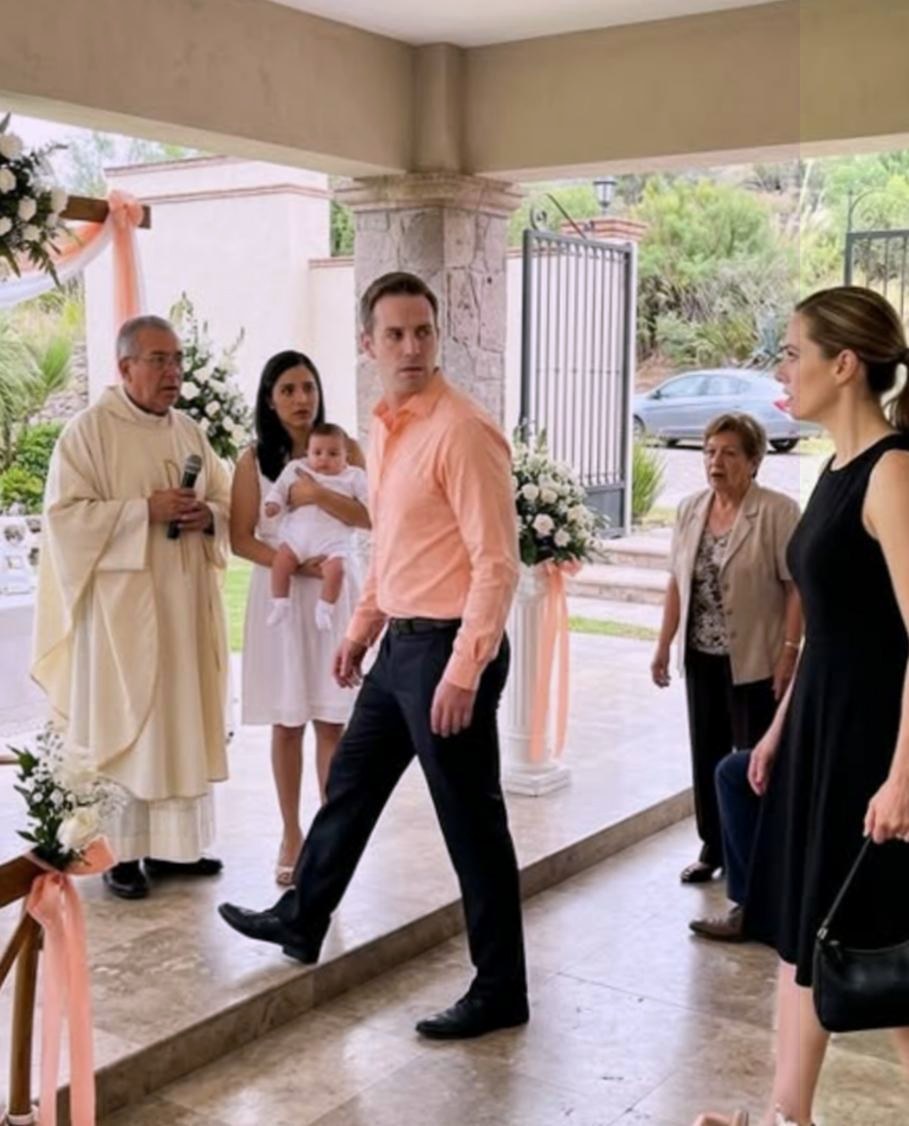

The answer was waiting for me in my father’s empty house, but I was not going to go there alone.
I left the clinic and went straight to the police.
Liam followed me.
“Adeline, we need to talk first.”
“I talked to you for two years. And instead of answers, you gave me lies.”
“I wanted to protect you.”
“From whom?”
He opened his mouth, but no sound came out.
At the police station, Lieutenant Harris listened to my account to the end. The small black device placed on the table repeated Liam’s voice again: “If she does not believe it, we will take her to court.”
This time I heard my own husband’s words not through someone else’s mouth, but in his real voice.

Liam sat on a chair and looked at the floor.
“This conversation has been cut out of context,” he said.
“Then the complete recording must exist,” the lieutenant answered.
“My lawyer will come.”
His lawyer came forty minutes later. He carried a leather bag and entered with such confident steps as if he could still control the situation.
He looked at me.
“Madam, it would be better if you settled this matter as a family.”
“As a family? My medical records were altered, my child was hidden from me, and I was deceived into coming to a baptism. This is no longer a family misunderstanding.”
The lawyer glanced at Liam.
“You told me the child matter had been resolved.”

Liam answered quickly:
“It had been resolved.”
“No,” the lawyer said and closed the leather bag. “You told me that the child had never been seen by your wife. This is something entirely different.”
It was the first minute when Liam completely lost control.
“You work for me,” he shouted.
“Not from today onward.”
The lawyer left the room.
Maggie and Abigail were brought to the station that same evening. Abigail was carrying Lloyd in her arms. The child was still wearing his white baptismal clothes, but the golden ribbon had loosened around his neck.
Maggie was crying.
“I did not know that the child was connected to your child,” she told me.

“But you knew that Liam was living with Abigail.”
“Yes.”
“Did you know that my records had been altered?”
Maggie hid her face in her hands.
“Only partially.”
“Partial truth is the cruelest form of a lie.”
Then the police played the hospital camera recording in front of us. The night from two years earlier appeared on the screen. I was lying in a small room, tired and pale. Liam stood beside my bed. Then the door opened and a nurse entered.
She was holding a baby.
I was looking at him and crying.
My voice sounded in the recording:

“Is he alive?”
Liam took my hand.
“Yes. But the doctor said they have to take him away for a few minutes.”
Then he looked toward the camera. It was exactly the look I had seen everywhere during the last two years—calm, convincing, and false.
Another woman appeared in the recording. It was Dorothy, the assistant of my doctor at that time. She handed the baby to Liam and said quietly:
“Tell the mother that the child did not survive. I will change the documents.”
I was watching the screen and my breath caught.
“Why?” I asked.
Liam lowered his head.
“You said you could not endure losing the child. We thought that if Abigail and Lloyd were with me, I would at least keep my family.”

“You took my child to build a family for another woman.”
“I thought I would explain it to you later.”
“When? When he went to school? When he called another woman mother in front of my eyes?”
Abigail said through tears:
“I thought the child was mine. Liam told me that everything had ended safely during the birth and that your child had not survived. I learned only a few months ago that he was hiding something.”
“Then why did you stay with him?”
“I was afraid. He told me that if I left, I would lose both children.”
At that moment Lloyd began to cry. Abigail immediately pressed him to her chest.
I looked at him and realized that he too had been deceived. Lloyd was not my enemy, nor was Abigail. All this time the only person controlling the whole story had been Liam.
Dorothy was arrested that same night. From her confession it became clear that my child had been taken to a temporary children’s shelter. There he was given another surname and, three months later, adopted by a family—a family that lived in the same city.

His name was Niko now.
He was alive.
Two weeks later I saw him for the first time.
The child protection center had white walls and a warm wooden floor. Niko sat by the window and turned a small wooden train. He was four years old, with dark hair and eyes in which I saw something very familiar.
I stopped at the door.
The social worker quietly told me:
“Do not hurry. Give him the opportunity to come to you himself.”
Niko took the train in his hand and looked toward me.
“Are you the woman from the photograph?”
“Which photograph?”

“The woman who is standing beside my bed.”
My heart contracted with pain.
“Yes. I am.”
“Why did you not come until now?”
I had no answer to this that I could give a four-year-old child.
“I thought I could not find you.”
Niko lowered his head.
“I thought you did not want me.”
I went to him and knelt down.
“There is not a day when I have not wanted you.”

He watched me for several seconds, then held out his little wooden train.
“Then hold this.”
I took it.
This was the whole richness of our first meeting.
During the following months, the court held Liam responsible for the child’s custody and for falsifying documents. Dorothy received a sentence. Maggie left the city and sent me a letter in which she only asked for forgiveness. I read the letter, but did not answer.
Abigail retained the right to care for Lloyd, because the court established that she herself had also been deceived. I did not begin a hostile relationship with her. Lloyd was a small child who understood none of the guilt of any adult.
Liam called me several times.
The first time he told me:
“Come, let us start everything again.”
I answered him:

“Starting again without the truth is impossible.”
The second time he said:
“I still love you.”
“Love that separates a person from their own child is not love.”
The third time I did not answer.
Three months later I moved to a new city. I lived in a small apartment where mountains could be seen from the kitchen window in the morning. I began working as an administrator at a child protection center. Every morning Niko came with me and rang the small bell hanging by the doors.
He loved drawing. On the walls he drew trains, houses, and people reaching their hands toward one another.
One day he drew four people on a sheet of paper.
“Who are these?” I asked.
“Me, you, Lloyd, and Abigail.”

“Why did you draw us together?”
“Because we did not start this story, but we can finish it differently.”
His answer struck me more strongly than any words of a court.
On the first snow of winter, Niko brought home a small drawing from school. In the drawing a woman in a black dress stood, and beside her was a little boy. Above them was a golden sun, and in the corner a small peach-colored ribbon was drawn.
“Why did you draw this?” I asked.
“Because everything was bad that day, but the ribbon still looked beautiful.”
Just then I realized that I did not need to erase my memories. It was enough to find another place for them.
One evening I received Liam’s last message: “I left the cream-colored folder at the house. Everything I hid from you is there. If you ever want to return, the door will be open.”
The folder was indeed found in our old house and sent to me.
I did not open it.

Niko asked me:
“You do not want to know what is written there?”
“No. I already know what I need to know.”
“And what if he deceives you again?”
“Then it will be his burden, not mine.”
That night I put the folder in the fireplace. The papers slowly curled, the ink turned black, and the words disappeared into the fire. I saved only one thing—the peach-colored ribbon that I had accidentally brought from the baptism table. That ribbon now hung above Niko’s bed, on a small wooden hook.
In the morning Niko rang the bell.
It was snowing outside.
I took his hand and we left the house together.
This time no one hid my child from me.
And I did not hide myself either.
Missed the beginning?
Related posts:
 My Husband Told Me He Was Going to a Client’s Child’s Baptism, but When He Reached the Altar, My Aunt Lost Color
 Two days earlier they forcibly took me to marry, but on the wedding night Niko’s face lost its color
 My Father Was Fed by a Poor Woman at Night, but When I Followed Her Trail, a Stranger’s Face Suddenly Turned Pale
 When the dangerous mobster’s son reached out towards me, his father looked at the photo and went pale.
 An Unknown Man Humiliated Me in Front of Everyone, but the Restaurant Owner Looked at Me Only Once — and His Smile Immediately Disappeared
 My Pregnant Wife Was Made to Kneel on the Floor by My Mother, but After I Ran Away, the Smile Disappeared from Her Face for the First Time