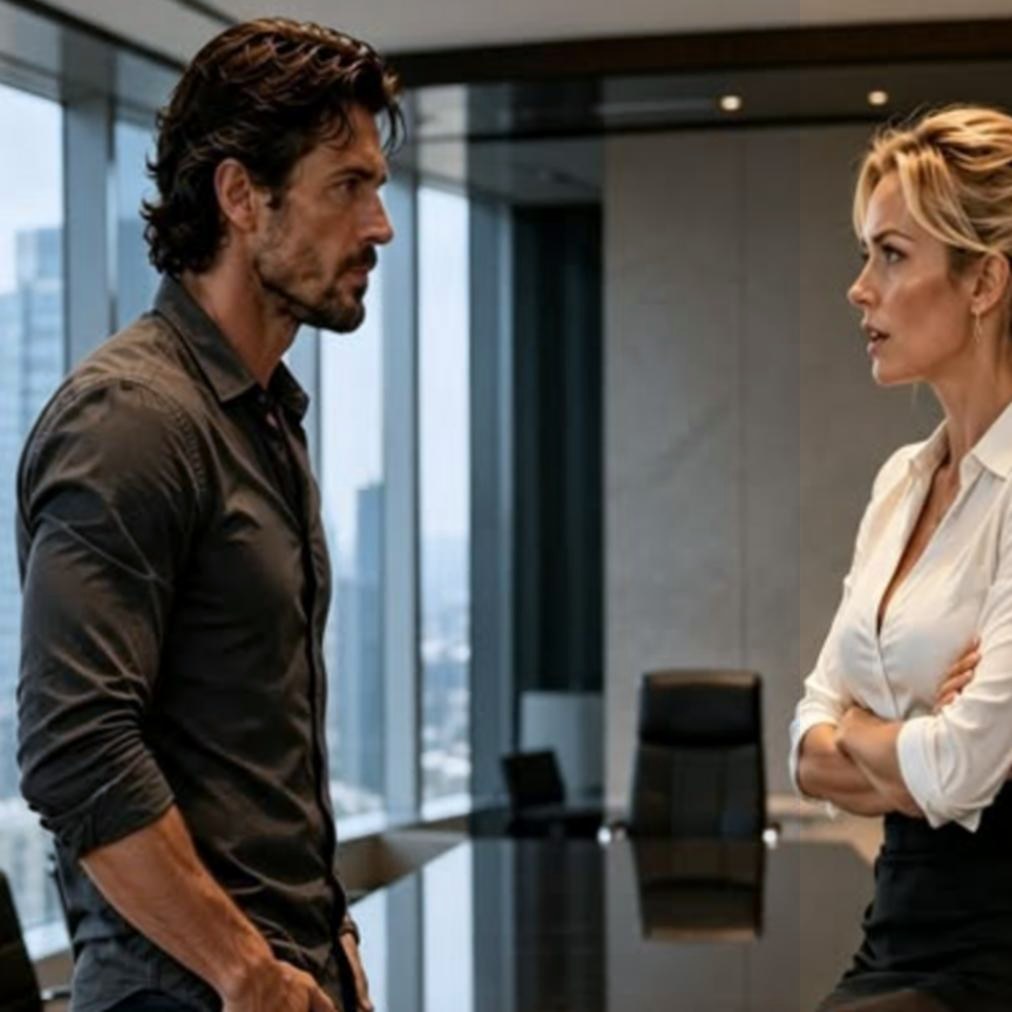

As soon as the door opened, a tall man entered the room, holding a dark-blue coat and a thin leather folder. Behind him stood a woman with a calm, almost cold smile on her face.
“Ms. Calder,” the man said, “sorry for the delay. We are ready to sign.”
Vivian did not answer.
She looked toward me, then toward Marcus.
“No one will sign in this room.”
The woman’s smile disappeared.
“This had already been agreed.”
“What had been agreed was what I had not read,” Vivian told her. “Now I have read it.”
Marcus put his phone into his pocket and headed toward the door.
“I am no longer taking part in this discussion.”
“On the contrary,” I said. “You are now the most important participant.”
He stopped.
Vivian looked at the head of security.
“Lock the door. Do not let anyone approach the documents or the computers.”
Marcus raised his voice.
“This is illegal detention!”
“No one is detaining you,” I said. “You simply cannot go for the first time to a place where your words cannot follow you.”
At that moment Vivian’s lawyer called again.
“Ms. Calder, the audit team is on its way. The bank has stopped the transfer. But the consortium says it will immediately file a lawsuit against you.”
Vivian put the phone on the table.
“And our board?”
“Two members are already trying to call an emergency meeting.”
Marcus immediately smiled.
“You see? This was not only my decision.”

Vivian did not answer for the first time. Fatigue could be seen on her face, but it no longer looked like fear.
I turned the laptop around and played the audio recording from the beginning.
Edmund’s voice sounded in the room again.
“If the contract is signed, Vivian, remember: whoever says that he did not know, first ask him whom he was giving the right not to read to.”
Marcus lowered his hands.
His old voice immediately followed in the recording.
“Your daughter needs only the title. We will take care of the details.”
The phrase remained in the room as if someone had stopped all the clocks.
Marcus looked at the screen.
“I did not say that.”
I stopped the sound.
“It is your voice.”
“No.”
“They are your words.”
Vivian slowly lowered her eyes.
“You said this about me.”
Marcus heard himself through another person for the first time. His face tensed, as if mirrors had suddenly appeared in the room.
“I was trying to save the company,” he said.
“You were maintaining control,” Vivian answered.
“Your father could no longer make decisions.”
“And so you decided that I could be deceived?”
“You were not ready.”
Vivian laughed quietly, but there was no warmth in the laughter.
“I was not ready? For eleven weeks you hid from me that you were handing the heart of the company over to foreigners.”
The foreign representatives looked at each other.
The man closed the folder.
“We knew that the company’s advisers had approved the conditions.”
“Then your advisers were deceiving you,” I told him.
“Who are you?”
“The person who saw different faces of the same lie in your three languages.”
The man took out his phone.
“We are ending this conversation.”
“No,” Vivian said. “You will stay now and listen to the independent auditor’s conclusion.”

Over the next three hours, the room slowly changed.
The expensive paintings hanging on the walls remained the same. The coffee cups on the table were still cold. But the people no longer had on their faces the confidence with which they had entered in the morning.
The auditors requested all correspondence, translation versions, and the history of changes. It turned out that the English summary had been changed in Marcus’s office. The original file said “conditional transfer of ownership.” In the final version, these words had become “expanded license.”
Marcus first denied everything.
Then he blamed the outside translator.
Then he stated that Vivian herself had known.
But each version was destroyed by a new document.
At seven in the evening his personal lawyer entered the room.
“Marcus, from this moment I can no longer speak on your behalf.”
“What are you saying?”
“There is a conflict of interest. You personally signed consulting-fee payments to the firm that represented the consortium.”
Marcus lost color.
“It was only technical service.”
“The court will decide that,” the lawyer answered.
It was not an arrest. Nor was it a court verdict.
But at that moment Marcus heard for the first time what a door sounds like when it is no longer opened for you.
The next morning Vivian called an emergency board meeting. The contract was canceled, the bank transfer was finally stopped, and Marcus was stripped of all the company’s rights. An independent investigation established that he had made a secret fee agreement with the consortium.
Vivian did not celebrate.
She only entered her father’s office and stood by the window for a long time.
I remained at the door.
“Do you want me to leave you alone?”
“No,” she told me. “You have already left too many things alone.”

Edmund’s old pen lay on her desk. It had a small brass bird on top.
“Why did my father leave all this to you?” she asked me.
“Probably because I once already told him that trusting the title of a contract before reading it was a bad habit.”
Vivian smiled for the first time.
“And why did you not tell me from the beginning who you were?”
“Because then everyone would have listened only to my past. And I wanted them to listen to the text first.”
Three weeks later Marcus sent me a letter. It was short.
“You knew I could not escape this. You still could have reached an agreement with me.”
I looked at the screen for a long time.
Then I did not write back.
Sometimes a person does not need revenge, but rather for you not to save him in the end anymore.
Vivian asked me to remain in the company as an independent adviser on international contracts. She offered me my own office, a high salary, and travel.
I chose half-time work.
I had to be home at four o’clock.
Layla marked her first day of work with a drawing. On the paper she drew a large building, and attached a small winged bird above it.
“This is you, Dad,” she told me. “You enter everywhere others think the door is locked.”
“Why is there a bird?”
“Because you still have to fly, only return home.”
I hugged her.

Over the following months our life slowly settled into place. In the morning I combed Layla’s hair. Then I worked on the company’s new contracts. I checked every page together with the original language. In the evening we made soup and waited by the window for the first snow.
It was a cold December morning in Chicago when I received Marcus’s last message.
“You can change everything if you say that you understood the recording incorrectly. You will both survive.”
I showed the message to Vivian too.
“What will you answer?” she asked me.
“Nothing.”
“Are you sure?”
“Yes.”
That evening Layla placed her drawing on the table. The small winged bird was still visible in the corner. Beside it lay my old cream-colored folder, with the brass fastener. The one I had brought into the boardroom that day and which no longer served to hide my past.
The folder already contained a new contract—a future written for the company, for Layla, and for me. Every clause was clear. Nothing was hidden behind the translation.
I went to the window.
The first snow was beginning outside.
Layla took my hand.
“Dad, is everything all right now?”
I looked at her small fingers, then at the winged bird on the corner of the folder.
“Now the truth is coming home,” I told her.
She rested her head on my shoulder.
And for the first time in many years, I was not afraid of a door being locked.
The brass bird on the folder shone in the light of the snow.
This time I was home.
Missed the beginning?
Related posts:
 The Director Mocked Me When I Asked to Translate the Contract, but Minutes Later Her Lawyer Dropped the Pen from His Hand
 My mother-in-law took my car and left me on the road with the baby, but one call from my father erased her smile
 I left my job because my director ruined my life, but when she saw me with a suitcase at her door at night, her hands began to tremble
 Every night he took a different woman home, but one question of mine suddenly erased his confidence
 Before the Championship, My Son’s Biological Father Confronted Him, but His First Words in the Gymnasium Left Danny Frozen in Place
 My Husband Threw Me Out of the Mansion with Infant Twins, but After My Calm Call Graham’s Smile Froze on His Face