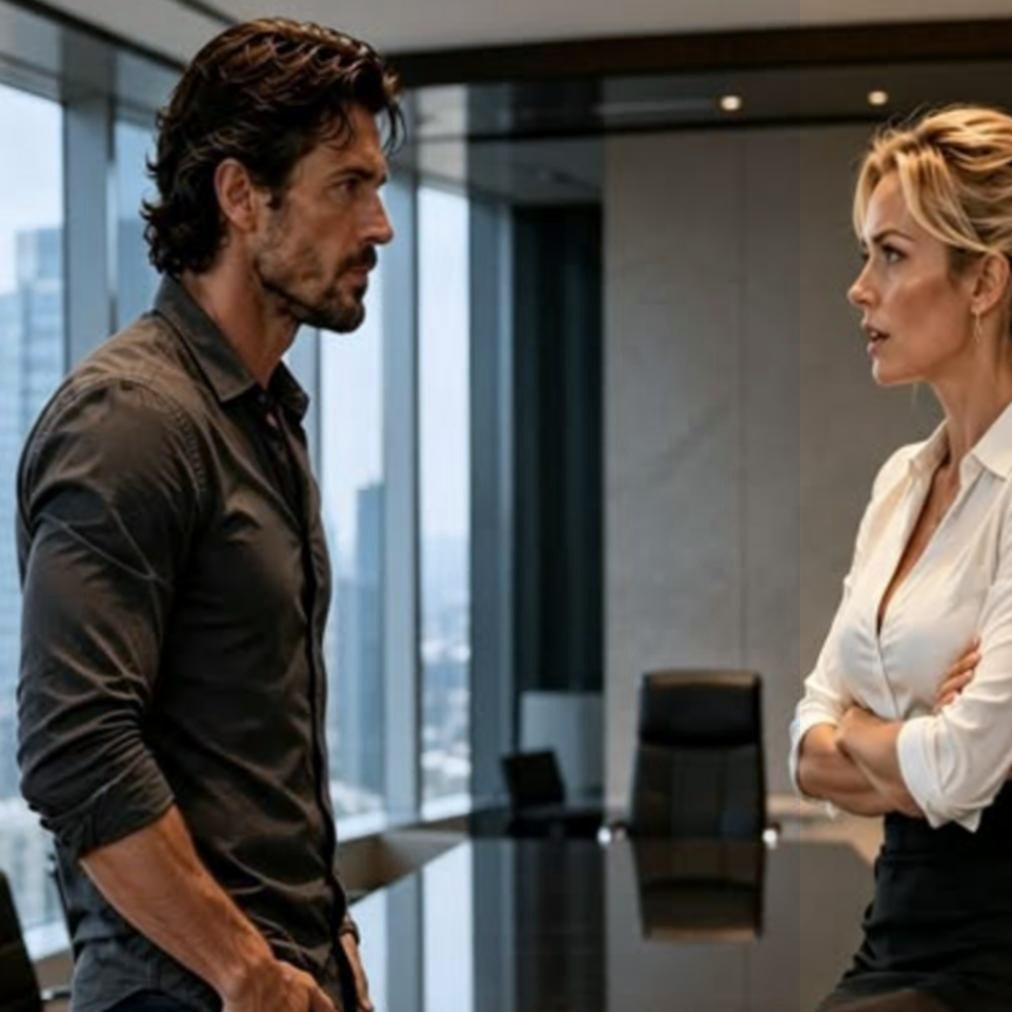

Vivian Calder dropped the signing pen on the table and told me that if I could not translate the contract, I would have to apologize in front of everyone. Laughter sounded in the room.
I was still standing on the aluminum ladder, holding a screwdriver in one hand and checking the wobbling mount of the ceiling fan with the other. The Chicago River shone below the windows of the forty-fourth floor, while twenty-six executives sat around a polished walnut table.
“Your name?” Vivian asked, looking at my work badge.
“Caleb Mercer.”
“Mr. Mercer, since you have decided to become an international-law expert, perhaps you can explain this part to us yourself?”
She pushed the contract lying in front of her toward me with her finger.
“French, Dutch, and Spanish entries. If you translate everything correctly, I will write you eight thousand dollars right here. If you cannot do it, you will apologize to all the professionals for wasting their time.”
Laughter sounded again.
Vivian did not know that I had been in the building since half past five that morning. She did not know that at six in the evening I had to pick up seven-year-old Layla from the after-school program, take her home, refill her inhaler, and help her with her math homework. She did not know that an unopened hospital envelope lay in my kitchen and that I had to postpone repairing my truck for another week.
To her, I was only the technician whose job was to replace the fan mount.
But when the lawyer called the French sentence “a normal distribution right,” I stopped the tool. The Dutch subsection sounded even worse. The Spanish deadlines connected everything with one another.
“This is not a distribution right,” I said quietly.
The room fell silent.
“It concerns the transfer of ownership of improvements. If we also take the previous explanations into account, it may even concern the design of the main compressor coil.”
Marcus Weil, the company’s chief lawyer, raised his glasses.
“This agreement was studied by multilingual lawyers for nine weeks.”

“I am only saying that in the original the meaning is stricter than in the English summary.”
Vivian looked at me. Her father, Edmund, had died three years earlier and left her shaken factories, frightened shareholders, and aggressive creditors. Vivian attacked everyone in advance, because softness was expensive in her world.
“Come down,” she told me.
“I did not mean to interrupt.”
“You already did.”
I folded the ladder and went to the table. She placed the contract in front of me and wrote the date on the check.
“Prove that what you said is true.”
I looked at the money. Eight thousand dollars was not a joke to me. Layla’s treatment, rent, the car, the hospital bill—all of it came back to me at once.
But then I remembered Nora. My wife, who had been left alone in a hospital room on the day when I was translating a multilateral agreement in Brussels. Then I understood that being a professional in five countries made no sense if you could not protect the most precious person at home.
I locked away my old life and became a technician.
“If I am wrong, tear up the check,” I told Vivian. “If I am right, pay me and listen to me.”
Her smile disappeared.
I sat down and began from the first page. In French, “partner facility” meant only an enterprise under direct control. In Spanish, “best efforts” and “commercially reasonable efforts” were not the same thing.
“They are cousins, not twins,” I said.
The young lawyer began taking notes.
Then I reached the Dutch clause. The translation sounded safe, but the original did not. I changed the meaning of three words, and the air in the room seemed to disappear.

“It says here that after the goals are achieved, the rights to the improvements will be transferred to them,” I explained.
“A license?” Marcus asked.
“No. A transfer.”
Vivian looked at the contract.
“What belongs to them?”
I placed my finger on the explanation opened in front of me.
“This wording is so broad that they can declare even an improvement of the main design to be an improvement.”
Marcus’s face changed. Twenty-three minutes later he said quietly:
“He is right. My team made a mistake. The outside translator also made a mistake. Mr. Mercer did not.”
The eight-thousand-dollar check lying on the table suddenly no longer looked like a joke.
Vivian slowly raised her head.
“Who are you?”
I reached into my pocket and took out a cream-colored document folder with a small brass fastener in the corner. I was supposed to submit it to Human Resources that morning as my resignation.
But there was something else in the folder.
Vivian reached toward it and began opening the clasp…
Vivian’s fingers touched the small brass fastener, but before that Marcus reached his hand forward.
“That is enough,” he said.
For the first time, his voice no longer carried a superior’s confidence. He sounded more like a person who had learned, before opening a door, that there was a fire on the other side.
I pressed the folder to my chest.
“You have not even seen what is inside yet.”
“This is a matter of the employment relationship,” Marcus answered coldly. “Bringing personal documents to a board meeting is unprofessional.”
“You asked me yourself who I am.”
Vivian raised her hand.
“Marcus, be quiet.”

Only the low hum of the air conditioner could be heard in the room. I knew that sound. The fan on the right swayed once every twenty seconds, as if someone behind the wall were knocking on a door.
I opened the folder.
My name was written on the first page, but not with the position by which everyone here knew me.
“Eleven years ago I worked in Belgium as an international-procurement lawyer,” I said. “Then in Brussels I led a team of contract translators. I did not learn French, Dutch, and Spanish only from books.”
The young lawyer exhaled loudly.
Vivian looked at the document, then at my work shirt.
“Why do you work as a technician?”
“Because my wife died. Because I was not beside her at that time. Because Layla needed a father, not a man who lives in airports.”
The answer fell into the room like a heavy object.
I said Nora’s name aloud for the first time in this building. My fingers went cold, but my voice did not tremble.
“The job I could not afford to lose, I already lost,” I continued. “Now I have chosen a life in which my daughter waits for me every evening.”
Vivian took a second sheet from the folder.
“This is my father’s handwriting.”
I nodded.
I first met Edmund Calder when his company was selling refrigeration systems for hospitals in South America. He was not like other billionaires. At meetings he read the notes himself and always used the same thing—a thick pen filled with dark-green ink that had a small brass figure of a bird on top.
“You knew my father?” Vivian asked.
“I knew him. I worked for him.”
“As a lawyer?”
“For a certain period.”
Marcus pushed his chair back.

“This is ridiculous. If Mr. Mercer had such qualifications, why did he not work in the company’s legal department?”
“That interests me too,” Vivian said.
I took a small memory device out of the folder, but did not place it on the table. It was black, with a scratch in the shape of a star on one side. This was a mark made by Layla; she thought that every important thing should have its own ‘way out into the sky.’
“I received this recording last night,” I said.
Marcus lost color.
“What recording?”
“I do not yet know how complete it is. But Edmund knew how to leave it.”
Vivian looked at me quickly.
“Did Father send you something before he died?”
“No. I received the letter this morning, in your mail.”
“In my mail?”
“A lawyer sent it to me. He said the letter should be opened only if the company encountered wording resembling a transfer of ownership in a foreign contract.”
Someone quietly murmured in the room:
“My God.”
Marcus stood up.
“This is illegally obtained material. We cannot listen to it at this meeting.”
Vivian looked toward him.
“Sit down.”
Marcus did not sit down.
I connected the device to the laptop. One audio file appeared on the screen. The date was six months earlier, two weeks before Edmund’s death.
The sound was first followed by crackling, then by Edmund’s tired breathing.
“If you are listening to this, it means that my suspicion was justified,” he said.
Vivian pressed both hands against the table.
“Marcus Weil does not change the language inserted into a contract by accident. He knows what he is doing. But the most dangerous thing is that he is not acting alone.”

The recording stopped there.
In the silence Marcus muttered for the first time:
“It is forged.”
“Perhaps,” I said. “That is why Edmund pointed to a second piece of evidence in the letter.”
Vivian turned over the last page of the folder. One address and a meeting time were written there—for four o’clock that same day.
Under it was a short phrase: “If you trust Caleb, do not go alone.”
Vivian read the letter twice.
“Caleb?”
“That is what Edmund called me.”
Marcus took out his phone and looked at the screen. At that moment a message arrived on his phone. He read it, and a strange fear appeared on his face.
“What happened?” Vivian asked him.
Marcus did not answer.
But over his shoulder I saw one word: “Signed.”
Then building security called Vivian and told her that two foreign representatives were waiting below for her—to finish the contract…

The security call came fifteen minutes before four. Vivian ended the call and looked at Marcus.
“Who are they?”
“Representatives of the consortium,” he said.
“To sign the contract?”
Marcus delayed his answer.
“They thought the board had already agreed.”
I looked at the laptop. Edmund’s recording had stopped at the same sentence: “He is not acting alone.”
Vivian locked the door.
“Let us listen to the recording to the end first.”
Marcus put his hand on the chair.
“This is legally dangerous for the company.”
“For me it became more dangerous to hear that after my father you were dividing my company into pieces,” Vivian answered.
I played the recording from the beginning. For several seconds only the rustling of papers could be heard. Then Edmund’s voice returned.
“Marcus told me that the foreign partners were asking only for a license. But I myself read the Dutch text. They want ownership of the core technology after the conditions are fulfilled. Marcus could not have missed this. He left it there for them.”
The young lawyer dropped the pen from his hand.
Marcus shook his head.
“That is not my voice.”
In the recording Edmund continued:
“I asked him to stop the contract. He told me that if I did that, the financing line would be closed. Then he advised me not to tell my daughter anything, because Vivian would sign the contract anyway.”
Vivian’s face went pale.
“He knew that I would sign?”
“Because only an English summary was prepared for you,” I said.
Marcus struck the table with his hand.
“Enough! This does not prove that I did anything illegal.”
“No,” I answered. “But the next part may prove it.”
Heavy breathing sounded in the file. Then a second voice was added. It was Marcus’s voice, younger but completely recognizable.

“Edmund, you must understand that the company needs a new owner. If the deal is completed, you will receive your share and your daughter will remain chief executive. This will be best for everyone.”
Edmund’s voice became angry.
“You are selling my company and calling this the best solution?”
“I am selling only the part that you can no longer protect.”
No one in the room was breathing.
Marcus leaned against the wall. His face became gray.
“This was a private conversation,” he said. “You cannot use this.”
“I am using nothing,” I said. “You yourself were using it when you secretly prepared the transfer of ownership.”
Vivian took another document from the folder. It bore a notary’s seal.
“What is this?” she asked me.
“An instruction prepared by Edmund. If a similar entry appeared, it was to verify all foreign contracts and suspend Marcus’s signing authority.”
“Why you?”
“Because he did not trust the people who remained around him. And because he knew that I read not only languages, but also the intentions hidden between them.”
Vivian placed her hand on the document.
“What should we do now?”
“The signing must be stopped. The bank must be notified. An independent auditor must come. And before someone changes the story that has gone outside, security must preserve all the records.”
Marcus suddenly took out his phone.
“You cannot fire me at this meeting.”
“I am not asking you to leave yet,” Vivian told him. “First I want you to stay here and hear everything.”
At that moment her phone rang. The call was from a lawyer.
Vivian turned on speakerphone.
“Ms. Calder, the bank has just sent us confirmation that the consortium’s advance financing has already been transferred. And one of the conditions no longer waits for the contract to be signed.”
Vivian closed her eyes.
“What does that mean?”
“It means that if the deal is not stopped today, they can say that the company has already accepted the condition.”
Marcus smiled for the first time, but this smile no longer resembled victory.
“You see? Now you can no longer do anything without me.”
I opened the last sheet of the folder.
There was Edmund’s signature and one additional clause that neither Vivian nor Marcus had yet seen.
After reading the clause, Vivian squeezed the phone in her hand.
It said below that receiving the advance financing imposed criminal liability on the consortium’s representative himself if the hidden transfer of ownership in the contract was discovered.
Marcus looked at the sheet.
“That is impossible.”
“No,” I said. “You simply did not know that your father had already prepared this.”
At that very moment heavy footsteps sounded beyond the door. Someone took hold of the handle.
Vivian looked toward me.
“They are already here.”
The door opened and two foreign representatives appeared on the threshold, with the company’s head of security standing behind them.
They thought they were coming to sign.
But I already knew that the heaviest document in this room had still not been seen by anyone…
მარკუსმა ეკრანზე საკუთარი ხმა პირველად მოისმინა…
მე მეგონა, ყველაზე რთული სიმართლის თქმა იყო. მაგრამ ნამდვილი ბრძოლა მაშინ დაიწყო, როცა მათ კონტროლის დაბრუნება სცადეს.
„ეს სიტყვები მე თვითონ ვთქვი?“
ოთახში აღარავის შეეძლო მისთვის პასუხის დამალვა.
👇 ისტორიის ფინალი უკვე გახსნილია
Related posts:
 Part 4 — The Director Mocked Me When I Asked to Translate the Contract, but Minutes Later Her Lawyer Dropped the Pen from His Hand
 My mother-in-law took my car and left me on the road with the baby, but one call from my father erased her smile
 I left my job because my director ruined my life, but when she saw me with a suitcase at her door at night, her hands began to tremble
 My Husband Threw Me Out of the Mansion with Infant Twins, but After My Calm Call Graham’s Smile Froze on His Face
 At the Divorce Hearing, I Held a Baby in My Arms When My Husband Saw Her and His Confident Face Suddenly Turned to Stone
 Meu marido me humilhou diante de quatrocentas pessoas, mas quando saí sem olhar para trás, o irmão dele empalideceu