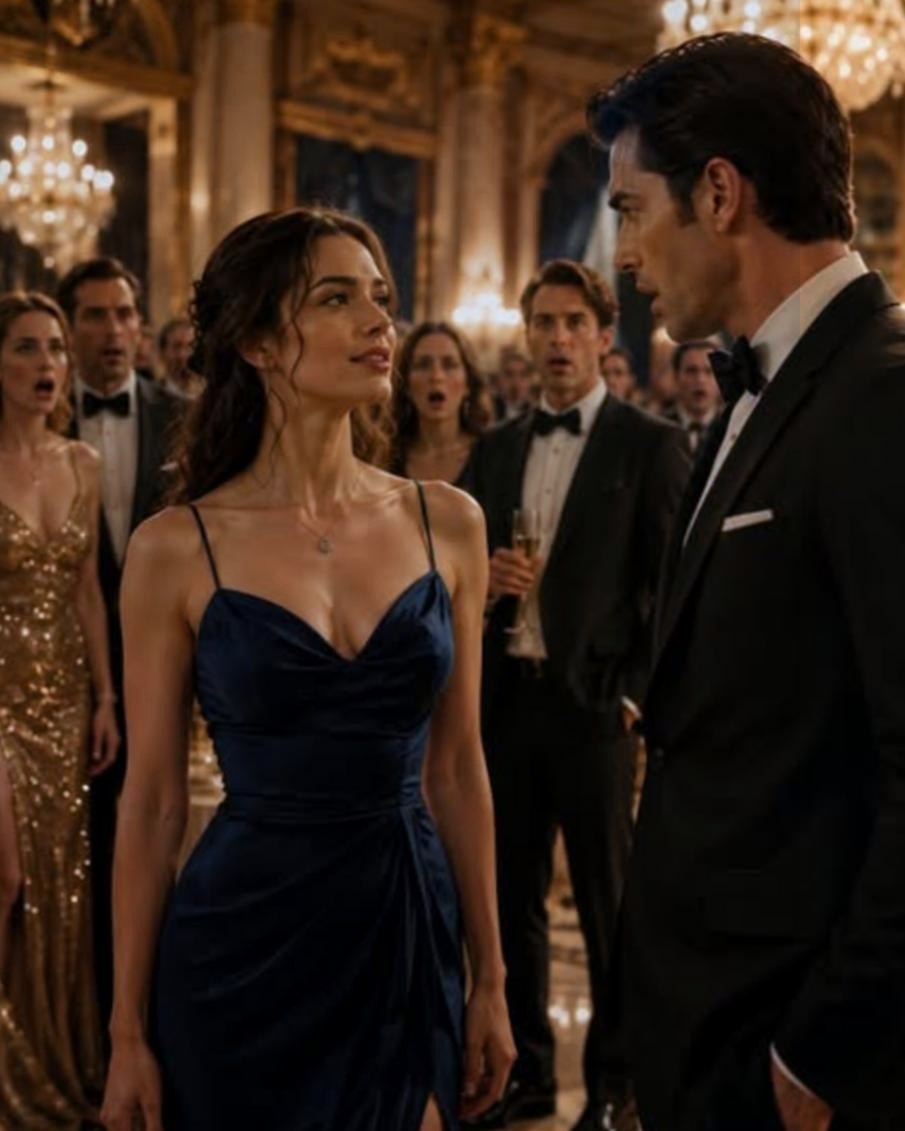

As soon as he saw the document, Adrian took out his phone.
“Call my lawyer,” he told security.
“I already called,” one of the guards replied. “Mrs. Hart said that she is no longer representing you in this matter.”
Isabel looked at me quickly.
“All of this is your fault.”
“I do not even know what it says yet.”
“But you will soon find out.”
Adrian picked up the document. The paper was trembling so much that its corner rubbed against the table.
“This is my signature,” he said.
“What is it?” I asked.
He could not answer me.
The security employee took the document from me. It was an agreement from five years earlier. It stated that the Cole company could stop the main witness’s testimony if the witness became employed by the company and no longer spoke publicly about the case.
The witness was me.
And the signature was Adrian’s.
“You bought my silence,” I said.
“No. I bought time from your father so that you could escape.”
“Where is my signature?”
“I did not ask for it.”
“But you made an agreement in my name.”
“Because that night I could no longer trust the police. My father had people everywhere.”
Isabel laughed loudly.
“What a convenient story. And now everyone is supposed to believe that the billionaire’s son was a silent hero.”
Adrian looked at her.
“You yourself were in that warehouse.”
Isabel’s face hardened.
“You cannot prove it.”
“She already did,” I said.
I had uploaded a copy of the recording to cloud storage before I went to his home. The automatic link had already been sent to the investigator, Priya, and Adrian’s lawyer.
Isabel took a step back.
“You prepared this in advance?”
“For the first time in my life, I did not wait for anyone to try to save me.”
That same evening the police took Isabel away for questioning. Adrian went with me, but at the door of the investigative building a federal agent blocked his way.

“Mr. Cole, you must come in too.”
“With Grace.”
“No. Separately.”
In the room where the questioning was taking place, I heard my own voice for the first time. The investigator played the old recording: five years earlier, with wet hair and trembling, I said that Isabel was closing the back door of the warehouse, while Richard Cole was telling someone on the phone that the fire would spread faster if they turned off the alarm.
My voice was small.
But the truth was not.
Then Adrian’s recording was played.
“My father planned everything. I only hid the documents so that Grace could leave the city that night.”
“Why did you not turn this in then?” the investigator asked.
“Because they were holding her brother hostage.”
“And afterward?”
“Afterward it was already too late. My father died. And I thought that if I saved the company, Grace would also be protected.”
I heard his words now from outside. For the first time I understood what his fear sounded like. Not like the fear of a victim. Like the fear of a person who had hidden the truth even inside himself for years.
The investigator asked Adrian:
“Why did you stop the promotion?”
“Because Isabel was on the board. Grace’s promotion would have exposed her past. I thought that remaining invisible would be safer.”
I closed my eyes.
His decision had been born of goodwill, but it still resembled a prison.
That night, after leaving the investigators’ room, Adrian picked up his phone.
“All my accounts will be checked,” he said.
“Probably.”
“The company may be deprived of its right to operate.”
“Probably.”
“Stay. We will endure all of this together.”
For the first time there was no command in his voice. Only a request.
“No, Adrian.”
“Grace…”
“I no longer want to be your protection.”
The next day his advisory board assembled. At an emergency meeting, the directors demanded that Adrian temporarily leave his position. An investigation into Isabel began, Richard Cole’s old case was reopened, and the agreement concerning my silence was declared void.

Adrian said only one sentence to the press:
“The greatest injustice committed against Grace Ellison was that I took away her right to choose.”
Then he heard the recording of his own voice. It happened in the room preparing for the trial. The lawyer played precisely the fragment where Adrian said: “She must remain in this position. It is safer this way.”
Silence descended in the room.
Adrian buried his head in his hands.
“I said that,” he pronounced quietly.
“Yes,” I answered.
“I thought I was doing the right thing.”
“Sometimes people cause the greatest harm precisely when they consider themselves saviors.”
Within a week my old office was emptied. Only the silver clasp remained on the desk, the one I had worn on my cardigan sleeve for years. It lay on the dusty floor, while the black reflection of the screen showed me a hidden woman for the first time no longer.
I left.
Three months later I was living in Boston in a small apartment, from whose window I could see the tram line. I started working at an organization defending human rights. My desk was small, but every document on it had my name on it.
Priya called me every week.
“Are you still wearing loose cardigans?” she asked once.
“Only when I am cold.”
“And the glasses?”
“For my eyes.”
“Not for hiding?”
I looked at my reflection in the window.
“No longer.”
The first snow came at the end of December. That day my nephew, Luka, stayed with me. At the kitchen table he drew a picture on a sheet of paper: a woman stood in front of a tall building, and in the sky there was a large yellow sun.
“Is this you?” I asked.
“Yes. You are no longer hiding.”
“How do you know?”
“Because I drew your face.”
I attached the drawing to the refrigerator.
That same evening I received a message from Adrian. He was already living in another city and waiting for the court hearing of the case. The message was short: If you ever talk to me, I will listen to everything. I will no longer decide anything in your place.
I stared at the screen for a long time.
Then I wrote back: I wish you would fulfill this promise first to yourself. I am not coming back.
I deleted the message.
Not because I hated him.
Because at last I was no longer waiting for his answer.
Several weeks later they sent me a box of my things from the old office. Inside were a photograph, two pens, and the silver clasp. I picked it up. The metal was cold, but this time I did not touch my finger to it from nervousness.
I fastened the clasp to the collar of a new black jacket and went out into the snowy street.
The city was making noise.
But for the first time I did not disappear.
I stayed.
Missed the beginning?
Related posts:
 My Billionaire Boss Bet a Thousand Dollars That No One Would Dance with Me — But His Smile Disappeared When I Entered the Ballroom
 I accidentally entered the mafia boss’s meeting in wet clothes — but instead of getting angry, he came straight toward me, and everyone’s faces changed
 My Husband Returned Every Gift, but That Evening His Right Hand Suddenly Turned Pale
 I helped an injured man in an abandoned building, but after my six words, the smile disappeared from his face
 Three Little Boys Met Me with Humiliation, but When I Told Their Father the Truth, the Glass in His Hand Stopped Motionless
 My husband gave flowers to his former lover, and I left the hall — behind the cameras, his smile disappeared