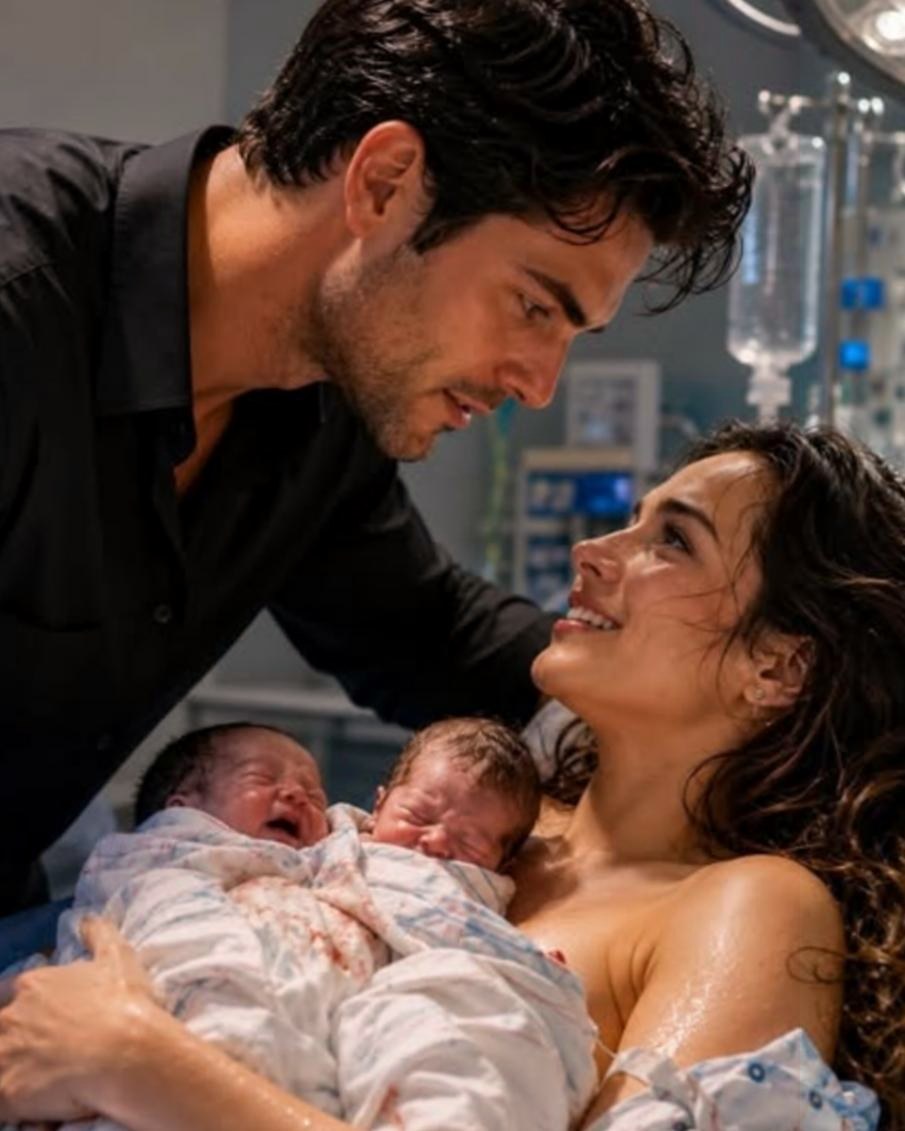

The blue lights of the police cars flickered on the windows when Victoria Caldwell lost her composure for the first time.
Her phone rang.
“Do not answer,” Leon told her.
Victoria picked it up anyway.
“What happened?”
We could not hear the answer, but we read everything on her face.
“You would not dare,” she said. “I am a Caldwell.”
Then she threw the phone against the wall.
Ethan walked toward the door.
“Mother, this is over.”
“You understand nothing.”
“For five years I thought Hanna had betrayed me.”
“She worked against you.”
“You forced me not to listen to her.”
Victoria turned toward me.
“You planned all of this, didn’t you? The children, the letter, this performance…”
I was lying in bed, my abdomen burning from the stitches, but for the first time my voice was firm.
“I only wanted to survive. You destroyed my life for five years.”
There was a knock at the door.
A police detective, two investigators, and the hospital lawyer entered.

“Victoria Caldwell, you must come with us for questioning,” the detective said.
“My lawyer is on the way.”
“We have already called your lawyer. He said that at this stage he will not be able to represent you.”
Victoria blinked.
“I pay him.”
“Not today.”
This small sentence fell into the room more powerfully than any shouting.
Victoria left, but stopped at the door.
“Ethan, if you speak against me, you will lose everything.”
Ethan answered calmly:
“What I lost, I lost with your help.”
That same evening the police brought Daniel out of the old station warehouse. He was injured, but alive. He handed the full recording to the investigators and confessed that he had falsified the bank documents on Victoria’s orders.
In our room, Leon played the audio recording again.
Victoria’s voice sounded:
“Ethan must believe that she stole.”
Then my voice from five years earlier, trembling:
“I did not touch your money. Your mother is lying to me.”
And finally Ethan’s voice:
“My family will not fall apart because of you!”

Ethan was sitting in the armchair, listening to his own words.
For the first time he heard them not from his own mouth, but from outside.
His face tightened.
“I said this.”
“Yes,” I told him.
“How could you live after that?”
“Very badly. Then little by little I learned.”
He lowered his head.
“I will apologize.”
“An apology was needed when you opened the door. Now responsibility is needed.”
The next day Victoria’s house was searched. In her office they found copies of bank records, false statements prepared in my name, and documents stolen by a clinic employee.
The trial took place months later.
I did not go there for revenge.
Only to tell the truth.
Victoria partially pleaded guilty, while Daniel fully cooperated with the investigation. In the end Victoria was sentenced to imprisonment and a large fine. An independent board took over the right to manage the Caldwell Foundation.
When I left the courthouse, I felt none of what I had once imagined.
Neither joy.
Nor the desire for victory.
Only exhaustion.
And a strange peace.

Ethan came to the hospital every day. At first he only stood behind the glass with the children.
“May I be with them?” he asked me once.
“You may. But do not ask me for trust.”
“I will not ask.”
That was the first correct answer I had heard from him in five years.
The children spent three weeks in the neonatal unit. I named the boy Niko and the girl Eliza. Niko’s breathing improved every day. Eliza, meanwhile, clenched her fingers at even the smallest noise.
One morning the nurse tidied their room and told me that the room beside my bed was already free.
Only one thing remained there.
My copper bracelet hung on an old hook.
The little bird on the bracelet had a broken wing. For years I had hidden it inside my fist. Now for the first time I saw that its other wing had not been broken at all—it had simply been hiding in the shadow.
Six weeks later I moved from the small apartment to a bright house in Evanston, by the river. We placed two wooden beds in the living room. I arranged a small table by the window, where I again drew for children’s books.

Ethan came to see the children, but no longer tried to force his way back into my life.
He became a present father, not a lost lover.
We both learned this difference.
Three months later, on a snowy morning, Niko took his first two steps. Eliza held a colored pencil in her hand and drew four figures on the paper.
Me.
Him.
Niko.
And Ethan, slightly farther away.
“Why is Daddy standing there?” I asked.
Eliza placed the pencil on the paper again.
“He is waiting for you to tell him to come.”
My heart contracted.
“Sometimes people have to wait a long time.”
“Why?”
“Because trust does not grow quickly.”
She nodded, as if this were the simplest thing in the world.
That evening Ethan wrote to me.
“I know I have not earned your forgiveness. I am not asking you to start everything again. If you ever need me, I will be here for the children.”
I looked at the screen for a long time.
Then I wrote a reply.

“You can be there for the children. You do not need to return to me.”
I deleted it.
I wrote it again.
“We no longer live in the past. Let us give the children a future.”
I sent this.
Ethan replied with only one word.
“Okay.”
This time I believed him.
Not as a lover.
As a man who was trying for the first time to live with the consequences of his own decisions.
In the following months I began working again. In the morning I fed the children, then sat by the window and drew. Niko stole the pencils, while Eliza added a sun to every drawing, even when the sky outside was gray.
During the first snow I brought them to the balcony.
Niko placed his palm on the glass surface.
“It is cold,” he said.
“But it is beautiful.”

Eliza looked for my hand.
I was still wearing the bracelet.
The little copper bird swayed lightly on my wrist. The wing still looked broken, but now I knew that it was only a shadow.
That night I put the children to sleep and remained alone in the kitchen. The phone rang once again.
It was Ethan.
“Hanna,” he said when I answered. “Today the court announced the final decision. They took everything from my mother.”
“I know.”
“I wanted to come to you.”
“You will see the children tomorrow.”
“I want to talk to you.”
I looked at the snow in the window.
“One day we may talk. But not in order to bring back the past.”
“I understand.”
“Then you truly understand.”
The call ended.
I took off the bracelet and hung it on a small wooden hook beside the children’s room door.
Niko mumbled something in his sleep. Eliza pulled the blanket over herself.
I stood at the door and listened to their breathing.
Five years ago I thought I was broken.
Now I understood that I had simply been preparing for another life.
The copper bird swayed silently in the night air.
This time I was no longer clutching it.
It stood on its own.
Missed the beginning?
Related posts:
 I Entered the Operating Room Pregnant with Twins, but When the Surgeon Quietly Said My Name, the Color Drained from His Face
 My Father Was Fed by a Poor Woman at Night, but When I Followed Her Trail, a Stranger’s Face Suddenly Turned Pale
 I Went to the Cemetery with Five Children, and My Ex-Husband’s Gaze Suddenly Froze
 Two days earlier they forcibly took me to marry, but on the wedding night Niko’s face lost its color
 Two Hours Before the Wedding, the Groom Threatened My Family, but the Sound of the Helicopter Drained the Color from His Face
 After I refused to terminate the pregnancy, he abandoned me, but five years later, seeing the twins at the shopping center, his face changed and he turned pale