PART 4
The photograph showed Greg standing in the stone house three nights earlier, long before I had canceled the wedding.
He was not alone.
Daniel Price stood beside him, holding a stack of papers. Elaine was near the fireplace, pointing toward the wall where Michael’s landscape painting hung. In the corner, Samantha sat with her head lowered.
I enlarged the image with trembling fingers.
On the table between them was a document bearing my name.
Margaret leaned toward the screen.
“That photograph was taken by the missing camera?”
“No,” I said. “It came from the investigator they hired.”
Ben called again.
“The sheriff is here. He found another camera hidden near the creek.”
“Can it still have the recording?”
“Apparently. The memory card was inside the battery compartment.”
For several seconds, nobody spoke.
Then Margaret said, “Do not answer Greg. Do not sign anything. Bring the camera to my office.”
I drove through the darkness with the brass grape-leaf key in my coat pocket. It tapped against my phone every time I turned the steering wheel.
At eight the next morning, Greg began calling again.
First, he threatened me.
Then he apologized.
Then he claimed Samantha was crying and blamed me for ruining her life.
At nine, Daniel sent an email demanding immediate access to the property.
At nine fifteen, he sent another withdrawing from the matter.
Margaret had called him.
“What did you say?” I asked.
“I told him his own signature appeared on documents he had no authority to prepare.”
“Was he afraid?”
“He was practical. Lawyers often look brave until their license is at risk.”
At ten, the sheriff arrived at the farmhouse with a warrant for the equipment shed and stone house.
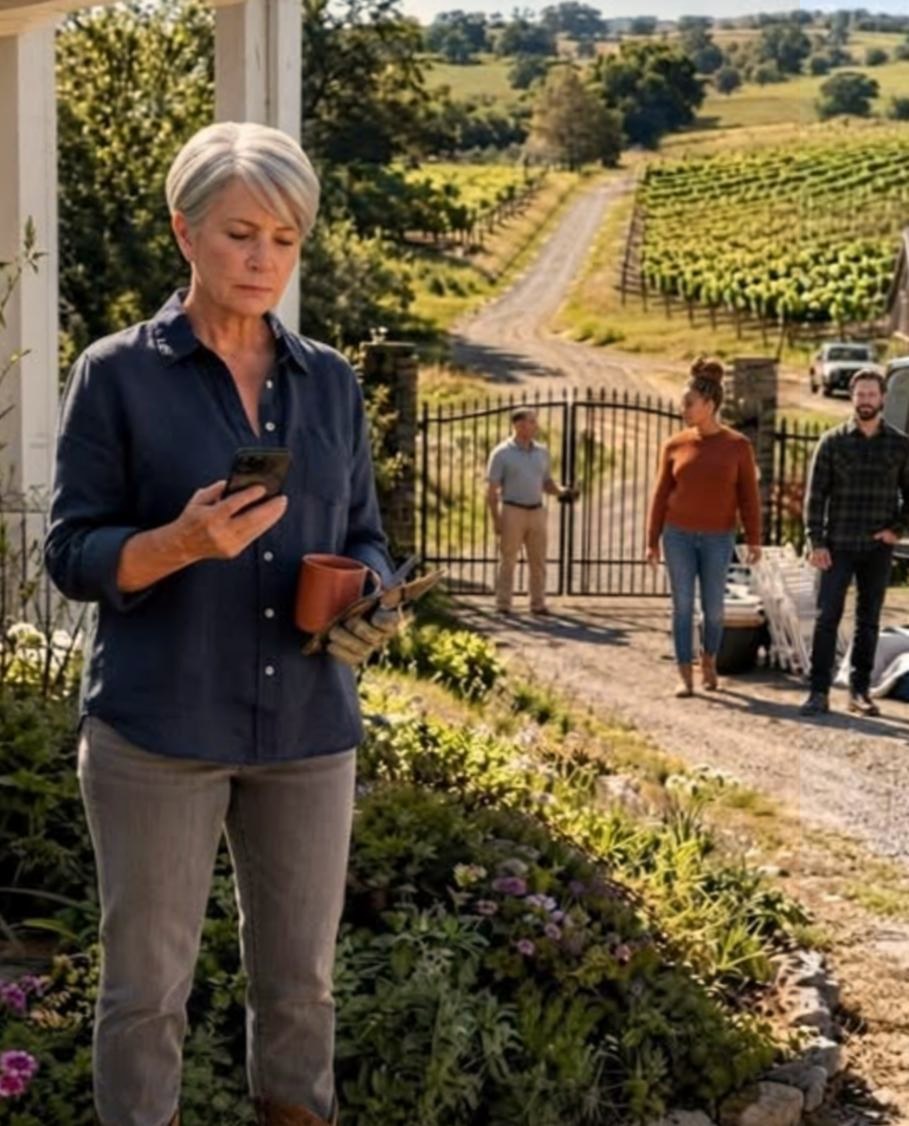
Greg and Elaine were already there, shouting near the gate. Samantha stood behind them, pale and silent.
The sheriff raised his voice.
“Everyone step away from the entrance.”
Greg pointed at me.
“She stole my fiancée’s property.”
The sheriff looked at the brass key in Greg’s hand.
“Do you have a recorded deed?”
Greg hesitated.
“She gave us the house.”
“Do you have a recorded deed?”
“No.”
“Then step aside.”
Inside the house, the hidden camera recorded everything. Greg had entered with a copied key and told Samantha that once the wedding was over, she needed to sign a power of attorney. Elaine had urged her to place the vineyard into a holding company. Daniel had prepared the paperwork before any gift existed.
The recording showed Greg laughing.
“Her mother will give us anything if Samantha cries hard enough.”
Samantha’s voice answered, barely audible.
“What if she refuses?”
“Then she loses you,” Greg said. “And she’ll come crawling back.”
We watched the footage in the farmhouse living room while the sheriff stood behind us.
Samantha covered her mouth.
“That was me,” she whispered.
“Yes,” I said gently. “It was.”
Greg shook his head.
“The recording is manipulated.”
The sheriff turned off the screen.
“You are being detained for unlawful entry and attempted document fraud. Further charges will be determined by the district attorney.”
Elaine began to cry.
Greg looked at Samantha.
“Tell them you wanted the house.”
She looked at him for a long time.
“I wanted my mother to come to my wedding,” she said.
His face emptied.
The sheriff took the copied key from his hand.
That afternoon, Samantha sat across from me at the kitchen table. Between us lay Michael’s letter, the original deed, and the brass grape-leaf key.
“I was ashamed of where I came from,” she said.
“I know.”
“I thought Greg was teaching me how to belong somewhere better.”
“He was teaching you to despise the place that made you.”
Tears slid down her face.
“Can you forgive me?”
“I love you. Forgiveness will take time.”
She nodded.
“Will you still let me live here?”
“Not in the stone house. Not yet. You need to learn the difference between receiving help and surrendering your life.”
She looked at the key.
“What happens now?”
Before I could answer, Margaret’s phone rang. Her expression changed as she listened.
When she ended the call, she looked directly at me.
“Greg has been released on bond.”
My chest tightened.
“He left the county?”
“No. He went straight to the wedding venue.”
“There is no wedding venue.”
Margaret placed her phone on the table.
“He filed an emergency claim saying the ceremony must proceed because two hundred guests are already traveling.”
Outside, a truck rolled slowly past the vineyard gate.
Greg was trying one last time to take control…
Within an hour, Margaret filed our response. The judge denied Greg’s emergency request before sunset, noting that no transfer had occurred and that a canceled celebration did not create ownership rights.
The next morning, detectives charged him with unlawful entry, attempted fraud, and harassment. The district attorney also questioned Daniel about the forged property documents. Daniel cooperated immediately, providing emails and drafts that proved Greg had planned the scheme weeks before the engagement party.
Elaine stopped answering his calls.
Samantha canceled the wedding herself.
There was no ceremony beneath my roses. No white tent faced the vineyard. The chairs were returned, the flowers donated to a hospice, and the wine bottled for another season.
A week later, I watched Greg hear the recording in a courthouse conference room.
His own voice filled the walls.
Her mother will give us anything if Samantha cries hard enough.
Greg stared at the table.
The prosecutor paused the recording.
“Did you say those words?”
Greg’s mouth opened.
“I was angry.”
“That was not my question.”
He looked toward Samantha.
She was sitting beside me, not beside him.
“Yes,” he said finally. “I said them.”
The words seemed to strike him only after they came from his own mouth.
He had heard himself.
And he could no longer pretend the monster was someone else.
The criminal case lasted four months. Greg accepted a plea agreement that required restitution, probation, and a permanent order forbidding him from contacting me or entering the vineyard. Daniel lost his license after the state bar reviewed the forged documents. Elaine sold her house to pay Greg’s legal bills and moved to another state.
I did not celebrate any of it.
I simply stopped standing in front of the consequences they had created.
The stone house remained empty for a while. I walked through it one rainy afternoon and found the photograph from the mantel lying face down on the floor. It showed Michael and me beside the first row of vines, both of us younger, sunburned, and laughing at something outside the frame.
I placed it back where it belonged.
Then I removed every wedding decoration from the guest room.
The room looked larger afterward.
So did my life.
Six months later, Samantha moved into a small apartment in town and began working at a community garden. She paid her own rent. She attended counseling twice a week. Some mornings, she came to the vineyard before sunrise and helped Ben check the irrigation lines.
One cold Saturday, she brought a six-year-old boy named Oliver with her. He was the son of one of Michael’s former farmhands, and Samantha had started mentoring him through a local program.
Oliver found me near the rose bushes.
“Are you the owner?” he asked.
“I am.”
“Do you grow the grapes yourself?”
“Not every one. But I help them grow.”
He considered that.
“My mother says people are like vines.”
“What does she say?”
“That they need something solid to hold on to.”
I glanced at Samantha. She was carrying a box of empty jars toward the farmhouse, her cheeks red from the cold.
“That is very wise,” I said.
Oliver handed me a drawing. It showed the vineyard, the creek, the farmhouse, and a tiny red door on the stone house. Beside the door, he had drawn three people holding hands.
“Who are they?” I asked.
“You, Samantha, and me.”
I swallowed the ache in my throat.
“That is a beautiful house.”
“You can live there someday,” Samantha said quietly.
I turned toward her.
“Someday,” I agreed. “But only when you want a home, not a trophy.”
She nodded.
The first snow arrived in December. It settled on the vines like powdered sugar and softened every hard edge of the property. I spent the morning in my office, reviewing harvest numbers while Samantha made soup in the farmhouse kitchen.
My phone buzzed.
A message from an unknown number appeared.
I know you’re still angry. I can explain everything. Let me come home.
I knew it was Greg, despite the order forbidding contact. Perhaps he believed the word home still belonged to him. Perhaps he believed time had made me forget.
I showed the message to Margaret.
“Do you want to respond?” she asked.
“No.”
“That may be wise.”
I deleted it and sent a copy to the investigator.
Samantha watched from the doorway.
“Did he ask to come back?”
“Yes.”
“What did you tell him?”
“The truth.”
“What truth?”
“That there is nothing here for him.”
She looked down at the floor.
“I’m sorry I helped him believe otherwise.”
“I know.”
“Are we ever going to be all right?”
I walked over and took her hand.
“We already began.”
That evening, I went to the stone house alone. Snow pressed against the tall windows. The rooms were quiet, clean, and finally free of imagined guests.
On the entry table sat the brass grape-leaf key.
For months, I had kept it locked away because it reminded me of how easily love could be mistaken for permission. Now I picked it up and carried it outside.
The creek moved beneath a skin of ice. Beyond it, the vineyard stretched into the blue dusk. Michael’s roses slept beneath the snow, their roots protected in the dark soil.
I held the key in my palm.
It had once been meant to open a house for someone else.
Now it opened nothing.
And that was the point.
I placed it on the stone wall beside the roses and watched the last light catch the little metal leaves.
For the first time, the silence did not feel empty.
It felt like mine.
I left the key in the snow.
And walked home free.
Missed the beginning?
Related posts:
 I was barred from my daughter’s vineyard wedding, and when I quietly canceled everything, her fiancé stopped smiling
 I found my townhouse key on my husband’s mistress’s bracelet at a Manhattan party, and my husband suddenly stopped smiling
 I was humiliated for feeding an unwanted old man, but when a black car stopped outside, Beatriz suddenly stopped smiling
My husband’s fiancée used my surname on her wedding invitation, but when I mentioned one stolen bracelet, his face went white
I brought my daughter to the Cole mansion for one dinner, but when Julian saw her sleeve, his polite smile vanished
I was humiliated for feeding an unwanted old man, but when a black car stopped outside, Beatriz suddenly stopped smiling
My husband’s fiancée used my surname on her wedding invitation, but when I mentioned one stolen bracelet, his face went white
I brought my daughter to the Cole mansion for one dinner, but when Julian saw her sleeve, his polite smile vanished
 I was ordered to feed the city’s most feared man, but when he tasted my burnt garlic, his expression suddenly changed