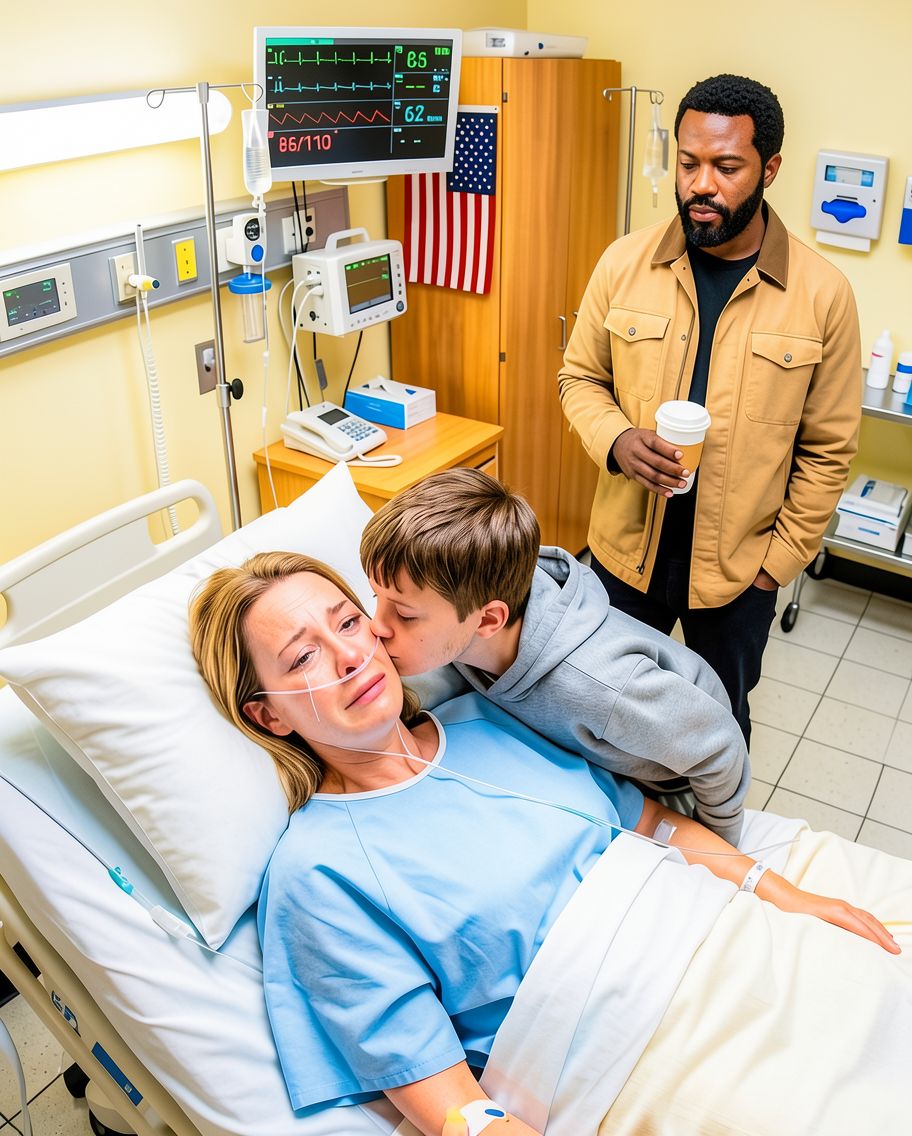

…I read the message once more and immediately called the service’s security department.
“Is my child protected?” I asked.
“From this moment, yes,” Dato answered. “But you must know that Andria’s last plan was not only about obtaining custody.”
“Tell me.”
“He wanted to use your service access. Several files had been ordered in your name, which he had no right to view. If this came out, he would shift suspicion onto you.”
The door in the corridor opened and Andria’s lawyer came out. He was holding a phone, and for the first time his face showed not tension, but fear.
“Mr. Kovalenko, I no longer represent you in this case,” he told Andria.
“What does ‘no longer represent’ mean?”
“It means that circumstances concealed from me make it impossible to continue your defense.”
“I paid you!”
“Money does not give me the right to create a false version for the court.”
Sergo looked toward me.
“Mrs. Kovalenko, I apologize to you. At first I thought it was only a custody dispute.”
I nodded.
“I thought so too.”
Andria struck the wall with his fist. The plastic clock continued ticking above with a click.
“You planned all this!” he shouted at me. “You wanted to destroy me!”
“No, Andria. I only did what you could not imagine: I kept the truth.”
That same night the investigators seized Andria’s phone, laptop, and the apartment camera recorder. Irina was taken separately for questioning. Galina remained alone in the corridor, still holding that expensive bag.
The next morning the court issued a temporary protection decision. Andria was forbidden to see the child, and approaching my house was restricted by a special order.
After the court ended, an officer led us into a small room. A recorder stood there on the wall.
“You must listen to the last recording,” the investigator told me.
“Another one?”
“This one is the most important.”
The recorder was turned on.
I heard Andria’s voice, but this time he was not speaking to anyone. He was recording himself on his phone.
“If Alexandra resists, they will take the child from her. No one will believe a woman who is not in her right mind after giving birth. Irina will only help me. Galina knows too. When the child is with me, Alexandra will sign everything.”
There were several seconds of silence in the recording.
Then he chuckled.
“She always thought she was very strong.”

These words of Andria had already been spoken before us, but when he heard the recording, his face slowly changed. It was as if he heard his own voice through someone else’s mouth for the first time.
“Turn it off,” he said.
“No,” the investigator answered. “Now you will listen to it to the end.”
Irina’s voice could be heard in the recording:
“If something happens to the child, we will go to prison.”
Andria answered:
“Nothing will happen to him. Everyone simply has to believe that Alexandra is dangerous.”
Silence descended in the room.
Andria lowered his head.
“I did not say it like that.”
“That is exactly how you said it,” I told him.
“You do not understand what was happening.”
“No, Andria. Now for the first time I understand everything.”
That same evening I returned home. My old apartment was already empty. The investigators had taken Andria’s things, while Irina’s bag had remained in the corner of the living room—probably at that moment she could no longer remember where she had put it.
I entered the child’s room.
The crib stood by the window. The white blanket was folded, and only one thing remained on top of the dresser—the small yellow card on which I wrote the child’s feeding times.
On the back, the four digits written by Dato were visible.
That night I slept for the first time without waking at every sound of the door.
Three weeks later the investigator called me.
“Andria confessed to the forged statements,” he told me. “Irina confirmed that a plan to pressure you existed. Galina also gave testimony.”
“What did she say?”
“That for years she had been presenting information about your service incorrectly to you. Andria asked her to tell everyone that you represented nothing.”
I stood by the window. The first snow was falling over the city.
“How is Galina?”
“Badly. But that is already her responsibility.”
I did not answer anything.
I no longer wanted to save from pain someone who had chosen lies herself.

Two months later I returned to work. In the new office, my desk stood by the window. In the morning I no longer drank coffee—I made warm tea before the child woke. I always carried a small plastic spoon in my bag, because of all the things left at home, my child liked the tapping of the spoon most.
Dato visited us once a week.
“Does he already know that his mother has a job?” he asked one evening.
My son did not yet speak well, but on a sheet of paper with two people and a large sun drawn in pencil on the table.
“He knows,” I told him. “He just says it differently for now.”
Five months later the court issued its final decision. Andria was not granted custody of the child. Restrictive conditions were imposed on him, and the investigation into document forgery and creating a danger for the child continued.
I did not attend Andria’s punishment at the court.
My child was crying that day because his teeth were coming in. Staying beside him was more important.
Several weeks later Andria sent me a letter.
“Let us start again. I made a mistake. Our child still unites us.”
The letter lay on the table for a long time.
Then I wrote a reply.
“Our child is no longer a road to you. He is a person whose protection is my responsibility. Do not contact me again.”
I sent the letter and put the phone aside.
That evening my child sat on the floor and arranged colored blocks. Cold air entered the room through the window, but for the first time I was no longer afraid at home.

I took the small yellow card from the dresser. Its edges had already become worn, and a small stain of the child’s juice remained on it.
The four digits were still clearly visible on the back of the card.
For years I thought these marks were only a memory of my first day of service.
Now I knew that on that day I had made a promise to myself—I would not let anyone use my silence against me.
My child raised his head.
“Mom,” he said.
I sat beside him.
“I am here.”
Snow was falling outside. White flakes struck the windowpane and immediately disappeared.
I did not put the yellow card into his small hand. I simply returned it to the dresser, beside the wooden toy the child loved.
It was no longer a record of fear.
It was evidence that we had survived.
And that night, when my child slept peacefully for the first time, I closed the burgundy folder.
This time forever.
Missed the beginning?
Related posts:
 Six days after giving birth, my husband took my child from me to court, but even the lawyer stopped breathing when he saw my uniform
 In the eighth month of pregnancy, I saw oil on the stairs, but when a scream came from below, my husband froze
 My husband left me and the children in poverty, but his mother stopped at the door, and her expression changed strangely.
 My daughter-in-law emptied our yard in front of the guests, but her hands trembled when she heard one decision of mine
 Part 4 — My daughter-in-law emptied our yard in front of the guests, but her hands trembled when she heard one decision of mine
 On Christmas Eve, my family shut the door on me, but five days later Father opened an envelope and the color drained from his face