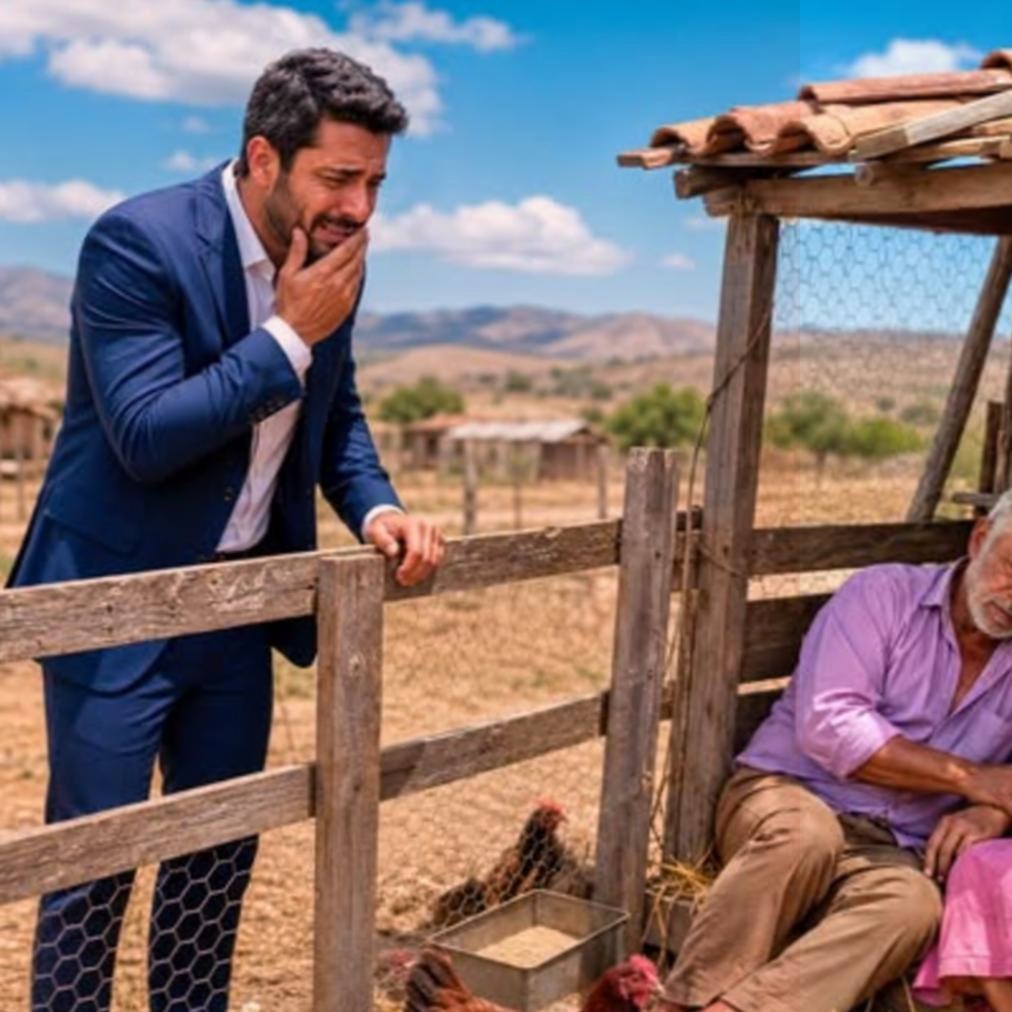

“My son would never have allowed me to live among chickens” — these were the words I heard when I returned to San Isidro de la Sierra for the first time in twenty years.
I drove all night from Monterrey. In the morning, when the first houses of the village appeared, I was gripping the steering wheel as if someone were pulling my past back. The white truck was covered with dust, while the suit still smelled of the office. Twenty years ago I left this village with one bag and swore I would not return until I had money.
I returned.
I had twelve trucks, my own transport company, and an amount in the bank that my father could not have dreamed of all his life. But the moment a little boy told me where I would find the old people, my wealth meant nothing.
“Don Mateo’s old parents live there, behind the mesquite, toward the old pasture,” he told me. “By the chicken coop.”
I expected a house.
I found a chicken coop.
Behind the wire fence, my father lay on straw. He was barefoot, and rough stitches could be seen in several places on his shirt. My mother was curled up beside him, a worn shawl wrapped around her shoulders. They had a broken bucket for water, while a rusty tin can served as a container for the chickens’ feed.
My knees gave way. I sat down in the dust and cried so that no sound came out.

My father woke first. He narrowed his eyes and looked toward the fence.
“If you are from the ranch, young man, we will go with you today,” he said. “Only let us wait until sunset; I have to take my daughter’s chickens.”
“Father…”
The smile disappeared from his face.
“It’s me. Julian.”
My father came to the fence. He put his hands on the wire and first laughed, then began crying at that same moment.
My mother recognized my voice, but turned toward the wall.
“Tell him to go, Mateo.”
“Mother, look at me.”
“My son lives well in Monterrey. It will hurt him when he sees me like this.”
I took a small copper whistle from my pocket. In my childhood, my father used it when the cattle scattered along the mountain slope. I brought it to my lips and blew the long, twice-interrupted sound that I remembered exactly even after twenty years.
My mother immediately turned around.
She came to the wire and placed both hands on my face.
“My God… Have you eaten anything, my son?”
That question finally broke me.

That evening they told me everything. The old ranch had been sold, and my father, who had worked there for forty years, had been deprived of the workers’ house. My three siblings made an agreement: three months with Ernesto, three months with Teresa, three months with Rogelio. At first, everything seemed to work.
Then Ernesto needed the room for his cattle. Teresa’s husband grew to dislike the chickens. Rogelio was always on the road.
“One day Teresa gave my chickens to someone else,” my mother said quietly. “I left. Father followed me.”
“And did nobody come looking for you?” I asked.
My mother lowered her eyes.
Ernesto thought they were with Teresa. Teresa thought they were with Ernesto. Rogelio thought the older brother was taking care of them.
And for twenty years I called Ernesto’s store every month. They always told me the same thing: “They are fine. Father can no longer hear. Mother gets nervous when she hears your voice. Do not bother them.”
Two hundred forty calls.
Two hundred forty lies.
The next morning I went to Ernesto. I still did not know that abandoning my parents was only the beginning of everything that had been taken from them. When I reached the store door, I put my hand into my pocket, touched the folder full of documents, and lowered the handle. Inside, Ernesto was already waiting for me, holding the old telephone receiver, and slowly bringing his other hand toward me…

…a small key was shining between his fingers. Ernesto put down the telephone receiver and looked at me as if I had entered not a store, but his own home.
His store had become the largest building in the village. Food was arranged on the left, a small fuel station stood on the right, and an enormous sign hung on the wall: “The Ramirez Family.” When I looked at those letters, I remembered the childhood home where my father received his pay in an envelope and the four of us sat at one table.
“Where are my parents?” I asked.
Several customers fell silent. A bottle of milk stopped in one woman’s hand.
Ernesto did not even blink.
“They are where they want to be.”
“In the chicken coop?”
“The old man is stubborn. He always wanted to return to the ranch.”
“My mother sleeps on the floor.”
Ernesto tapped his fingers on the counter.
“And you spent twenty years in Monterrey making money. Who stayed here, Julian? Me.”
I took an envelope of money from my pocket and put it on the counter. The papers inside rustled like dry leaves.
“Tell me how much caring for them cost you. I will pay you and take them.”
Hurt appeared on his face.
“I do not sell my parents.”
“Then why did you hide where they were from me?”
“I hid nothing from you. They ran away from you themselves.”
The two women standing behind me looked at each other. Within a few seconds Ernesto had turned me, in the eyes of the people, into a heartless son, while he was the only protector of abandoned parents.


Before leaving, I pointed to the old telephone. The cord was attached to the wall with a nail, and greasy fingerprints showed on the plastic surface.
“For twenty years I called this number. Why did you never put me through to Father?”
Ernesto’s smile disappeared for the first time.
“Because he did not want to hear you.”
“Did Father tell you that?”
He did not answer.
That same afternoon I went to Teresa. Bunches of dried lavender hung in her yard. When Teresa opened the door, her eyes immediately filled with tears.
“I thought they were with Ernesto,” she told me.
“And why didn’t you check?”
“You didn’t check either.”
Those words hurt me more than an accusation.
Teresa went into the kitchen and took old notebooks from a wooden cabinet.
“For years I wrote down records of cattle transfers. I have good handwriting. Ernesto said we were moving old cattle.”
“Whose cattle?”
She bit her lips.
“Rogelio used to take four or five cows. Every time.”
“Where did he take them?”
“I don’t know. Or I didn’t want to know.”

I called Rogelio that same evening. His voice was lost in the noise of the road.
“I transported cattle many times,” he told me. “Sometimes I also left food by the coop, but I was afraid to go inside.”
“You couldn’t look your mother in the eyes?”
He was silent for a long time.
“No.”
“Where is Father’s cattle?”
On the other side, there was only heavy breathing.
My father had an old agreement: of every four calves, one belonged to him. Over forty years, those calves had multiplied. Yet Father told me the drought had taken everything.
I did not believe him.
I went to the old clerk Eusebio. His room was full of the smell of archive dust and tea. From a book he showed me a drawing of an iron brand: a half-moon, with a small cut in the middle.
“This mark still belongs to Mateo,” he said. “I recognized it even from a hundred steps away.”
Everything matched.
Ernesto had been selling my father’s cattle little by little for years.
But while I was searching, he was acting too. That night he went to the coop, brought food to my parents, and told Father to put his fingerprint on “a simple piece of paper.”
“If you do not sign, they will arrest Rogelio,” he threatened.
Father, afraid that his children would be ruined, put down his finger.
But Mother opened an old bell that had been wrapped in cloth. Behind it she took out a rusty iron brand.
“I cannot read, but I am not stupid,” she told me. “I hid this.”
Then she began the names of the cows: Mother, Daughter, Granddaughter. Each had its own mark and year of birth.
I turned on the telephone recorder. Mother did not stop until dawn. By morning I already knew that the list hidden in her memory was destroying Ernesto’s entire lie.

But just then I received a message on my phone. It was from an unknown number. Only one sentence was written: “If you want to know what Father signed, come alone to the old veterinary clinic at noon…”
…I read the message a second time. Then a third.
At two o’clock in the afternoon I opened the door of the old veterinary clinic. The room smelled of iodine, dampness, and old wood. A strip of dust ran across the window glass. Ernesto, Rogelio, Teresa, and the village notary Raul Mendez were waiting there.
A yellowing folder lay on the table.
“You were supposed to come alone,” Ernesto told me.
“I came alone. They were already here.”
Teresa lowered her head. Rogelio’s hands were clasped between his knees. The notary had put his glasses on his nose and was touching the edge of the paper with his fingers.
“This is the consent left by Father,” Ernesto said. “He voluntarily transferred all rights to the cattle and land to me.”
“Father did not have land.”
“He had a share in the cattle.”
He pushed the folder toward me. My father’s fingerprint was visible on the paper. Below it was written that Mateo Ramirez agreed to transfer his entire share to Ernesto because “due to age and illness he could no longer manage the property.”
I felt cold in my throat.
“When did you formalize this?”
“Three days ago,” Ernesto answered.
“Father cannot read.”
“But the fingerprint is his.”
The notary cleared his throat.
“There are two witnesses’ signatures on the document.”
“Who are the witnesses?”
He lowered his eyes.
“Rogelio and Ernesto.”

Teresa suddenly cried out:
“I was not there, but I know Father was frightened!”
Ernesto turned toward her.
“Shut up, Teresa.”
At that moment I played Mother’s voice from my phone. The room suddenly fell silent.
“He had a white spot on his left ear. His mother was Violeta. Violeta’s first calf was born on May fifteenth. The second — before the rain began. Both had Father’s brand…”
On the recording Mother calmly, without any hesitation, told the story of forty years. Then we heard my father’s voice, recorded that morning.
“I am not selling anything. Ernesto told me they would arrest Rogelio. I put down my finger because I was afraid.”
Ernesto jumped up from his chair.
“You recorded this illegally!”
“Who recorded your words does not change them.”
The door opened. Eusebio and two investigators entered. One of them was holding an old register.
“We found every transfer in the Farm Association archive,” he said. “The cattle numbers indicated by Ernesto match my father’s brand. And the sales were deposited into an account registered in your name.”
Rogelio went pale.
“I only transported them…”
“I know,” the investigator replied. “That is why we need your testimony.”
Teresa covered her face with her hands. The notary looked at the document and said quietly:
“This document has no force. The witnesses are interested parties, while the signer did not understand its contents.”

Ernesto came toward me. His eyes were bloodshot.
“You are destroying this family.”
“No,” I told him. “I only brought light into the place where all of you drew the curtains.”
At that same moment the investigator’s phone rang. He listened, his expression changed, and he looked toward me.
“Another thing has come to light,” he said. “The money from the cattle sold by your brothers did not go only into one account. The account holder… is you, Julian.”
My breath caught.
“Me? Impossible.”
“Your signature is on the account. The transfers began twenty years ago, exactly after you left for Monterrey.”
An unusual calm came over Ernesto’s face.
“Now do you understand why I told you that your parents were fine?” he said quietly. “If you open all this, you will be accused first…”
ერნესტომ საკუთარი ხმა მოისმინა და პირველად დადუმდა…
მეგონა, სიმართლე ყველაფერს დაასრულებდა. მაგრამ ყველაზე მძიმე პასუხი ამის შემდეგ უნდა მიმეღო.
„მე აღარ დაგიცავ საკუთარი მშობლების ფასად.“
ერნესტომ თავი დახარა.
😱 გაიგე, რას მალავდნენ ისინი →
👇 ისტორიის ფინალი უკვე გახსნილია
Related posts:
 My husband knocked my mother’s wheelchair to the floor and demanded that we be thrown out of the house, but several hours later the smile disappeared from his face
 On the third day after my C-section, three children were left at my door, but after the call my husband’s face turned pale
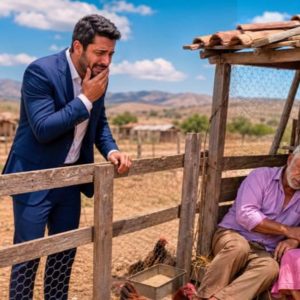 Part 4 — Twenty Years Later I Found My Parents in a Chicken Coop, but the Whole Village Fell Silent at My Brother’s Answer
 At My Sister’s Wedding, My Father Poured Wine Over Me and Mocked Me, but the Man Who Entered the Hall Suddenly Turned Pale
 Powerful Men Threatened My Family, But an Old Man Stood Up to Them and Hector Stopped Smiling for the First Time
 My mother-in-law gave me two weeks to leave the house, but when my husband saw the truck, he suddenly turned pale