The voice from the phone spoke its final word and the connection was cut off.
Jonathan stared at the screen for several seconds.
Then everything in the room moved at once.
“Call the bank!” he shouted.
His assistant Mark took out his phone.
“I am already calling.”
“Not you!” Jonathan grabbed him. “You are not calling there.”
Mark stopped.
Claire looked at him and stepped back.
“You knew.”
“That is absurd,” Mark said.
“Your voice is in the video,” she replied.
“The video may have been altered.”
“Then why did you run?” the young doctor asked.
Mark looked toward the door.
Two police officers were already standing there.
Behind them stood another woman — with a black bag and a small recorder in her hand. Later I learned that she was the hospital lawyer, Nina Rivera. She had called the police even before the video ended.
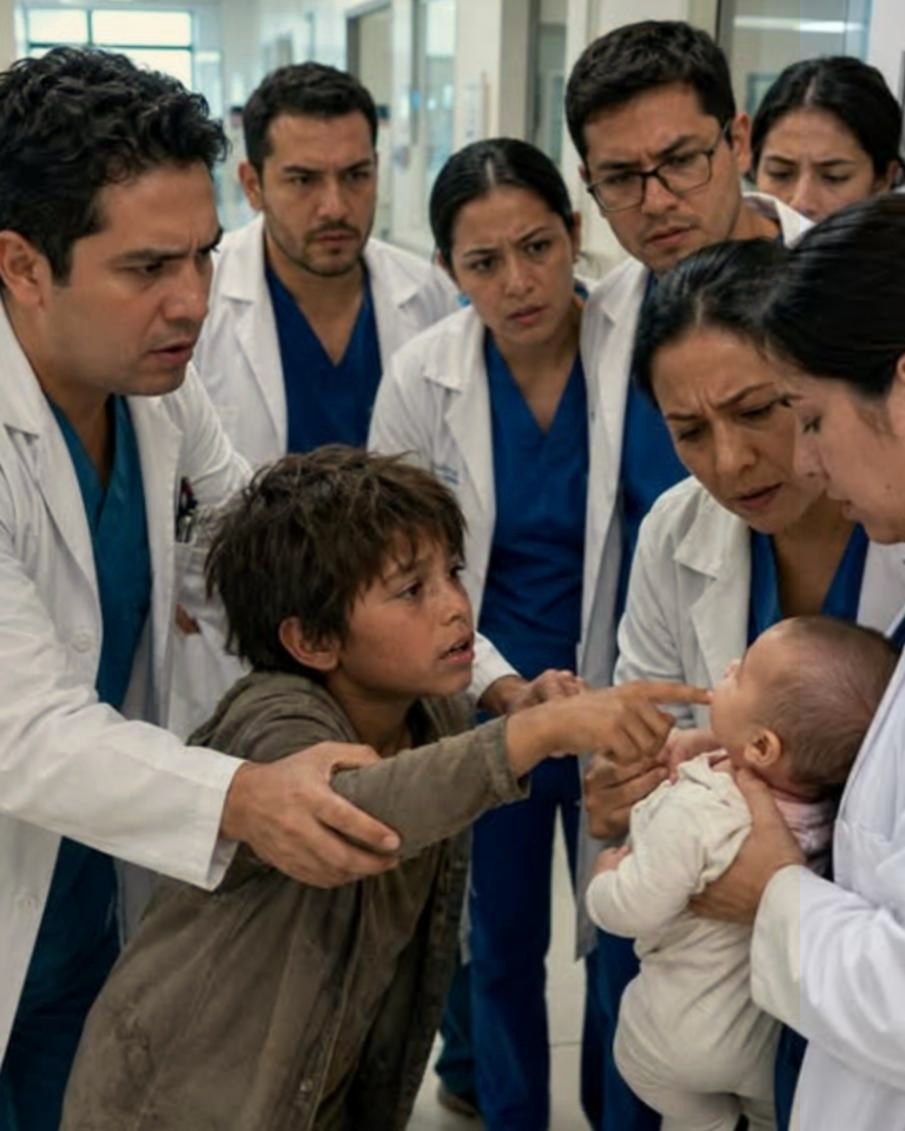
Dr. Vale stood by the bed and looked at Noah’s face.
His hands were trembling even more now.
“I did not want to kill the child,” he said.
“But you knew he could die,” Nina replied.
Vale raised his head.
“I was told it was only for research.”
“Who told you?”
He looked at Jonathan.
Jonathan stepped back.
“I did not say anything.”
“You told me that the company’s board of directors would cover everything if the experimental drug appeared successful.”
“I did not know about the child!”
At that moment, the small speaker standing in the corner of the room suddenly sounded.
It was Jonathan’s own voice.
“My son’s health is more important than the company’s value, but if he survives and the case is recorded as a natural complication, we both win.”
Jonathan froze.
The recorder continued.
“Jonathan, this is illegal,” Mark was saying.
“Only what you cannot control is illegal,” Jonathan answered. “We paid the doctor, changed the records, and the family will understand nothing.”
Jonathan could not endure hearing his own voice.
“Turn this off!” he shouted.
Nina shook her head.
“This is from the hospital surveillance system. You yourself left the room microphone on.”
The police officer put handcuffs on him.
Mark tried to escape, but stopped at the door. Laura Bennett, who had been standing against the wall a few minutes earlier, stepped in front of him.
“I will not let you go,” she said.
“Move aside.”
“Not this time.”
Dr. Vale sank to his knees. No one was happy to see him like that. Neither was I. He was guilty, but at that moment he looked only like a tired man who had finally understood how far he had gone.
Noah’s monitor showed a steady heartbeat.
I looked at his little fingers. There was still a blue color around the nails, but he was breathing.
Jonathan looked toward me.
“Eli, listen to me. I will help your grandfather. I will buy you a house. I will give you food, medicine, everything.”
“I returned the wallet because it was not mine,” I told him.
“You should take the money anyway.”
“No, not if you want silence in exchange.”
His face collapsed.
“I was not asking you to be silent.”
“You had not asked yet. But now you are trying.”
That evening the police removed documents and computers from the hospital basement. There they found contracts, transfers, and copies of camera recordings. It turned out that Laura had hidden the second copy because she was afraid Vale would destroy her too.
Mark and Vale were arrested.
Jonathan was not taken home that same night. His lawyer, the famous David Cross, came into the corridor, but closed his bag after five minutes.
“I cannot get involved in this case,” he said.
“You are my lawyer,” Jonathan held his arm.
“I was. Now you have witnesses and a recording.”
“I will solve this.”
“No,” Cross told him. “Now for the first time you will have to face the consequences yourself.”
After these words he left.
Within several days, the shares of Jonathan’s company fell. The board of directors removed him from his position. The accounts were frozen. The trial began, but I went to the courtroom only once. There no one asked me to observe carefully anymore. Everyone already had evidence.
The hardest thing was still what I found in our room that night.
My grandfather was sitting in a small hospital waiting room. He held an old plastic bag in his hands. My bag, the one whose seam came undone every day, lay on the chair. A small yellow subway ticket was tied to its handle so I would not lose it.
The ticket swayed in the wind.
My grandfather looked at me.
“Did the child survive?”
“Yes.”
“Then today has been a good day.”
“But that man…”
“A rich man carries his own decisions himself, Eli. You only saw the truth.”
Six weeks later Noah went home. Claire called me before the trial and told me that she had not given the child my name, but had written one word on a small piece of paper beside his bed: “Observation.”
My grandfather and I moved from Chicago to Milwaukee. A charity foundation gave us a small apartment and began my grandfather’s treatment. I started school. On the first day the teacher asked me what I wanted to become.
“Not a doctor,” I answered.
“Then what?”
I looked at the snow through the window.
“A person who will see what others miss.”
My grandfather got better. Every morning I arranged pencils in the kitchen, repaired my bag myself, and never threw away small things without looking at them. Noah’s photograph hung on the wall. Claire had sent it to us: the child was smiling wrapped in a blanket, and only a small doctor’s bandage could be seen on his neck.
One evening, months later, a message came to my phone from an unknown number.
“I am paying for everything. Meet me just once. You are not guilty of what happened.”
Then a second message:
“I want to explain why I did this.”
My grandfather looked at me from the table.
“Do you want to answer?”
I stared at the screen for a long time.
“No.”
“Why?”
“Because his explanation will no longer change my truth.”
I deleted the message.
I went to the window. The first snow was falling outside. Beneath the streetlamps, the flakes fell slowly, as if the city were learning silence for the first time.
There was a place for my old bag on the shelf. I no longer needed it, but I could not throw it away. The small yellow subway ticket that I had tied to it that morning still hung from its handle.
The ticket’s edges had curled, the wind no longer moved it, but it was still there.
As a reminder.
As a small sign that sometimes the weakest person in the room sees the only truth.
I touched the ticket with my finger.
And for the first time in my life I was no longer afraid of tomorrow.
The snow continued falling quietly.
Missed the beginning?
Related posts:
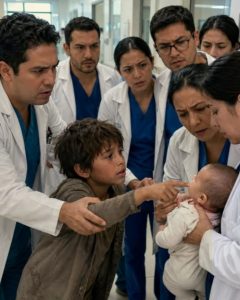 I pushed my way between eight doctors to save a billionaire’s son, and when I pointed at his neck, one of them lost color
 Encontré a mi esposo con una mujer embarazada en mi cocina, pero mi tranquila despedida hizo que su rostro perdiera el color
 An Unknown Man Humiliated Me in Front of Everyone, but the Restaurant Owner Looked at Me Only Once — and His Smile Immediately Disappeared
 Before her husband died, he gave something to the doctor, but when I needed to open it, the doctor’s face suddenly turned pale
 After My Son’s Fight at School, I Saw the Other Boy, and His Guardian Looked at Me, Stopped at the Door
 My Husband’s Mother Smashed My Daughter’s Birthday Cake on the Floor, and Suddenly Everyone in the Room Fell Silent